Showing posts with label steampunk. Show all posts

Saturday, June 24, 2017

UFOs are Dead, Flying Saucers Will Live Long
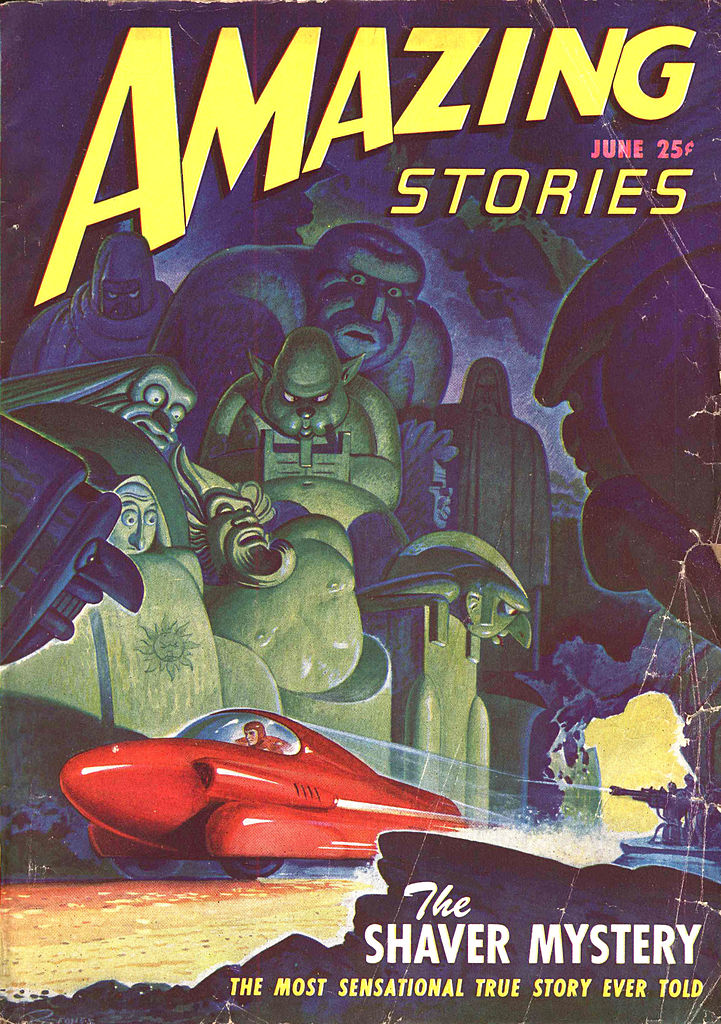


Amazing Stories, June 1947


Saturday will be the 70th anniversary of the Kenneth Arnold "Flying Saucers Sighting". The famous 24 June 1947 sighting is the traditional "beginning" of the Flying Saucer, kicking off a two-week craze that concluded with the Roswell Incident in July 1947.


But this wasn't the beginning of the UFO. EDIT 4 July 2017: Almost forty years ago Peter Rogerson made the same point I'm making here about UFOs vs. Flying Saucers, though as you'll read, I think the time in-between has been less than kind to the UFO. Nonetheless, I want to point this out, especially in the off-chance I read Rogerson's essay some time ago and forgot I had. I was reminded of this in an interesting review by Rogerson of a recent "estimate of the situation".

The UFO, the Unidentified Flying Object, emerged out of genuine official interest by US military institutions in the reports of things seen moving through the sky. Within a few years, institutional interest seems to have largely receded to keeping a UFO desk or project that had as much to do with public relations and institutional thoroughness as anything else. 

Watching the Skies near the end of the Second World War

The UFO, and cryptozoology, and other forms of "alternative" science, or as detractors would put it, pseudoscience, also emerged out of high social status for science and scientists in the wake of massive technological and social change from the industrial revolution, and especially the dramatic technological and scientific leaps made around the period of the Second World War.


 The social value of science, and the previously un-imagined discoveries made by scientists especially starting in the 19th century, made it sensible that analysis of evidence, using science (or activities that resembled science) could reveal amazing things.

Plotting Flying Objects over Britain during the Second World War. Is this the model for the UFO sightings database?

Over time, the UFO came to be largely, though not exclusively associated with the Space Age, extraterrestrials, and searching for evidence of these strange craft and their occupants. The stereotype of the serious ufologist involves collecting reports for databases, creating sightings maps to detect geographical or temporal patterns, looking for commonalities, piecing together puzzles.

Amazing Stories, December 1945

The flying saucer is another matter entirely. Kenneth Arnold and others in the crucial period of the flying saucer of the mid-to-late 1940s were in no small part in the orbit of Ray Palmer (you can read FBI reports into Palmer's involvement in early flying saucers and his publishing here), champion of the Shaver Mysteries. Shaver's stories, edited by Palmer, have roots in pulp fiction and earlier alternative religious influences including Theosophy and Oahspe. The foundations of the flying saucer community were laid among occult and science fiction enthusiasts of the 1940s, and it is unsurprising that the flying saucer first took root in the 1950s in science fiction films and among the Contactees and their transparent relationship to previous new and alternative religious movements.


The UFO, an acronym suitable for the Big Science of powerful government and military institutions of the 1950s, inherently begs for trace evidence, analysis of the situation, collation of reports. While one can still find this style in ufology, it is dying on the vine. This is expressed well in two essays by Vicente-Juan Ballester Olmos and Thomas Bullard, both musing on the 70th anniversary. While Ballester Olmos, keeper of a photographic database to collate evidence, is very pessimistic, Bullard the folklorist is only mostly pessimistic, hoping that among the dross and dashed hopes there may still be a non-mundane phenomenon at the core of the UFO mystery.
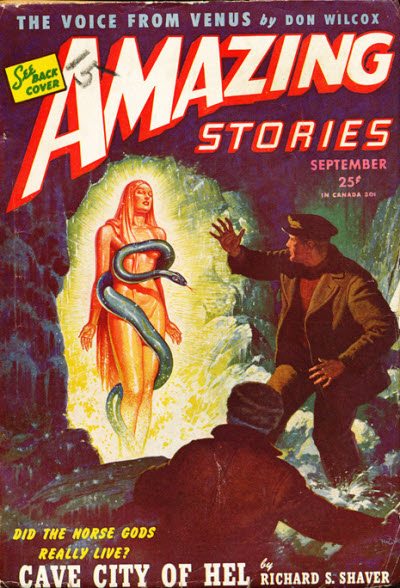


However, most of what is associated with the UFO, or rather the flying saucer, is now conspiracy theory. One can argue that much of conspiracy theory can trace its massive cultural popularity to the UFO. Conspiracy and paranoia are the very bones of the flying saucer. One important ancestor of the flying saucer, and other elements of 20th century pulp fiction and occultism is Edward Bulwer-Lytton's 1871 novel The Coming Race. The children and grandchildren of this tale of an ancient underground master race with psychical powers and menace towards the surface are many, including the Shaver Mysteries. Shaver's writings are of nearly all-powerful Deros causing no end of misery through their invisible stalking and influence on surface dwellers. Their resemblance to much of conspiracy theory and mysticism surrounding the paranormal and UFOs today is profound. Pulp fiction also interjected the Reptilians into the Shaver and Flying Saucer community by the late 1940s. And while the Contactees often preached positive messages in the style of earlier decades theosophical ascended masters, there were also dark warnings of evil forces that would silence such wisdom.
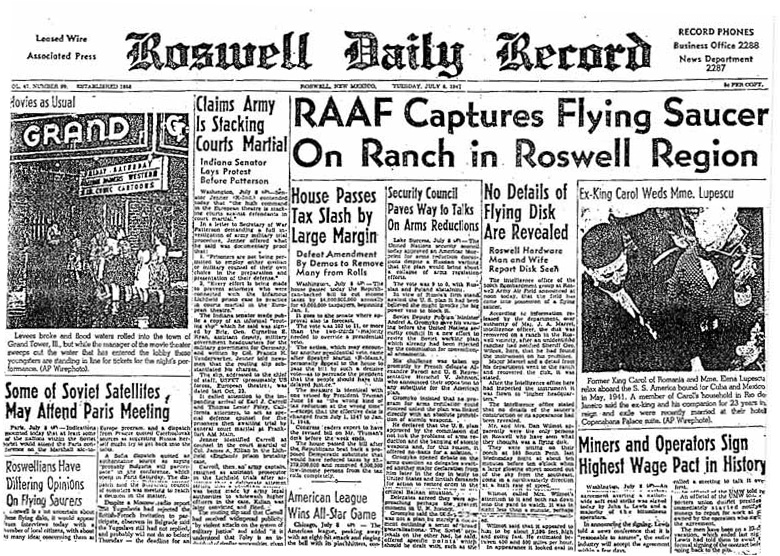


Conspiracy and coverup were constituent to ufology, including with influential early leader Donald Keyhoe. Self-proclaimed serious or scientific ufology until the 1980s was largely about moving towards analysis and away from mysticism on the one hand, and conspiracy fears on the other, though this proved impossible. In previous posts on this blog, and in podcasts, I've discussed the importance of the Roswell myth in strengthening a bond between conspiracy theory and mainstream ufology.


Today, if one looks about the UFO community and its media, one finds two basic styles have supplanted the sightings trackers and account analysts. One is disclosure and expolitics, a focus on government and institutional conspiracy, promises that all will soon be revealed or leaked, and of breakaway civilizations and hidden shadow governments. A rotating cast of characters and tropes promotes or sells the idea that long-suspected truths are being hidden by illegitimate authorities and institutions, and that the imminent revelation of these truths will end the inequities of the modern day and bring about a better future.


The other is focused on ancient evidence for alien or extradimensional origins of humanity, often with a focus on origin myth or  religion in one form or another. Though most prominent through various cable television programs, this element as has eclipsed every other aspect of interest in "UFOs", which seem almost an afterthought. One can easily go from dubious remains of a Roswell crash victim (actually indigenous remains in a museum) to dubious remains of an ancient alien hybrid without changing the roster. A rotating cast of characters and tropes promotes or sells the idea that long-suspected truths are being hidden by illegitimate authorities and institutions, and that the imminent revelation of these truths will end the inequities of the modern day and bring about a better future.


These are not mutually exclusive. Alleged modern conspiracies become new manifestations of ancient magical secret societies, shadow governments hide ancient inhuman bloodlines.They unite into an all pervasive Lovecraftian paranoia of deep secrets and debased cults. Last year, conspiracy theories about evil cults were fashioned out of leaked political emails, and a man was just sentenced to prison for responding violently. Yet one reason these resonated so well in the conspiracy theory world is that the stolen emails came from a long-time UFO disclosure advocate, paralleling a huge amount of chatter and speculation that UFO disclosure would hinge on the US presidential election.

The most viable alternatives in small pockets of the UFO community are hopes that the UFO can show the way to better understandings of the inner self and consciousness, that UFOs are something like poltergeists or Victorian elementals, soon to be erroneously conglomerated with descriptions of tulpas.

In other words, the flying saucers are once again just one manifestation of the underground Deros. Of the Great Old Ones. Of the Coming Race. Ancient wisdom, lost history, hidden cults, subterranean horrors, psychical manifestations.

The investigation of the UFO mirrored the rise of science's social status. It's fall, and the return of ascended masters, psychical entities, and lost races makes perfect sense in an era of partisan attacks on science and neo-Victorian political and social conditions.

The UFO is dead, the flying saucers have returned.

Sunday, June 14, 2015

Great Britain Trip: Part 4 - Time in Bath


Great Britain Trip: Part 4 – Time in Bath

Two weeks ago I embarked on my first trip to Europe, specifically to Great Britain. This journey had two aspects. First, it is the closest I’ve had to a vacation in at least four years. But honestly, I don’t really do vacation. The primary reason for the trip was to assist several projects I’m working on, including a volume I’m currently writing on why archaeology has the “spooky” image it has in the public imagination.

The following images are not in precise chronological order, though the general narrative does roughly follow the order of places I visited. I spent four days in London at the beginning and another two at the end, and these materials are something of a chronological jumble for thematic purposes. These images are a fraction (specifically, about 7%) of the images I took. Many of these were for research I am not discussing in depth here, or for teaching purposes. The images and text here are instead a rough tour not so much of where I went as why I went, what I learned, and why that might be of interest.

This travelogue is broken into seven sections

Rule Britannia!

Archaeology of Empire

Mysteries of London

Time in Bath

A Green and Magical Land

Investigating Inverness

The Legend of Loch Ness


Time in Bath

I had initially intended to write about some of the archival work I conducted in London, but I’ve ultimately realized I’ll leave this to my publications. I will briefly discuss some of this below before moving on to Bath.

Both the British Library and the National Archives were extremely efficient and helpful in both registering me as a reader, and getting me the resources I needed. The British Library has a lovely atmosphere, full of extremely nerdy people all over the grounds. It is a bit over-shadowed as it lies to the west of St. Pancras station and the hotel-structure I presented in the first post.


The National Archives is out in Kew, a bit under an hour on the tube from King’s Cross. The surrounding neighborhood is a mix of Kew Gardens and lovely urban/suburban residences, while the Archives themselves vaguely resemble Starfleet Academy.

Also somewhat in the vein of archival research, I got a glimpse of some of the Italian Renaissance majolica ceramic vessels that came to dominate my doctoral and post-doctoral research. I would love to go back and examine these vessels first hand to expand and refine my comparative work in Latin America.


If you know my research, you’ll understand the following image


After four days in London, it was time to move on to Bath, about an hour and a half by train to the west of London, a bit southeast of Bristol. The city is a World Heritage site for its archaeological and architectural legacy. For my purposes, it was also fairly well situated for the next two days of travels to the megaliths around Salisbury and to Glastonbury and then flying on to Scotland out of the Bristol airport.

I left King’s Cross for the outbound trains of Paddington Station. Even after four days of heavily using the Underground and related London trains, the romantic overtones of a major train station were present for me as I waited and ate a bit of sausage on a roll that made up brunch.

Once out of London, the English countryside was closer to the stereotypes and storybook images than I had imagined. Canal boats, beautifully maintained cottages and houses, country lanes, all were present. The rolling hills and rural flora weren’t too different from my years living and working in the Northeastern US, but the cultural pattern was far closer to traditional idealized imagery than I had expected. The equivalent might be if one visited Massachusetts and every small town looked like Marblehead, or if all of Arizona looked like movie versions of Old West Tombstone.

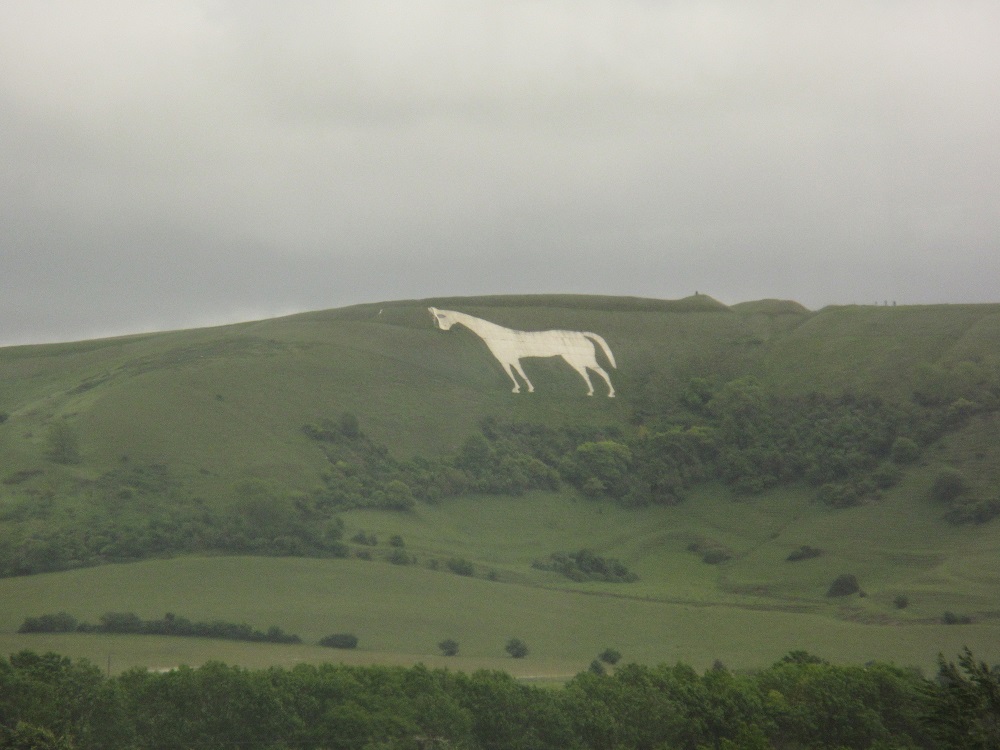
 I roused out of pleasantly watching the landscape slide by when I spotted something on a hillside in the distance. The unexpected appearance struck me like a thunderbolt.


It was one of the White Horses, specifically the Cherhill White Horse. The oldest of the White Horses of England is the Uffington Horse, which may date back to the Bronze Age in design but is regularly cleaned and repaired by digging into the chalk subsoil. The Cherhill White Horse was soon joined by another, the Westbury White Horse. 


These geoglyphs may have some antiquity to them, but in their current forms they are better thought of as follies, purposely romantic and archaic attempts to re-enchant the landscape in the Early Modern and industrial eras. Though these horses are “only” a few centuries old, their reference of the Uffington Horse and the Cerne Abbas Giant meant I had begun to enter the gateway into the purposely ancient landscape of antiquarianism, folklore, and tradition. This theme, which we have already encountered, is important to the larger journey.


Bath is beautiful, and I understand its designation as a World Heritage site. The city has been a mecca for visitors since Roman times when the city was Aquae Sulis. More recently, it benefited from first the canal system and then the railroads. There are a number of residents living in canal boats in Bath, not far from the Pulteney Bridge above, which holds a number of cafes and shops. For reference, the bridge is contemporary with the beginning of the American Revolution, or the destruction by earthquake of Antigua, Guatemala.


I stayed in the lovely Royal Hotel, right across the street from the rail station. This made sense of course, for as I pleasantly discovered, the hotel had been designed by Brunel himself, Britain's great engineering genius (and also one of my favorite characters in the steampunkish comic The Thrilling Adventures of Lovelace and Babbage). 


Bath is still a tourist town, where visitors come to relax and refresh themselves in the ancient spa waters as well as bathe themselves in the ancient and recent history. The connection with Jane Austen’s life and writings is strong and a major focus of the tourism industry. The city is also a cultural center with theaters, galleries, and a university, adding an eclectic student and artist vibe to the ancient center. 


Most striking is the gorgeous Georgian architecture, of which there can be no finer example than the Royal Crescent on the northeastern edge of town


The scope of the place, almost all private housing today, cannot be done justice, by my pictures at least.

The center of the city is still the Roman baths, today a major archaeological tourism attraction. I was struck once again by how commonplace the notion of archaeology is in the United Kingdom, a theme I will return to when I discuss Inverness. 


The heart of the Roman Baths is a mélange of original architecture and Victorian embellishment


The striking Roman statues are a pure Victorian invention, with governors and emperors depicted who were considered to have had important ties to Britain, as well as a depiction of Roma, the spirit of Rome. The baths are in essence lined with a Victorian equivalent of Disneyland’s Hall of Presidents except the recent images have taken on a faux antiquity of their own. The statue depicted below is a Victorian archaized image of governor Publius Ostorius Scapula.


The hot springs were the heart of the Roman settlement, and one can get a drink of the waters at the end of the museum (complete with a detailed statement of the mineral contents and how safe the water is to drink in which quantities)


But the history of archaeology at the site allows for a detailed examination of ancient Romano-British life within the complex facilities of the baths and the nearby temple, as well as in the larger community of Aquae Sulis.


One of the archaeological discoveries in Bath that contributes to the site’s World Heritage status is the collection of curse tablets. These objects are simultaneously exotic and mundane. They could easily be mentioned in my previous post on the esoteric in archaeological museums as they are indeed magical curses. 


On the other hand, the everyday grievances that deserved supernatural punishment are quite recognizable, most being the theft of personal items.


Watching over all of this from the temple would have been the symbol of the Roman Baths today, the Gorgon head.


Discussion of this image is complex, but it may be syncretic, blending a local British water god or spirit with Classical ideology and iconography such as of Oceanus. A Gorgon’s head is likewise worn by an image of Minerva, also found in Bath.


The baths are predominantly presented as a Roman settlement, but the enduring aspect is difficult to ignore. In the main hall, architectural remnants of the 12th century transformation into the King’s Baths are visible, as are seats and statues added in the 17th century in keeping with the legend of the necromancy-favoring King Bladud.


The Pump Room, a center of high social life (made famous by Jane Austen), was added above the baths in the 18th century, delivering us into the Georgian period still dominating the surface. And above it all looms the abbey.


The layers of the past, and the re-creation of an idealized past to serve the present, will continue in the next post on the imagined British countryside of myth and magic.

One last note: the ever-presence of cider made me very happy. 


Not everything I ate was fish and chips and cider, though that was a significant part of my diet. I sadly did not get pictures (though this one is pretty close to my experience) when I ate my final dinner in Bath at Yak Yeti Yak, a Nepalese restaurant decked out with many symbols of Nepal including religious objects, woodwork, a kukri knife and yes, Yeti footprints.

Monday, October 11, 2010

All the Myths are True (a little fun)


One of my favorite songs over the last few years, and one eminently suited for the topics this site covers is Abney Park's "All the Myths are True." It's all about legends, monsters, lost cities, zombies and the like. They had me at "Scientists unearth enormous skeletons" You'll hear what I mean.

Now, you can listen to it with Abney Park's Electro-Mechanical Music Listening Machine. Just twist the dial until the song you want is lined up with the selector cog within the machine's face. Or the winding stem. It's a little cantankerous.


If you haven't guessed already, Abney Park is one of the music groups flying the steampunk flag. The band flies the H. M. S. Ophelia, on the lookout for zeppelin freighters to plunder, and dodging air krakens of the sort we covered over the last two years.

You can check more of their music (I loved their last album Aether Shanties, and they've got a new one coming out this week) and other sundry goods at their site or myspace.

Wednesday, January 07, 2009

Tentacle UFO - Air Kraken or Lovecraftian Horror?

It really doesn't get better than this: The destruction of a massive windmill that some of the locals blame on ... a phosphorescent cyclopean tentacled anomaly emerging from the sky

'massive ball of light' with 'tentacles going right down to the ground' over Conisholme wind farm.

"It was huge" he said "At first I thought it must have been a hole where the moon was shining through but then I saw the tentacles – it looked just like an octopus.

When I blogged last year about Air Krakens and other flying monsters, I didn't think they'd show up this soon.

EDIT: Fireworks may have been involved. But I don't know of Yog-Sothoth is going to like such slurs on its character.

Thursday, March 13, 2008

Air Krakens and other Flying Monsters

Following the relatively recent post on the pilots of the 1897 Airship Wave, Cabinet of Wonders once again reflects on Air Kraken Day (declared March 17 by the steampunk nexus Brass Goggles) by noting the fact and fiction accounts of strange non-avian creatures in the sky.

In the most recent essay, Cabinet of Wonders discusses recent sightings of jellyfish-like UFOs, while in the previous essay last March, historical and fictional cases get their due, including Arthur Conan Doyle's "The Horror of the Heights."

Other stories of air monsters don't have the popular exposure of those most famous "air monsters" (extraterrestrials and their flying saucers), but they do persist under the radar (so to speak). Thunderbirds are probably the most famous, but pterodactyls also get some attention. I was more familiar with the various hoaxed/art photos of late 19th century slain pterodactyls, kickstarted by an 1890 account of a dragon killed in Arizona. Over a century later, airplane passengers claim to have photographed dragons over Tibet.

But only recently learned that there are ties between the hunt for pterodactyls and creationism. Though it shouldn't have surprised me since I've seen creationists invoke the Loch Ness Monster and other sea serpents, and the Creation Museum is chock full of dinosaurs.

And lets not forget that in the early days of flying saucers, sky animals were suggested as a possible explanation. As were intelligent bees from Mars.