Showing posts with label Area 51. Show all posts

Sunday, September 26, 2010

Spooky Dissertations Part 2: UFO Culture

Ongoing series on Spooky Dissertations

Part 1 introduces the series and covered cryptozoology
Part 2 explores the increasingly popular topic of UFO culture
Part 3 finishes off the UFO topic and included the larger context of Theosophy
Part 4 examines ghost culture and parapsychology
Part 5 covers paranormal culture

Last time, after an introduction we had a bibliography of dissertations and theses concerned with the culture and psychology of cryptozoology and monsters, as well as a handful of works on supernatural narratives.

Today we have one of two posts on UFOs and aliens. This first is solely for studies of UFO culture, examining the communities and beliefs surrounding flying saucers and ETs. As before, if I was directed to a work by one of the other dissertation listings mentioned in the first post, I have noted this at the end of the entry.

Studies of UFO culture follow a certain trajectory, chronologically. With the exception of one early journalism master's thesis in the earliest years of the flying saucer era, academia has no interest in the topic for over 20 years. After the Condon report declares UFOs of no significant interest and the Air Force officially ends Blue Book and other interest in the topic, the floodgates open, and it is alright to study UFO organizations and beliefs from a sociological perspective or as folklore. More generally this is the time when it starts to become more acceptable to study more pop and other non-mainstream culture, and to examine Western culture with a more critical eye. Within ufology, this era has a decidedly Fortean bent, ending with the rise of crashed saucer legends at the end of the 1970s.

With the shift towards more conspiratorial in ufology, in the US at least, there is less academic interest. But with the 1990s, studies of UFO culture multiply dramatically. It seems likely that the success of Communion and the books of Bud Hopkins have something to do with that, as abduction becomes an extremely ripe cultural studies topic by the end of the decade, though it recedes in popularity by the middle of the 2000s. By this time, the academic approach is to either see the UFO as symbolic of millennial angst and the problematic transition at the end of the Cold War, or to examine the UFO as not a source of folklore or a scientific puzzle, but the font of new religions.

Tomorrow, a somewhat shorter list focusing on aliens and the past, as well as the biology of anomalous experiences.

UFO Culture

Dallas, Roswell, Area 51: A social history of American "conspiracy tourism" – 2010 PhD, Shelley E. McGinnis, The University of North Carolina at Chapel Hill

Flying Saucer Culture: An Historical Survey of American UFO Belief – 2006 PhD, Dean Bertram, University of Sydney (DASH)

How the alien invaded the American mind: a history of experts, entrepreneurs, story-tellers, and a love of the alien in modern American culture – 2006 PhD, Zoe Couacaud, University of Sydney (DASH)

Tensions, synthesis and spirituality in the Norwegian UFO movement, especially exemplified by the world outlook of the organization NETI - 2005 PhD, Jan Bertil Heilund, University of Bergen, Norway (EUROUFO)

The Flight of the Ordinary: Narrative, Poetics, Power and UFOs in the American Uncanny - 2005 PhD, Susan Lepselter, University of Texas – Austin

The "Rael" World. Narratives of the Raelian Movement - 2005 MA, Tayah L. Hanson, University of Saskatchewan, Saskatoon (EUROUFO)

Mon Dieu... un ovni...: du phénomène ovni à ses dérives religieuses, en France de 1950 à nos jours - 2005 MA, Jérémy Morel, Université Jean Moulin (Lyon, France) (EUROUFO)

UFO-Hysterie in den USA - Ein interdisziplinäres Phänomen zwischen Wissenschaft, Politik, Religion und Kommerz - 2005 MA, Sandra Kemerle, Institut für Amerikanistik, Universität Leipzig (EUROUFO)

Weather-Workers, Saucer Seekers, and Orthoscientists: Epistemic Authority in Central Mexico - 2004 PhD, Ryan Cook, University of Chicago

SETI science: Managing alien narratives – 2004 PhD, Arthur C. Fricke, Rensselaer Polytechnic Institute

Controversias tecnocientíficas y medios de comunicación: el caso de la clonación humana y los raëlianos en El País - 2004 PhD, Miguel Alcíbar Cuello, Universidad de Sevilla, Spain (EUROUFO)

Valores, símbolos y representaciones en una experiencia de contacto extraterrestre: el Grupo Aztlán - 2003 PhD, Ignacio Cabria, Universidad Complutense de Madrid (EUROUFO)

An Alien in Roswell – 2002 MA, Kay Lang, University of Wyoming

Social Constructionist, Psychological, and Official Theories of UFOs - 2002 MA, Alan Greenhalgh, California State University, Dominguez Hills

UFO and Alien Encounter Narratives: A Cross-Cultural Analysis - 2002 MA, Ravi Ramkisoonsingh, Carleton University

Alien encounters: A close analysis of personal accounts of extraterrestrial experiences – 2002 MA, Krista Suhr Henriksen, Simon Fraser University

Taken: Constructions of 'Race', 'Biology' and Colonialism in Alien Abduction Narrative in the United States – 2001 PhD, Carol Suzanne Matthews, University of Kansas (PUFOI)

Biblical analysis of the UFO/Alien Abduction phenomenon with possible implications for end times deception - 2001 D. Min. - Robert C. Hendrix, Northwest Graduate School of the ministry, Redmond, Washington (EUROUFO)

The Terror is Real. The history and politics of alien abduction – 2001 PhD, Bridget M. Brown, New York University

Pop Culture and the UFO Narrative: Who's Buying it, Who's Selling it, and Who's not Telling it - 2001 MA, Kelly S. Rubbo, Utah State University

Approche sociologique complexe du charisme - Le Mouvement Raëlien et son prophète - 2001 PhD, Annie Chatelin, Université de Perpignan

A Confederacy of Faith and Fact: UFO Research and the Search for Other Worlds - 2000 PhD, Anne Boyle Cross, Yale University

Supposed Science, Alleged Fiction: Distortion Patterns in the Transmission, of Cultural Paradigms, in the Twentieth Century - 2000 PhD, Andres Zlotsky, State University of New York – Buffalo

UFOCRITIQUE: UFOs, Social Intelligence, and the Condon Committee – 2000 MS, Diana Palmer Hoyt, Virginia Polytechnic Institute and State University

New Religious UFO Movements: Extraterrestrial Salvation in Contemporary America – 2000 MA, Stefan Isaakson, California State University, Fresno (GREENWOOD)

The myth of communion: A rhetorical analysis of the narratives of alien abductees – 1999 PhD, Stephanie M. Kelley, University of Kansas (PUFOI)

A dialética do real e do imaginário. Uma proposta de interpretação do Fenômeno OVNI – 1999 MA, Cláudio Tsuyoshi Suenaga, Universidade Estadual Paulista (UNESP), Assis, Brasil (PUFOI)

The Lure of the Edge: Science, Religion, and the Alien Abduction Movement - 1998 PhD, Brenda Denzler, Duke University

Shaman and Abductee: American Ufology as Cryptoscience and Countersociology - 1998 MA, Ryan Cook, University of Chicago (EUROUFO)

Heaven's Gate: A Sociological Perspective - 1998 MA, Patricia L. Goerman, University of Virginia (EUROUFO)

Pulp science: Race, gender, and prediction in contemporary American culture – 1997 PhD, Beth Anne Loffreda, Rutgers The State University of New Jersey - New Brunswick

"Alien abductees'" Reports of worldview reconstruction (assumptive world theory, coping) – 1997 PsyD, Mindy Sue Kopolow, Antioch University New England Graduate School (PUFOI)

Pasts and futures: Space, history, and Armenian identity, 1988 – 1994 – 1995 PhD, Stephanie Semple Platz, The University of Chicago

Brothers from the sky: Myth and reality in a flying saucer group (Unarius, cults, colllective behavior) – 1995 PhD, Diana Jean Tumminia, University of California, Los Angeles

Otherworld Journeys: UFO Abduction Narratives as Transformative Stories - 1995 MA, Carol Suzanne Matthews, University of Kansas (EUROUFO)

UFO Stories: The Poetics of Uncanny Encounters in a Counterpublic Discourse – 1994 MA, Susan Lepselter, University of Texas (PUFOI)

Gods from the Machines: On the Anthropology of Alien Abductions - 1994 MA, Michael Tracy Blair, Washington State University (EUROUFO)

A social psychological investigation of UFO sighters – 1992 MA, Patricia Ann Cross, Carleton University

Personality characteristics and self-identified experiences of individuals reporting possible abduction by unidentified flying objects (UFOs) – 1992 PhD, Jo Stone-Carmen, United States International University

Flying saucers and the new angelology: Mythic projection of the Cold War and the convergence of opposites – 1990 PhD, Robert Pearson Flaherty, University of California, Los Angeles

Une secte soucoupique : les raëliens - 1989 MA, F. Follmer, Université Paul-Valéry, Montpellier III (EUROUFO)

OVNI : un tabou scientifique? - 1988 MA, Véronique Galzy, Montpellier III (EUROUFO)

The UFO debate: A study of a contemporary legend – 1988 PhD, Linda Jean Milligan, The Ohio State University

The UFO Movement: A Sociological Study of UFO Groups – 1985 MA, Shirley McIver, The University of York (United Kingdom) (DASH)

The Boundaries of Orthodoxy: A Folkloric Look at the “UFO Phenomenon” – 1984 PhD, Peter Michael Rojcewicz, University of Pennsylvania

Mysteries in the eye of the beholder: UFOs and their correlates as a folkloric theme past and present – 1982 PhD, Thomas Eddie Bullard, Indiana University

Politicking and Paradigm Shifting: James E. McDonald and the UFO Case Study – 1975 PhD, Paul Edward McCarthy, University of Hawaii (GREENWOOD)

Organizational Goals and Support-Seeking Behavior: A Comparative Study of Social Movement Organizations in the UFO (Flying Saucer Fields) – 1973 PhD, Michael K. Schutz, Northwestern University

The controversy over unidentified flying objects in America: 1896-1973 – 1973 PhD, David Michael Jacobs, The University of Wisconsin – Madison

The UFO Phenomenon: A Study in Public Relations – 1972 MA, David J. Shea, University of Denver, Colorado (GREENWOOD)

A survey of press coverage of unidentified flying objects, 1947 – 1966 – 1970 PhD, Herbert Joseph Strentz, Northwestern University (GREENWOOD)

Flying Saucers: Fact or Fiction? – 1950 MA, DeWayne B. Johnson, University of California, Los Angeles (GREENWOOD)

Thursday, June 12, 2008

Indiana Jones and the Extraterrestrial UFO Hypothesis

I just saw Indiana Jones and the Kingdom of the Crystal Skull. While it makes a total mockery of Mesoamerican archaeology (my professional forte), it was an entertaining movie. I'd rate it higher than the second or third films, but not close to the original.

It is also an interesting movie from the perspective of UFOs. The following will spoil the movie in a large way, so I suggest you don't read if you don't want to be spoiled.


SPOILER WARNING

A fair amount of interest in alt/psuedo-archaeology and ufology was involved in the making of this movie. I'll note some of the highlights

1.) The title character (aka Henry Jones Jr., PhD) was involved with the Roswell UFO recovery. However, the film takes its cues not from the Roswell narratives, but from a mix of Area 51/Groom Lake stories about security, and some elements of UFO crash retrieval stories that started appearing in the 1950s. Jones says he was called out in the middle of the night by government agents, forced to board a bus with blacked-out windows along with other scientists with whom he was not allowed to talk. They were each shown some of the Roswell wreckage and remains, but not given any real idea of what they were looking at, and were then sworn to secrecy on pain of treason. The idea of specialists being brought in dates back to the early 1950s in crash stories, but the blacked-out bus is similar to a specific crash retrieval tale dating to 1973, and stories of some of the security at Groom Lake.

It should also be noted that an archaeologist or archaeological team has been part of some versions of the Roswell story for decades. In the Roswell narratives, the team stumbles across the wreckage, they are not brought in to consult.

2.) Groom Lake/Area 51 vaguely makes an appearance as "Hangar 51" in Nevada.

3.) The "aliens" (more on that in a minute) are classical Grays. At least the ones recovered from UFO crashes (more on that too). Later in the film, other "aliens" are met that look like Grays, but rather than being stereotypically short, tower over humans.

4.) By 1957, there have been at least two other UFO crashes from which the Soviet Union was able to retrieve bodies. The idea of multiple crashes dates back as far as 1950 and Frank Scully's Behind the Flying Saucers.

5.) Unlike most Roswell stories, the FBI is aware of the case and at least somewhat involved. By contrast, Hoover is on record complaining about lack of access to Roswell materials.

6.) Here's the biggie: The movie favors extradimensional or ultraterrestrial "aliens" to space-faring ETs. It is explicitly and repeatedly mentioned that the aliens are from another dimension, from the "space between spaces." They have a flying saucer, but it disappears through an extradimensional portal, and does not zoom into outer space.

This is a very interesting little fact. Spielberg, one of the most successful promoters of interest in UFOs through his movies, has given the most public support for extradimensional ideas over the ET hypothesis. This is not a surprise. In his movie Close Encounters of the Third Kind. one of the main characters is a French ufologist based on Jacques Vallee. Vallee would go on to suspect human involvement in many UFO cases, but in the 1970s, was part of a small group that suggested extradimensional explanations for UFOs over space-faring ETs. Another proponent at that time was Dr. J. A. Hynek, the designer of the close encounter classification system. As a result of legal action, Hynek got a cameo in Close Encounters. Hynek was the scientific advisor to Project Blue Book and had a high profile regarding UFOs, but by the 1970s had left the mainstream views on the subject and became what some called a "demonologist."

I'm not saying this movie will sound the deathknell for the public's widely held equation of UFO = space-faring ET. But it will likely make the ultraterrestrial/extradimensional memes much more popular.

7.) Ancient astronaut ideas are the core of the film. Some reference von Daniken's main memes about the Nazca lines being involved with aliens, or ancient artwork showing spacesuits. The visitors teach the locals agriculture, irrigation, and other technologies. But other ideas are reminiscent of Zecharia Sitchin. In particular, the legend in the film is that the gods (aliens) ordered the people of South America to build a city of gold. This turns out to be a misunderstanding of pseudo-Maya translations of "treasure" but nonetheless the gold and ancient astronaut mix sounds familiar.

I'll be curious to see what effect this has on popular ideas about UFOs.

Thursday, February 14, 2008

Indiana Jones Trailer: Roswell and Mayas

The trailer for the new Indiana Jones movie is out (you can watch it here).

As I expected, it has Area 51, Roswell, and Maya ruins (though I didn't expect actual Maya warriors).

I'll be curious to see if they hire any "experts" to flack for this.

Thursday, January 24, 2008

No More "Area 51": The World's Least Secret Secret Base has Its Name Revealed

Homey Airfield.

That's right. That's the English-language designation Groom Lake, AKA Area 51 gets. It appears to be a descendant of an earlier nickname for the place, Home Plate, during the OXCART days.

If you prefer, you can also call it XTA.

It amazes me that, because of one reporter in Las Vegas, a guy saying he worked on a flying saucer, and a few activists, "Area 51" has become a legend and a household word across the globe. After its appearance in movies, video games, books, and countless tv shows, you know you've looked at satellite imagery of it on Google Earth.

Meanwhile, the US regularly operates out of secret military bases around the world, moving vast quantities of people, military and contractor, and material. And if you mention this to 99% of people, they stare at you like you're speaking Tzotzil.

William Arkin talked about these bases, for example those in Jordan and Israel, in his impressive book Code Names. Here in his blog at the Washington Post, Arkin goes into some detail about the secret facilities that aren't household words, that aren't even close to bubbling up into mainstream public view. And that of course is the point. As Arkin puts it


"There are some logistic security arrangements that we have with Jordan that I don't want to go into," Pentagon spokesman Lawrence Di Rita told the AP. I know that Di Rita is just a water boy, but this type of lying about the real U.S. military presence and intelligence relations with foreign governments ultimately undermines the war on terrorism and the American's public's ability to add its wisdom and values to the conduct of that war.

I'm all for legitimate secrecy to protect America's intelligence operations, but official secrecy imposed to obscure what is otherwise observable by the local population and the bad guys only serves to deny the American public the ability to understand what is being done in its name and to have proper context for understanding the not so insane targeting of our terrorist enemy.

Wednesday, January 09, 2008

Spooky Laws

Matt Soniak at mental_floss posts on five cryptids that have managed to get state or national legal protection, even though the scientific community does not find sufficient evidence for their existence. These laws protect Bigfoot, Nessie, the Mi-Go (ok, the Migoi of Bhutan, not H.P. Lovecraft's Fungi from the Former Planet Known as Pluto) from poachers or other harm.

While perhaps the highest profile, these are not the only laws or government decisions that touch on Spooky matters.

One of the more famous is the US Presidential Determination that rules the Groom Lake facility, aka Area 51, out of the bounds of US legal action and oversight. This order, which has since been annually reaffirmed by Pres. Clinton and Bush II, quashed a lawsuit brought against the US government by former employees, or their next of kin, regarding toxic contamination and sickness. While not specifically about UFOs, it does touch on one aspect of the subject. Edit: It also now appears that Groom Lake now has an airport designation, one more thing to bring it in line with the rest of the world.

Less famous but more important is JANAP-146. In 1954, the Joint Chiefs of Staff in the US issued a directive that required civilian airline pilots to report UFOs, in addition to missiles, submarines, foreign military aircraft, etc. to the US military. Once this occurred, because this was considered information important for national security, the pilots were not allowed to talk about the sightings in public. Pilots didn't like being interrogated for hours, and then being silenced, so it is no surprise if any stopped reporting UFO sightings.

One law often mentioned is a 1969 addition to the US Code of Federal Regulations, Title 14 Section 1211. As noted by Snopes, this law is often misrepresented as criminalizing making contact with extraterrestrials or their vehicles, when in reality the law is stated to apply to NASA vehicles and personnel, and does not criminalize contact but instead allows for quarantine (which frankly doesn't sound better). The law was repealed in 1991.

In the ghostly realms, there are various state laws concerning whether or not realtors or sellers must disclose whether or not a house is haunted. In 1991, the most famous of these decisions was handed down by the New York State Supreme Court, Appellate division in Stambovsky vs. Ackley. The case involved a house in New York's lower Hudson Valley which had been repeatedly described in the press (with the permission of the owners) as haunted. When the house was sold, the new owner found out the house had a reputation for poltergeist activity, and wanted out of the deal. In the final decision, the court found that the previous press made the house haunted in a legal sense of stigmatized property, regardless of whether a house can be considered haunted from a scientific perspective. Because a haunting cannot be easily determined by a buyer or their inspectors, it is the duty of the seller to disclose the haunting. Since that time, Massachusetts has passed a law that does not require sellers to disclose previous ghostly activity, unless the buyer asks.

Recently, there has been a lot of news about communities deciding whether to allow or to ban psychics, tarot readers, and other diviners. Salem, yes the famous one in Massachusetts, has had a very public fight about the topic, as chronicled (along with numerous other similar cases) in the Wild Hunt.

There are of course various proclamations by the US Congress or state legislatures, never mind laws elsewhere, that designate various days to celebrate religious holidays, and this has at times included the paranormal. I believe New Mexico did this for UFOs a few years ago to promote tourism, and Nevada of course renamed a section of highway near Groom Lake as the E.T. Highway. But these are ceremonial, not involving serious (or semi-serious) law.

That's all I can think of for the moment, but I'll post any other examples I run across.

Update: 4/15/08 - Italian homeowner is suing the former owners for not telling him the house is haunted. Not that it is supposedly haunted, but that it is actually haunted.

Sunday, July 08, 2007

Evolution of the Crashed Saucer Legend, Part 8: Aftermath and Bibliography


Please start at the beginning if you haven't yet

The Aftermath of a Saucer Crash

Government Secrecy

Even as far back as 1897, there is a relationship between stories of unidentified flying objects and government secrect (Clark 1998:141-159). But it is after 1947 that secrecy becomes one of the enduring hallmarks of the saucer era and later ufology. From the beginning, a vocal part of ufology has blamed a lack of good UFO information and public interest on “silence groups” in the American government. Probably the most influential of these researchers was NICAP czar Donald Keyhoe, who wrote about “Project Saucer” (actually called Projects Sign and Grudge [Swords 2000]), and continued to rail against government secrecy (Peebles 1994:44-48). In particular, throughout his ufological career, Keyhoe’s number one priority was pressing for open Congressional hearings. According to long-time ufological prankster and social historian James Moseley in his memoirs Shockingly Close to the Truth! (2002:46-47), Keyhoe’s persistence actually increased secrecy on the part of the U.S. military.


Jim Moseley signs copies of his memoirs after a lecture at the IUFOMRC. According to his semi-monthly 'zine Saucer Smear, Jim is apparently not welcome for a return performance.


Congressional action and the University of Colorado “Condon Report” (Gilmour 1969) from 1966-1968 silenced this cause to a large degree, but with the 1990s came an increase in popular interest in the concept of UFOs and government conspiracies. This has led toa focus on government documents obtained by the Freedom of Information Act, most notably The Black Vault, as well as the branch of ufology called "exopolitics," a topic I will not get into at this time.

At the heart of the Roswell legend is the issue of a government cover-up. Though the UFO issue has had an edge of paranoia about the American government since the 1950's, conspiracy theories and the belief that government officials are hiding information about UFO's have grown over the last two decades along with the Roswell legend. The most successful of these concepts has been that of the “Majestic” (also known as Majestic-12, MAJIC, and MAJIC-12) group formed to deal with saucer secrecy in the wake of the Roswell crash. Majestic came to public knowledge in 1987 with the release of the Majestic documents by William Moore, Stanton Friedman, and filmmaker Jaime Shandera. Shandera says he received the documents on anonymously-sent film. The debate about the validity of the Majestic documents is too lengthy to go into at this time, but as of 2003, many ufologists and critics believe the documents to be fake (Klass 2000), though several in this group support the existence of one or another group similar to Majestic with some cosmetic differences. A smaller number, led by Friedman (1992), hold to the validity of the original documents. A larger number of additional documents have appeared, which have even less support than the originals. On my reading list for the summer is Greg Bishop's book Project Beta: The Story of Paul Bennewitz, National Security, and the Creation of a Modern UFO Myth. This book touches on, but is not directly about the MJ-12 documents, but instead documents Air Force disinformation against ufo resarchers, and some of the players in the Bennewitz affair are involved in the release of the Majestic documents.

Despite the direct links to Roswell, Majestic is able to cross between different narrative threads. Roswell researcher Kevin Randle has generally shied away from, or flat out attacked, the Majestic documents. And yet, a dramatic sequence of scenes based directly on the Majestic documents provides the major climax of the 1994 film Roswell, largely based on the work of Randle and co-author Schmitt. Furthermore, while the film relies heavily on Majestic, it ignores the crash site championed by the highest-profile Majestic proponent, Stanton Friedman. The International UFO Museum and Research Center in Roswell follows the film’s lead, and marries a narrative similar to that proposed by Randle and Schmidt to exhibits about Majestic. This melding of sources is reminiscent of some of the elements of Walter Haut's affidavit, released in 2007.


Aftermath

In addition to looking at the specifics surrounding narratives of airship, saucer, and UFO crashes, we must consider the aftermath posited after these wondrous machines fall from the heavens. Only in a few fictional accounts is a flying saucer revealed to the public after a crash. Typically, the remains of the saucer and its crew are crated up and shipped off to one or more secret locations. As early as 1897, human-piloted airships were tied to (as originating from, not going to) secret military bases in Illinois and Colorado (Bartholomew 1998). By the saucer age, alien bodies and crashed saucers started to be hidden at places like Wright Field (later Wright-Patterson AFB) in Ohio. The history of the relationship between Wright Field and crashed saucers is still murky (though it seems to go back until at least the 1960s), but the base was home to Project Blue Book starting in the 1950s, and before that Project Sign and E.T.-friendly Air Force investigator General Nathan Twining. It should come as no surprise, then, that after the release of the Majestic documents, nearly all later Roswell and many crashed saucer stories would designate Wright-Patterson and its infamous Hangar 18 as a resting place (if not a final one) for bodies and debris.

Fictional film versions of UFO silence groups and UFO crashes began to presage as early as 1971 the next major geographical center in crashed saucer stories. Though not dealing with a UFO, the novel and film (1971) Andromeda Strain depict the analysis of an alien life form within a secret underground government facility under Nevada. Six years later, a multinational silence group (backed up by the U.S. military) seal off a section of Wyoming so they can meet with UFOs and their occupants near Devil’s Tower in Close Encounters of the Third Kind (Spielberg 1977). In 1980, a crashed UFO is transported from Arizona to a lunar landing facility at Wolf AFB in Texas in the film Hangar 18 (not located at Wright-Patterson in the film). Each of these films depicts a secret government base used for making contact with E.T.s or their material culture, located in the arid American West.

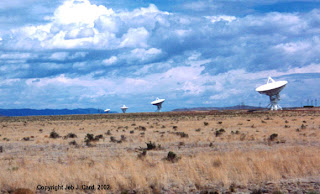
A "mysterious" black, or at least dark, helicopter (Stillings 1989), hovering over the center of the Very Large Array (a not very secret government research facility, located on the Plains of San Agustin in western New Mexico). The helicopter took off, hovered for a few minutes, and landed while I watched. A later visit to the VLA website mentions nothing about a helicopter, crew, or facilities. Secrecy in action?


By the mid and late 1980s, ufologists and others would turn their interest to a secret military facility in central Nevada, referred to as Groom Lake by many insiders, but most famous as Area 51 (Patton 1998). It became a geographical focal point where Cold War paranoia and secrecy, environmental activism, concerns about government overstep, belief in UFO's, and the nascent cyberculture mixed in the 1990s. Glenn Campbell's (aka Psychospy) Desert Rat journal of his activities as an activist at Groom Lake, and the general doings around the site, provide a great historical source for understanding this weird chapter in the history of American distrust of government. A wide variety of stories have grown up in and out of the subculture of Area 51 observers, and several reference the Roswell crash as the seed for alien technology or craft tested and developed at the base. Area 51 doesn’t appear as quickly in Roswell narratives in large part because of the focus on the events in 1947, which predate the establishment of Area 51. The UFO Museum and Research Center has a substantial exhibit on Area 51, but the base does not figure in a major way in most non-cinema versions of the Roswell or other crashed saucer stories. Interestingly, an argument could be made that while these fictional prototypes for Area 51 predate stories about the site, this differs from crashed saucer stories, which typically predate fictional analogs. Area 51 has followed in the footsteps of Roswell in becoming the inspiration for a musical play.

Once a research center is established, the material and crew undergo analysis, which can yield great benefits for society, though in most cases these are hoarded by the secret group in question. A small but persistent thread of ufology links Nazi Germany and flying saucers, and in a couple of crash stories, Nazi scientists are able to study saucers, possibly the origin of many of the German “wonder weapons.” (model below on display at the IUFOMRC).


The concept of reverse engineering to create advanced technology (particularly aircraft) is more commonly applied to the U.S. and Roswell. The most developed version of this thread is Corso’s (1997) The Day After Roswell, within which Corso claims to have been personally responsible for seeding technology from the Roswell crash to defense contractors, and thereby playing a part in the “creation” of nearly every major technological advance in the later 20th century.


Works Cited

Balch, Robert W.
1995 Waiting for the Ships: Disillusionment and the Revitalization of Faith in Bo and Peep's UFO Cult. In The Gods Have Landed: New Religions from Other Worlds, edited by James R. Lewis, pp. 137 - 166. State University of New York Presss, Albany.

Bartholomew, Robert E.
1998 Before Roswell: The Meaning Behind the Crashed-UFO Myth. Skeptical Inquirer, May/June:29-30, 59.

Berliner, Don, and Stanton T. Friedman
1992 Crash At Corona: The U.S. Military Retrieval and Cover-up of a UFO. Marlowe Company, New York.
2004 Crash at Corona: The U.S. Military Retrieval and Cover-up of a UFO. Paraview Special Editions, New York.

Berlitz, Charles, and William L. Moore
1980 The Roswell Incident. Berkeley Books, New York.

Bishop, Greg
2005 Project Beta: The Story of Paul Bennewitz, National Security, and the Creation of a Modern UFO Myth. Paraview Pocket Books, New York.

Bullard, Thomas E.
2000 UFOs: Lost in the Myths. In UFOs and Abductions: Challenging the Borders of Knowledge, edited by David M. Jacobs, pp. 141 - 191. University Press of Kansas, Lawrence.

Cantril, Hadley (With the assistance of Hazel Gaudet & Herta Herzog)
1940 The Invasion from Mars: A Study in the Psychology of Panic (With the complete script of the famous Orson Welles Broadcast). Princeton University Press, Princeton.

Clark, Jerome
1998 The UFO Book: Encyclopedia of the Extraterrestrial. Visible Ink, Detroit.
2000 The Extraterrestrial Hypothesis in the Early UFO Age. In UFOs and Abductions: Challenging the Borders of Knowledge, edited by David M. Jacobs, pp. 122 - 140. University Press of Kansas, Lawrence.

Corso, Philip J., and William J. Birnes
1997 The Day After Roswell. Pocket Books, New York.

Curran, Douglas
2001 In Advance of the Landing: Folk Concepts of Outer Space. Updated and Expanded. Abbeville Press Publishers, New York.

Dean, Jodi
1998 Aliens in America: Conspiracy Cultures from Outerspace to Cyberspace. Cornell University Press, Ithaca.

Denzler, Brenda
2001 The Lure of the Edge: Scientific Passions, Religious Beliefs, and the Pursuit of UFOs. University of California Press, Berkeley.

Dolan, Richard M.
2002 UFOs and the National Security State: Volume 1 - Chronology of a Cover-up 1941-1973. Revised Edition, Hampton Roads, Charlottesville.

Ellwood, Robert S.
1995 UFO Religious Movements. In America's Alternative Religions, edited by Timothy Miller, pp. 393 - 399. SUNY Series in Religious Studies. State University of New York Press, Albany.

Emery, C. Eugene, Jr.
1995 'Alien Autopsy' Show-and-Tell: Long on Tell, Short on Show. Skeptical Inquirer 19(6 November/December):15 - 16, 55.

Festinger, Leon, Henry W. Riecken, and Stanley Schachter
1956 When Prophecy Fails. University of Minnesota Press, Minneapolis.

Friedman, Stanton T.
1992 Crashed Saucers, Majestic-12, and the Debunkers. In UFOs: The Ultimate Mystery of the Millennia (MUFON 1992 International UFO Symposium Proceedings), pp. 68 - 87. Twenty-Third Annual MUFON UFO Sumpoosium. Albuquerque, New Mexico, July 10, 11 & 12.

Fuller, John G.
1966 The Interrupted Journey: Two Lost Hours "Aboard a Flying Saucer." The Dial Press, New York.

Gilmour, Daniel S. (editor)
1969 Final Report of the Scientific Study of Unidentified Flying Objects Conducted by the University of Colorado Under Contract to the United States Air Force. Bantam Books, New York.

Harris, Paola
2000 A Truly "Catholic" Priest, Monsignor Corrado Balducci: Outspoken Supporter of Serious Research on the UFO Phenomenon. UFO Magazine 15(9 October/November):65 - 67.

Jacobs, David M.
2000 The UFO Abduction Controversy in the United States. In UFOs and
Abductions: Challenging the Borders of Knowledge
, edited by David M. Jacobs, pp.
192 - 214. University Press of Kansas, Lawrence.

Kagan, Jeremy
1994 Roswell: The U.F.O. Cover-up. Kyle Maclachlan; Martin Sheen; Dwight Yoakam; Kim Griest. [Film]

Keel, John A.
1991 The Mothman Prophecies. IllumiNet Press, Lilburn, Georgia.

Klass, Philip J.
2000 The New Bogus Majestic-12 Documents. Skeptical Inquirer,
May/June:44-46.

Lewis, James R. (editor)
1995 The Gods Have Landed: New Religions from Other Worlds. State University of New York Press, Albany.

Mack, John E.
2000 How the Alien Abduction Phenomenon Challenges the Boundaries of Our Reality. In UFOs and Abductions: Challenging the Borders of Knowledge, edited by David M. Jacobs, pp. 241 - 261. University Press of Kansas, Lawrence.

McAndrew, James
1997 The Roswell Report: Case Closed. Headquarters United States Air Force, Washington, D.C.

McDermott, Suzanne
1998 The Roswell Incident (song). On McDermott Ephemera (Album). Drexel
Road Music (ASCAP). Available at
http://www.suzannemcdermott.com/recordings.html#roswell

Meehan, Paul
1998 Saucer Movies: A UFOlogical History of the Cinema. The Scarecrow Press, Inc., Lanham, Maryland.

Moseley, James W., and Karl T. Pflock
2002 Shockingly Close to the Truth!: Confessions of a Grave Robbing Ufologist. Prometheus Books, Amherst, New York.

Nickell, Joe
1995 'Alien Autopsy' Hoax. Skeptical Inquirer 19(6 November/December):17-19.

Palmer, Susan Jean
1995 Women in the Raelian Movement: New Religious Experiments in Gender and Authority. In The Gods Have Landed: New Religions from Other Worlds, edited by James R. Lewis, pp. 105 - 135. State University of New York Press, Albany.

Patton, Phil
1998 Dreamland: Travels Inside the Secret World of Roswell and Area 51. Villard, New York.

Peebles, Curtis
1994 Watch the Skies!: A Chronicle of the Flying Saucer Myth. Smithsonian Institution Press. Reprint 1995, Berkley Books, New York, Washington, D. C.

Peterson, Mark Allen
1991 Aliens, Ape Men, and Wacky Savages: The Anthropologist in the Tabloids. Anthropology Today 7(5):4-7.

Randle, Kevin D.
2000 The Roswell Encyclopedia. Quill, New York.

Randle, Kevin D., and Donald R. Schmitt
1991 UFO Crash at Roswell. Avon Books, New York.

Rojcewicz, Peter M.
1987 The "Men in Black" Experience and Tradition: Analogues with the Traditional Devil Hypothesis. Journal of American Folklore 100:148-160.

Saler, Benson, Charles A. Ziegler, and Charles B. Moore
1997 UFO Crash At Roswell: The Genesis of a Modern Myth. Smithsonian Institution Press, Washington.

Saliba, John A.
1995 UFO Contactee Phenomena from a Sociopsychological Perspective: A Review. In The Gods Have Landed: New Religions from Other Worlds, edited by James R. Lewis, pp. 207 - 250. State University of New York Press, Albany.

Scully, Frank
1950 Behind the Flying Saucers. Reprint 1951. Popular Library, New York.

Spielberg, Steven
1977 Close Encounters of the Third Kind. Dell Publishing, New York.

Stillings, Dennis
1989 Helicopters, UFOs, and the Psyche. ReVision 11(4):25-31.

Strieber, Whitley
1989 Majestic. Berkely Books, New York.

Swords, Michael D.
2000 UFOs, the Military, and the Early Cold War Era. In UFOs and Abductions: Challenging the Borders of Knowledge, edited by David M. Jacobs, pp. 82 - 121. University Press of Kansas, Lawrence.

Thomas, David E.
1995 The Roswell Incident and Project Mogul: Scientist Participant Supports Direct Links. Skeptical Inquirer 19(4 July/August):15 - 18.
2001 Retired Air Force Balloon Expert Expands on Origin of 'Majestic 12' UFO Hoax. Skeptical Inquirer, March/April:5 - 6.

Saturday, December 23, 2006

The Triangles - The One UFO Story that Really Gets Me

UPDATE: I'm leaving this up. But for some years now, I find I don't agree with what I once wrote. I've ultimately decided that the black triangles are a mix of misidentification and folklore, given credibility by the period of interest by American stealth designers in triangular craft. I think I came to this conclusion before the cratering of credibility regarding the book Night Siege, but that certainly didn't help matters.

By now, readers of this blog should be able to guess that I find the Spooky Paradigm interesting for a couple of reasons, but that I definitely put it in a cultural frame. In other words, I find it most interesting as a culture, a community, a movement, a worldview, something along those lines. I write about it here from that perspective.

But I can't say I don't have opinions and ideas about the ideas in the Paradigm. And the one mystery associated with UFOs, the one that I simply cannot explain to my own satisfaction, is that of the Triangles. These are also called the Black Triangles, though given that many sightings are at night, this may be a difficult call.

Anyway, UFOs have come in a lot of different shapes through the years, and still continue to do so. Trends in the appearance of reported UFOs can be interesting, but simple statements do mask the diversity, and the persistance of supposedly "out-dated" reports of disc or cigar-shaped UFOs. But one trend that has been remarked on from time to time is the growing popularity of triangle-shaped UFOs. I don't know if more Triangles are reported than in the past, but they do seem to be involved in more multiple or even mass witness cases.

There are numerous cases, but the four famous Triangle cases that define the others are the Hudson Valley sightings (1983 - 1985, see the book Night Siege in the sidebar for details, put back in print in 2002 after being difficult to obtain), the Belgian sightings (March 30, 1990), the Phoenix Lights (March 13, 1997), and the Illinois "Cop" Case (January 5, 2000 documented at a great page at the UFO Evidence website). In these cases, black triangles (sometimes smaller, but usually much larger and typically described with "football fields" as a unit of measure) are sighted moving low and slow. They have lights, often with a red light in the center of the ventral side of the triangle, and then brighter lights near the corners. But in a number of cases a rainbow of lights is described along one of the narrow edges of the triangle.

These sightings have attracted a great deal of attention for many reasons. Again, there are individual sightings of the Triangles. But the cases listed above were all multiple witness sightings (including mass witness sightings by hundreds of people) over populated areas. In the case of the Belgian sightings and the Illinois case, government officials were involved (Belgian fighter jets were scrambled, most of the Illinois witnesses were police officers from several departments) and photographs were taken (here is an example on Lieve Peten's site). Someone looking for a nuts-and-bolts UFO report couldn't do much better than the Triangles, except perhaps to get a piece of one or some clear and sustained daytime imagery of one, preferably from multiple sources to discount Photoshopping.

One problem immediately rears its head: the sightings are so good, they are too good. Yes the cases are famous spawning television documentaries and books and mainstream news reporting. But as I quoted in a previous entry in this blog " if a conspiracy theory turns out to be correct, it is quickly relabelled as investigative journalism"and this applies to the Triangles. Because they do have many of the characteristics of actual objects sighted by many people, including "credible" authorities, the reaction outside of the Spooky Paradigm is to admit the sightings may be of something real, but that it must be something exotic, but not too exotic.

Like experimental US military aircraft. This makes sense. The US was experimenting in the 1970s and on with black triangular aircraft as part of its stealth program. While none of the known US aircraft fly like the Triangles (in particular, slow or hovering low-altitude flight), perhaps the Triangles are something that hasn't been released to the public yet. Perhaps a stealth long-range transport ship. Perhaps using lighter-than-air, or even exotic antigravity technology. Perhaps the witnesses didn't understand exactly what they were seeing. This is the conclusion from a detailed study of the triangles by the National Institute for Discovery Science. (see also this page for various articles, maps, etc.). As with animal mutilations, they got interested in the Triangles as they seem to have more data to handle. Their conclusion was that the triangles may be experimental transport aircraft, and that they appear to cluster around airbases for transport and logistics (pdf here, jpg map here).

There are two problems with the experimental aircraft idea. The first is that ufologists can point to older cases of triangular sightings. Ok, but there does seem to be an upswing in sightings, and especially the impressive multi-witness sightings, starting around the time the Americans began building stealth craft and flying them out in Nevada at Groom Lake and other facilities (though these French sightings date to 1975-1976, when the F-117 was still a concept being worked out). Perhaps the earlier Triangles are not related to the post-1983 Triangles. There are only so many basic shapes thagt one could use to describe an unfamiliar object in the sky, and triangle is likely to come up. A rise in sightings of black triangular UFOs just at the time that the USAF starts flying secret black triangular planes is just a coincidence? Somewhat difficult to believe. So this I can live with.

What bothers me when I think about these reports is the time depth if this were a secret plane. It is a truism that secret planes typically stay secret for no more than a decade, and perhaps significantly less. This issue comes up with reports of the supposed Aurora, another mystery UFO of the stealth era. As discussed on the website of the Federation of American Scientists, Aurora is the label given to reports of a high-altitude, high-speed, sonic-boom generating triangular (hence why it is sometimes conflated with the low-altitude Black Triangles) aircraft. In both cases, sightings continued for a substantial period of time, but there is one major difference. Aurora sightings (and recording of sonic booms) are largely confined to the late 1980s and the early to mid 1990s. One could conceivably argue that Aurora was what so many think: a replacement for the SR-71 in the niche of the high-altitude high-speed reconaissance and potentially strike aircraft. Perhaps some prototypes were created and flown, but ultimately the project was cancelled, and the entire thing kept secret perhaps due to extravagant costs, spectacular failure, or scandalous corruption. Who knows, but this is a believable excuse for why the plane could have been in operation for half a decade and then disappeared behind National Security/Cover-Your-Ass.

But this explanation simply doesn't work for the Triangles. They have been sighted for more than two decades (here is a multi-witness sightings in Venezuela from last month) so far with no end in sight. And if they are advanced transport aircraft, there have been enough American wars and military actions that one would imagine they would have been used. And if they are so secret for decades, why fly them over populated areas, in some cases multiple times over the course of a year or more as in the Hudson Valley case?

Historian Richard Dolan wrote a good and more detailed essay similar to this one for the National Institute for Discovery Science, back in 2003. While I am sure I must have read this essay, I forgot about it until tonight. Yes, we agree on a number of points, and reach some similar conclusions. But where Dolan suggests a possible ET origin for some of the Triangles due to lack of disclosure as a military craft, I take his other suggestion as more likely. That the reports are indeed of structured non-ET craft, perhaps stealthy, perhaps for transport. But the continued secrecy points to a very different kind of relationship between whoever flies the craft, the federal government, and the American people. Or as Dolan puts it, a "shadow government." Such a craft would clearly have value in a war, say by rapidly deploying troops and equipment in difficult to reach places (such as Afghanistan in 2001, or Northern Iraq in 2003). But no such craft has emerged, nor have stories by soldiers of having ridden in or unloaded such craft.

If these obvious cases for using the Triangles didn't unveil them, then what are they being saved for? This is where, as Dolan notes, things start to get dark. Quiet craft able to deploy military or police forces, and being tested and flown around urban areas? Developed by someone in the US government but not used to fight its wars? This starts to lead to disturbing ideas to say the least.

And hence this post. The Triangles confound easy explanation as hoaxes or folklore. They seem to exist. They certainly sound like something a military would, and possibly could, create. And in fact they look at least something like recent creations for the US Air Force, though with major differences. Yet for decades they haven't been revealed as such, even when their use could have won wars or saved lives (imagine a black triangle descending on the Convention Center in New Orleans in September 2005, rescuing hundreds of the trapped and dehydrated people, continuously ferrying everyone out in the course of some hours). This might lead some to suggest a non-human explanation for what appear to be structured mechanical air craft, while it would lead others to think about a military or intelligence organization that has such aircraft, but is not beholden to the will of the people and their elected representatives.

Either option disturbs me.

EDIT: I'll add triangle sightings to this post when I come across them. Like this one in the UK on January 30, 2007.

EDIT: French Triangle Sightings from the 1970s. Most importantly, they were published in the 1970s, before the meme of the black triangle, and just before the first stealth prototypes were flying in Nevada.

EDIT: Black Triangle seen in British Colombia. News report on the sighting.