Showing posts with label military. Show all posts

Saturday, June 24, 2017

UFOs are Dead, Flying Saucers Will Live Long
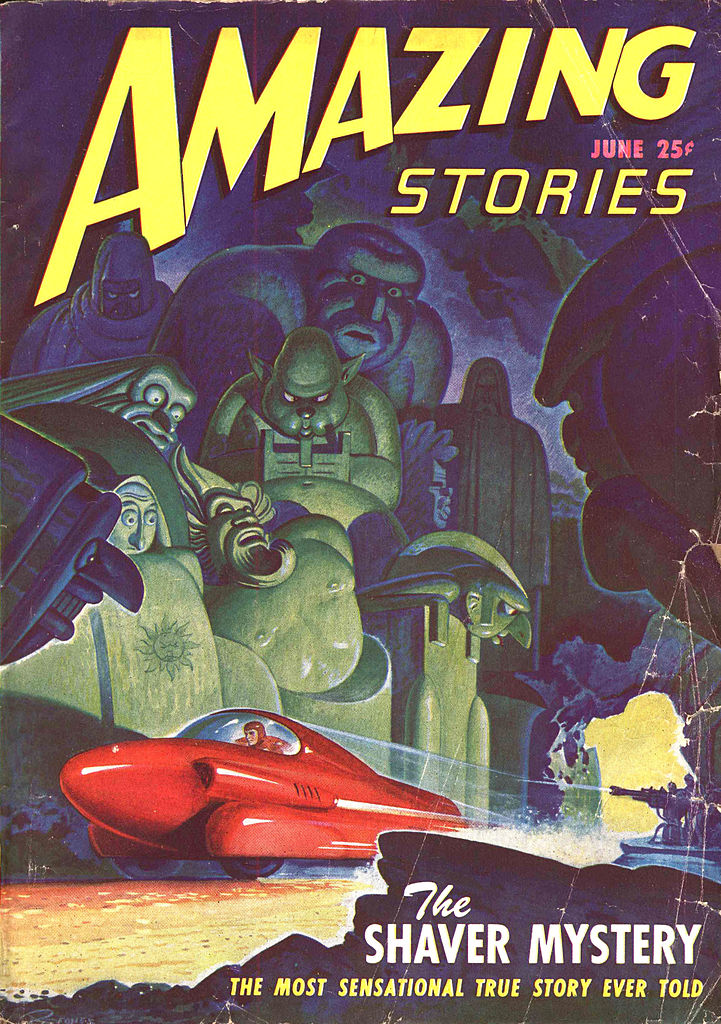


Amazing Stories, June 1947


Saturday will be the 70th anniversary of the Kenneth Arnold "Flying Saucers Sighting". The famous 24 June 1947 sighting is the traditional "beginning" of the Flying Saucer, kicking off a two-week craze that concluded with the Roswell Incident in July 1947.


But this wasn't the beginning of the UFO. EDIT 4 July 2017: Almost forty years ago Peter Rogerson made the same point I'm making here about UFOs vs. Flying Saucers, though as you'll read, I think the time in-between has been less than kind to the UFO. Nonetheless, I want to point this out, especially in the off-chance I read Rogerson's essay some time ago and forgot I had. I was reminded of this in an interesting review by Rogerson of a recent "estimate of the situation".

The UFO, the Unidentified Flying Object, emerged out of genuine official interest by US military institutions in the reports of things seen moving through the sky. Within a few years, institutional interest seems to have largely receded to keeping a UFO desk or project that had as much to do with public relations and institutional thoroughness as anything else. 

Watching the Skies near the end of the Second World War

The UFO, and cryptozoology, and other forms of "alternative" science, or as detractors would put it, pseudoscience, also emerged out of high social status for science and scientists in the wake of massive technological and social change from the industrial revolution, and especially the dramatic technological and scientific leaps made around the period of the Second World War.


 The social value of science, and the previously un-imagined discoveries made by scientists especially starting in the 19th century, made it sensible that analysis of evidence, using science (or activities that resembled science) could reveal amazing things.

Plotting Flying Objects over Britain during the Second World War. Is this the model for the UFO sightings database?

Over time, the UFO came to be largely, though not exclusively associated with the Space Age, extraterrestrials, and searching for evidence of these strange craft and their occupants. The stereotype of the serious ufologist involves collecting reports for databases, creating sightings maps to detect geographical or temporal patterns, looking for commonalities, piecing together puzzles.

Amazing Stories, December 1945

The flying saucer is another matter entirely. Kenneth Arnold and others in the crucial period of the flying saucer of the mid-to-late 1940s were in no small part in the orbit of Ray Palmer (you can read FBI reports into Palmer's involvement in early flying saucers and his publishing here), champion of the Shaver Mysteries. Shaver's stories, edited by Palmer, have roots in pulp fiction and earlier alternative religious influences including Theosophy and Oahspe. The foundations of the flying saucer community were laid among occult and science fiction enthusiasts of the 1940s, and it is unsurprising that the flying saucer first took root in the 1950s in science fiction films and among the Contactees and their transparent relationship to previous new and alternative religious movements.


The UFO, an acronym suitable for the Big Science of powerful government and military institutions of the 1950s, inherently begs for trace evidence, analysis of the situation, collation of reports. While one can still find this style in ufology, it is dying on the vine. This is expressed well in two essays by Vicente-Juan Ballester Olmos and Thomas Bullard, both musing on the 70th anniversary. While Ballester Olmos, keeper of a photographic database to collate evidence, is very pessimistic, Bullard the folklorist is only mostly pessimistic, hoping that among the dross and dashed hopes there may still be a non-mundane phenomenon at the core of the UFO mystery.
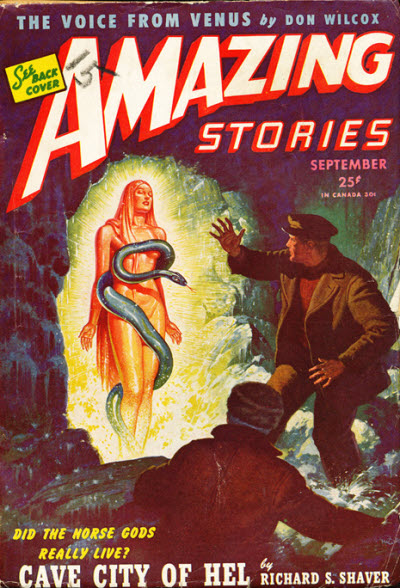


However, most of what is associated with the UFO, or rather the flying saucer, is now conspiracy theory. One can argue that much of conspiracy theory can trace its massive cultural popularity to the UFO. Conspiracy and paranoia are the very bones of the flying saucer. One important ancestor of the flying saucer, and other elements of 20th century pulp fiction and occultism is Edward Bulwer-Lytton's 1871 novel The Coming Race. The children and grandchildren of this tale of an ancient underground master race with psychical powers and menace towards the surface are many, including the Shaver Mysteries. Shaver's writings are of nearly all-powerful Deros causing no end of misery through their invisible stalking and influence on surface dwellers. Their resemblance to much of conspiracy theory and mysticism surrounding the paranormal and UFOs today is profound. Pulp fiction also interjected the Reptilians into the Shaver and Flying Saucer community by the late 1940s. And while the Contactees often preached positive messages in the style of earlier decades theosophical ascended masters, there were also dark warnings of evil forces that would silence such wisdom.
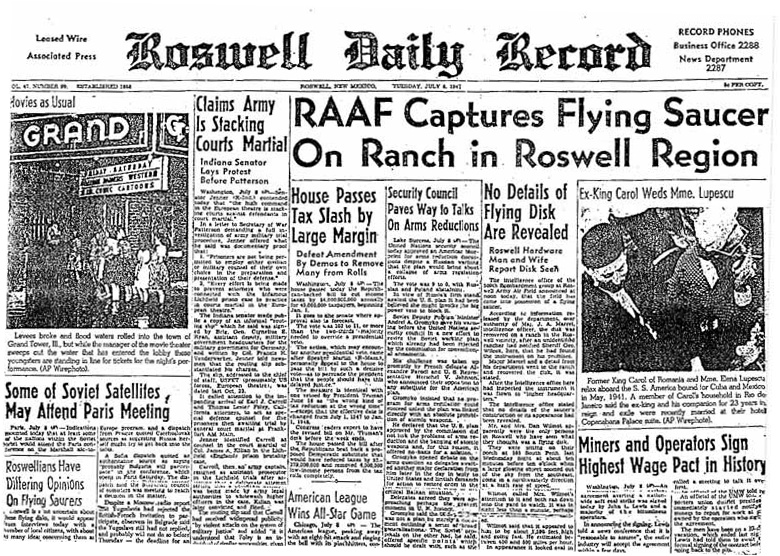


Conspiracy and coverup were constituent to ufology, including with influential early leader Donald Keyhoe. Self-proclaimed serious or scientific ufology until the 1980s was largely about moving towards analysis and away from mysticism on the one hand, and conspiracy fears on the other, though this proved impossible. In previous posts on this blog, and in podcasts, I've discussed the importance of the Roswell myth in strengthening a bond between conspiracy theory and mainstream ufology.


Today, if one looks about the UFO community and its media, one finds two basic styles have supplanted the sightings trackers and account analysts. One is disclosure and expolitics, a focus on government and institutional conspiracy, promises that all will soon be revealed or leaked, and of breakaway civilizations and hidden shadow governments. A rotating cast of characters and tropes promotes or sells the idea that long-suspected truths are being hidden by illegitimate authorities and institutions, and that the imminent revelation of these truths will end the inequities of the modern day and bring about a better future.


The other is focused on ancient evidence for alien or extradimensional origins of humanity, often with a focus on origin myth or  religion in one form or another. Though most prominent through various cable television programs, this element as has eclipsed every other aspect of interest in "UFOs", which seem almost an afterthought. One can easily go from dubious remains of a Roswell crash victim (actually indigenous remains in a museum) to dubious remains of an ancient alien hybrid without changing the roster. A rotating cast of characters and tropes promotes or sells the idea that long-suspected truths are being hidden by illegitimate authorities and institutions, and that the imminent revelation of these truths will end the inequities of the modern day and bring about a better future.


These are not mutually exclusive. Alleged modern conspiracies become new manifestations of ancient magical secret societies, shadow governments hide ancient inhuman bloodlines.They unite into an all pervasive Lovecraftian paranoia of deep secrets and debased cults. Last year, conspiracy theories about evil cults were fashioned out of leaked political emails, and a man was just sentenced to prison for responding violently. Yet one reason these resonated so well in the conspiracy theory world is that the stolen emails came from a long-time UFO disclosure advocate, paralleling a huge amount of chatter and speculation that UFO disclosure would hinge on the US presidential election.

The most viable alternatives in small pockets of the UFO community are hopes that the UFO can show the way to better understandings of the inner self and consciousness, that UFOs are something like poltergeists or Victorian elementals, soon to be erroneously conglomerated with descriptions of tulpas.

In other words, the flying saucers are once again just one manifestation of the underground Deros. Of the Great Old Ones. Of the Coming Race. Ancient wisdom, lost history, hidden cults, subterranean horrors, psychical manifestations.

The investigation of the UFO mirrored the rise of science's social status. It's fall, and the return of ascended masters, psychical entities, and lost races makes perfect sense in an era of partisan attacks on science and neo-Victorian political and social conditions.

The UFO is dead, the flying saucers have returned.

Thursday, September 15, 2011

Why Skepticism is So Important: The anti-Muslim FBI CounterTerrorist Expert and the Satanic Panic


Matteson-jacobs


UPDATE 5-10-12: It's even worse than you thought

A recent revelation of anti-Muslim FBI counterterrorism training suggests disturbing parallels to previous panics, including the Satanic Panic of the 1980s.

Wired Magazine is running an expose on counter-intelligence training within the FBI that trains agents that, I'll quote the Wired piece


"“main stream” [sic] American Muslims are likely to be terrorist sympathizers; that the Prophet Mohammed was a “cult leader”; and that the Islamic practice of giving charity is no more than a “funding mechanism for combat.”
At the Bureau’s training ground in Quantico, Virginia, agents are shown a chart contending that the more “devout” a Muslim, the more likely he is to be “violent.” Those destructive tendencies cannot be reversed, an FBI instructional presentation adds: “Any war against non-believers is justified” under Muslim law; a “moderating process cannot happen if the Koran continues to be regarded as the unalterable word of Allah.”
These are excerpts from dozens of pages of recent FBI training material on Islam that Danger Room has acquired. In them, the Constitutionally protected religious faith of millions of Americans is portrayed as an indicator of terrorist activity."

The author of the training briefings is William Gawthrop, a faculty member at American Military University, a for-profit university focused on military and law enforcement issues, aiming its recruitment especially at veterans. Gawthrop, prior to the Wired piece, was an expert on Islamic law and war for WorldNetDaily, a far-right website known for calls and dreams for secession and "civilian uprising" by actor Chuck Norris and singer Pat Boone, but more recently for being the center of "birther" conspiracy theories that claimed U.S. President Barack Obama was not born in the United States or otherwise is not a natural citizen.

This pattern should be very familiar to anyone who paid attention to the havoc wreaked by the Satanic Panic a generation ago. In the 1960s, foreign and new religions were recognized and gained ground in the United States, including the Church of Satan, driven by charismatic showman and entertainer Anton LaVey. But starting in the late 1960s and throughout the 1970s, a few of these new religions, or cults as their detractors called them, met disastrous ends. The Manson family and its infamous murders was not a religious movement, but was lumped in due to its cultish structure and nature. The nadir of all of this was the Jonestown murders and massacre in which 918 people were either killed or committed suicide in the self-destruction of the People's Temple after the murder of a fact-finding mission led by a U.S. Congressman.

Jonestown became the bedrock of the anti-cult movement. While the movement was already underway, the Jonestown horror gave it much more credibility. As a result, throughout the 1980s especially, the myth of a grand Satanic Conspiracy thrived in American culture. It was a popular theme in movies and television, and it wasn't hard to find media with scenes of ritual human sacrifices by robed cultists. Satanic-themed entertainment had already been popular with movies like The Exorcist, Rosemary's Baby, or The Omen, but the trope became commonplace. Satanists became the first explanation for rumor panics of "cattle mutilations" in the American Plains and West, until UFOs became a more popular explanation. The most public and most ridiculed component of this was the campaign against Dungeons and Dragons (let us all remember to mourn Black Leaf) and against heavy metal music, both products of 1970s pop culture that incorporated elements of fantasy and demonic imagery, just as did the previously mentioned films and television shows. However, because these were media aimed primarily at teenagers, they were seen as particular threats.

But the Satanic Panic also intersected at times with law enforcement. You can explore the extensive wiki page as a start on the topic, but people were investigated, accused, and tried for crimes based on what turned out to be faulty or misleading coaching of witnesses, in some cases alleging vast mass murders and other crimes that were simply physically impossible, and would leave overwhelming physical evidence where none existed. These investigations were at times prompted either directly or as part of a general atmosphere encouraged by "anti-cult experts" that would give instructional briefings to law enforcement, educators, and other authority figures. While not in all cases, in quite a few these experts were heavily invested as activists of a fundamentalist Christianity that was on the rise starting in the 1970s. And some of their "expert advice" reflected this, while other advice was simply silly (infamously telling parents or educators that graph paper [for Dungeons & Dragons maps] and mirrors were signs of Satanic ritual magic on the part of their children or students). I've blogged about this before as a form of "folk archaeology."

The Satanic Panic isn't old news either, at least not entirely. It made headlines again in a different way, with the release of the West Memphis Three. Likewise, such allegations have become involved in the prosecutions in the Meredith Kercher murder case, better known by the name of the woman convicted for the crime, Amanda Knox, who like the West Memphis Three has attracted considerable international support by people who doubt the case against her.

The revelation of the FBI briefing authored by Gawthrop reminds me strongly of some of the "anti-cult expertise" offered to law enforcement during the Satanic Panic. I don't know Gawthrop's religious background, but it is hard to miss the zealotry against Islam, while praising Judaism and Christianity (Gawthrop even provides a graph!).

But a bigger pattern is present. In both cases, horrific criminal acts including mass murder provide credibility to "experts" who instead push religious or political issues. The horror of these mass casualty events, as well as smaller but more gruesome events associated with the larger threat, is a powerful influence on people who might otherwise rationally dismiss some of the more absurdist ideology coming from these "experts." Further, by pointing at the wrong targets, these "experts" get to attack those people and communities they don't like, but actually cloud and damage real efforts to deal realistically with threats. Was training like Gawthrop's responsible for the detention, interrogation, and strip searching of Shoshana Hebshi this last weekend, along with other unnamed people, all of whom were either from southern or southwest Asia, or had genetic heritage as such, and committed no crimes nor ultimately were found to be at all suspicious?

The pattern of rumor panics is a familiar one. It's no accident that Arthur Miller was able to find such easily parallels between McCarthyite anti-communism and the Salem Witch Trials of 1692. In the case of McCarthyism, in addition to the general Cold War fears, that war had recently turned hot in Korea. It has been suggested that the Salem trials may have been nursed by anxiety stemming from recent bloody wars with Native Americans, wars that had not gone well and were considered incompetent or failed by the populace. The witch trials may have been an expression of powerlessness, fear, and anger over failure.

I visited Salem this summer, a weird tourism experience to say the least. But in the more serious moments, the tragedy does come through, and reminds us that just because something horrible is happened, we shouldn't just listen to whoever gives us the most lurid and enticing take on the matter, one that we can deploy against the innocent when we can't lash out against real threats.

So I'll leave this with part of the memorial to the victims of the Salem trials

Monday, October 04, 2010

Fantasies of Control: Government and Supernatural Fears

Image by RadioKirik (Wikicommons)


A recent news item, and two book releases concerning UFOs and the US government, got me thinking about the concept of government reaction to claims of the paranormal.

According to a recent Freedom of Information disclosure from the Dyfed Powys police in Wales, UK. In the past five years, they've dealt with 86 calls concerning witches, as well as
"one call about a werewolf, seven about vampires, 19 about UFOs, 13 about big cats, 73 reports of ghosts, 16 of zombies, 35 of demons, five regarding big foot sightings, 33 of monsters and 18 about wizards"

One of the more cliched ideas in fantastical fiction is that of the government agency that polices the supernatural. While there are more fantastical examples in fiction, the most cliched version boils down to a secret organization, with an odd number or acronym in its name, that investigates and eliminates paranormal threats, often containing them in some fashion. I don't know what the earliest version of the concept is in either folklore or fiction, but by the 1980s it had already become something of a humerous trope (warning: link to addictive tvtropes site, where they call this is some variation on the Extranormal Institute and its subtype Secret Government Warehouse). Current examples include the MiB in the Men in Black Films, Warehouse 13 and Fringe on television, the B.P.R.D in comics, X-Com and Delta Green
in games, and amongst plenty of examples in print, Charles Stross' "The Laundry" (such as his recent The Fuller Memorandum).


More intriguing are the two sorts of groups that appear in both folklore and reporting in the real world. The UFO world in particular has had an obsession with government conspiracies and secret organizations for decades, crystallizing in the form of the Majestic documents, discredited in the eyes of many within and without of ufology. The original documents describe a high-level, shadow-cabinet of sorts, set up after various flying saucer crashes in the 1940s and early 1950s, but subsequent documents include operations manuals and other suggestions of active operations. The operations of Project Moon Dust and other government agencies (US and otherwise) to retrieve objects fallen from space have been brought into the larger UFO mythology. Such efforts, aimed at collecting and exploiting foreign military and aerospace technology, have been enmeshed into Majestic and other ufolore. Paranormal researcher Christopher O'Brien has suggested government or other secret special forces-style occult teams as explaining part of the patterns he finds in cattle mutilations, as he discusses with Greg Bishop on the podcast Radio Misterioso in January 2005. Like something out of the B.P.R.D., he suggests that copycat cattle mutilations may be rituals by such a group to counteract the activities of possibly non-human entities, ultramodern blood sacrifices to deal with ultraterrestrials, if you will.

As exciting as these ideas are, more documented paranormal task forces within government seem to be much less proactive, or active at all. The fall into one of two categories.

The first are those willing to use paranormal beliefs as psychological and propaganda weapons. Legends and supernatural beliefs, most famously Filipino vampire myth, have been used in combat, with mixed success. The CIA thought flying saucers made a great human interest story to flood the Guatemalan papers when their plans for a coup had been exposed, and also were happy for some UFO reports to continue when they were actually sightings of the U-2 and other spy planes (the Soviets made similar efforts regarding space launches). Mark Pilkington's recent book Mirage Men: An Adventure into Paranoia, Espionage, Psychological Warfare, and UFOs suggests that much of the UFO phenomenon can actually be chalked up to such intelligence activities. I have not read this book and cannot evaluate its claims. Arguably Project Bluebook would fall into this category. The very public US Air Force project was in reality a small operation based out of Ohio, and while it did occasionally conduct field investigations of UFO sightings, such as the Socorro, New Mexico landing or the Kelly-Hopkinsville goblin siege, scientific advisor J. Allen Hynek and others have made it clear that the office was primarily an effort to minimize public concerns and interest in UFOs, in keeping with the recommendations of the Robertson Panel.

The second type is intriguingly close to the fictional and more impressive folkloric concepts. Harold Blum's Out There: The Government's Secret Quest for Extraterrestrials suggested back in 1992 that there was an informal UFO study group composed of officers of the intelligence and military communities. Blum's findings would eventually be echoed by the work of Jon Ronson and others culminating in The Men Who Stare at Goats, including some of the same individuals and groups, as well as the release of information on Project Stargate, the CIA psychic/remote viewing project. Despite plenty of myth-making all around, there was clearly at least one set of officers within the military and intelligence establishment that pursued paranormal interests and studies. Similar projects have been declassified by the British Ministry of Defense.

So it is with both interest and skepticism that I mention the most recent high profile claim of an intra-governmental paranormal study and action group. Nick Redfern chronicles (I have listened to and read several discussions of Mr. Redfern's findings, including some on his blog for this book, but not the book itself) in FINAL EVENTS and the Secret Government Group on Demonic UFOs and the Afterlife the tale of a loose group that became convinced that UFOs are actually demonic in nature, and that the transformation of American society to a Christian fundamentalist culture is necessary to defend against these forces. This belief is persistent amongst a subset of UFO followers, and I believe it is growing. Given the public resurgence of the Christian right in recent years, and especially in the training and top-level conduct of the military and government, the concept is controversial but timely. I would like to see some of the evidence that such a group might exist, but its existence is eminently plausible. Just as eastern religious ideas influenced the individuals described in The Men Who Stare at Goats, we would expect more radical Christian ideas to be reflected by some in the power establishment, no matter what you think of those ideas.

All of these groups and efforts, real or imagined, are about control. A classic skeptical critique of conspiracy theory is that people unable to accept that an unruly world is chaotic, imagine secret controlling factions, placing events in someone's hands (even if they are sinister hands), belieinv that someone is in control. While I am a skeptic, I've never liked that idea much, it doesn't make a lot of sense either logically or from experience. Sure, we might feel more comforted if we believe that in the case of catastrophe, say an asteroid impact, that there is some super-secret organization which will spring into action and save us. But I don't see how belief in all-powerful conspiracies controlling the world to the detriment of the believer and society is terribly comforting. Instead, in many cases it seems, in my experience, that belief in a powerful evil conspiracy allows for belief in a powerful counterforce. The New World Order/Satan will rouse good patriots or Christians to battle in a final war and be victorious. Moral decay and oppression acts as a backdrop for enlightened consciousness and transformation into a New Age. This perhaps is comforting, not in imagining control in the hands of a conspiracy, but instead providing the believer with an enemy to fight, something to focus angst upon rather than ill-defined unease.

In the cases of psychological warfare and propaganda, control is the obvious goal. Here, the right words or symbols, including powerfully charged supernatural symbols, are hoped to magically bend a population's or an enemy's will, without the application of brute force physical violence. A push button society, controllable through manipulation, is a technocratic dream of the modern era, by the intelligence officer and the ad man alike.

And lastly, in the case of government paranormal action groups, control is indeed sought over an unruly world. The UFO phenomenon is believed to be maddeningly chaotic to many who study it, to the point that the "trickster" concept from anthropology and mythology has become a popular buzzword in the community. Likewise, parapsychology has a long history of fitful starts and stops, vague and problematic findings and methods, and lack of scientific progress. Individuals feeling as such, but with organizational power at their fingertips, have a tool to possibly control some of that chaos. On the other hand, such beliefs can be a key to understanding and controlling the logic of a chaotic world. Projects like Stargate, the remote viewing effort of the CIA, are shortcuts to hopefully better results than those obtained through traditional intelligence work.

Sunday, December 13, 2009

Debunking the Sea Monster of U-28

Great article by Mike Dash conclusively demonstrating that the oft-repeated story, of a sea monster blown up during a battle between a German U-boat and a British freighter, was almost certainly invented in response to the original media frenzy over the Loch Ness Monster.

Thursday, January 24, 2008

No More "Area 51": The World's Least Secret Secret Base has Its Name Revealed

Homey Airfield.

That's right. That's the English-language designation Groom Lake, AKA Area 51 gets. It appears to be a descendant of an earlier nickname for the place, Home Plate, during the OXCART days.

If you prefer, you can also call it XTA.

It amazes me that, because of one reporter in Las Vegas, a guy saying he worked on a flying saucer, and a few activists, "Area 51" has become a legend and a household word across the globe. After its appearance in movies, video games, books, and countless tv shows, you know you've looked at satellite imagery of it on Google Earth.

Meanwhile, the US regularly operates out of secret military bases around the world, moving vast quantities of people, military and contractor, and material. And if you mention this to 99% of people, they stare at you like you're speaking Tzotzil.

William Arkin talked about these bases, for example those in Jordan and Israel, in his impressive book Code Names. Here in his blog at the Washington Post, Arkin goes into some detail about the secret facilities that aren't household words, that aren't even close to bubbling up into mainstream public view. And that of course is the point. As Arkin puts it


"There are some logistic security arrangements that we have with Jordan that I don't want to go into," Pentagon spokesman Lawrence Di Rita told the AP. I know that Di Rita is just a water boy, but this type of lying about the real U.S. military presence and intelligence relations with foreign governments ultimately undermines the war on terrorism and the American's public's ability to add its wisdom and values to the conduct of that war.

I'm all for legitimate secrecy to protect America's intelligence operations, but official secrecy imposed to obscure what is otherwise observable by the local population and the bad guys only serves to deny the American public the ability to understand what is being done in its name and to have proper context for understanding the not so insane targeting of our terrorist enemy.

Wednesday, January 23, 2008

Stephenville (or Texas) UFO Flap - Military Offers Explanation

Could have seen it coming a mile away. The US military has decided to send scads of ufologists and observers into a fit by offering the exact same explanation given for the Phoenix Lights - Two weeks after the sightings, they now say that initial reports of no jets in the area were mistaken, and that a flight of fighters were on maneuvers after all.

Maybe that's the case. One pilot in the area suggested he saw flares that night.

But it isn't going to be an easy sell. A number of witnesses described a massive craft. Others described incredible speeds. And some noted that they saw jets, but that the UFO was a different animal. Doesn't mean misidentification didn't happen. But since this is a well known meme in the relationship between the US military and the UFO phenomenon (cultural or otherwise), it will be an uphill explanation.

Meanwhile, Axcessnews lists several more sightings in what can be called either the Stephenville UFO Flap or the 2008 Texas UFO Flap, and responds to the F-16 explanation with further perusal of the reports. It also links in a videotaped sighting from earlier in the month in San Diego, California. It doesn't link to a report, also on January 8, from northern California. And a woman reports something strange in Jacksonville, Florida.

Update (January 25, 2008): Looks like people aren't buying the F-16 explanation. A good roundup by a NYTimes blogger points to a Dallas Morning News story that notes the witness descriptions don't sound like F-16 activities.

Update (January 31, 2008): Pilots involved in the sightings say the military explanation doesn't make sense.

Monday, January 14, 2008

Stephenville, Texas - A UFO Flap in the Making

January 10, 2008 - The Stephenville Empire-Tribune reports that two days earlier, four local residents saw strange lights in the sky, a UFO they refer to as a ship. One is a pilot. They also report the "ship" was pursued by fighter jets.

January 11, 2008 - The same paper, from the same staff writer, reports that more people are reporting seeing the strange object or lights, including a constable and an ex-Air Force navigational specialist. A local naval reserve officer believes he can solve what is now a full-blown mystery.

January 13, 2008 - A new report states that MUFON investigators will be arriving to interview witnesses and talk about the sightings. The naval reserve officer believes the sighting was a misidentification of an aircraft under certain lighting conditions.

January 14, 2008 - A local UFO eyewitness, enthusiast, and lecturer does an interview on a paranormal radio show about his claim to have sighted the January 8 UFO. Meanwhile, CNN has picked up the story and is bringing it to millions of readers. The story has no discussion of aliens, outer space, or anything fringe or kooky.

I'm going to try and continue to see what develops here, and if or when other aspects of UFOdom become involved, or what the media does with this.

Monday, January 07, 2008

A Not-so-Spooky as Terrifying Conspiracy of Nuclear Espionage in the US Government and Terrorism: Sibel Edmonds Breaks Her Silence

This isn't a Spooky Paradigm story on the face of it. Or is it? It's a conspiracy story, and Edmond's allegations have floated in the world of alternative politics for several years, but now that she has broken her silence and named names (something she did in front of the Congress, only to have the US government give her an unprecedented gag order) it is happening now, and if even the allegations here are true, it is the story of the decade. And as of a day later, not a single US news source is covering this story after it splashed big in the UK.

I don't know how much you know about Sibel Edmonds, so here are two links. One is to the story itself in its most recent iteration.

http://www.timesonline.co.uk/tol/news/world/middle_east/article3137695.ece

The other is from a blog that has been heavily following this story for years.

http://www.bradblog.com/?p=5518

I will note that she had to go to a non-US paper to spill this, and a day later, no US media sources are touching it. Her story damns both GOP and former Clinton officials, but many in her naming of names are tied to Bush I, Bush II, Reagan, or are otherwise sympathetic or instrumental to the neocon cult. She names the names, or rather puts their pictures up to get around the gag order, as discussed at this link

http://letsibeledmondsspeak.blogspot.com/2008/01/sibel-names-names-in-pictures.html

http://cannonfire.blogspot.com/2008/01/bombshell-sibel-edmonds-speaks.html

To wit (from the BradBlog post)

Foreign intelligence agents from Turkey, Israel and Pakistan enlisted
the support of high-level US officials in order to acquire a network of moles
deep inside of sensitive American military and nuclear agencies, including "PhD
students – with security clearance [at] Los Alamos nuclear laboratory in New
Mexico, which is responsible for the security of the US nuclear
deterrent."


● Members of the diplomatic community were given lists of potential
"moles" at the sensitive installations. Edmonds tells the Times: "the lists
contained all their 'hooking points', which could be financial or sexual
pressure points, their exact job in the Pentagon and what stuff they had access
to."


● Well-known US officials were then bribed by foreign agents to steal
US nuclear secrets. One such incident from 2000 involves an agent overheard on a
wiretap discussing "nuclear information that had been stolen from an air force
base in Alabama," in which the agent allegedly is heard saying: "We have a
package and we’re going to sell it for $250,000."


● Nuclear secrets were then subsequently sold by foreign agents to
America's enemies, including Iran, North Korea and Libya.


● Pakistani officials involved in the nuclear black market network have
significant cross-over with al-Qaeda and 9/11. Officials such as the chief of
ISI, Pakistan's spy agency, allegedly sent $100,000 to 9/11 hijacker Mohammed
Atta, and aides of A.Q. Kahn --- who had used the stolen secrets to develop
nuclear weapons for Pakistan --- met with Osama bin Laden "weeks before
9/11...to discuss an Al-Qaeda nuclear device."


● Elements of the US government have repeatedly shut down
investigations into these crimes under the guise of protecting "certain
diplomatic relations."


● The US government has been aware of all of the above information
since at least 2001.

Tuesday, January 01, 2008

The Bhutto Assassination and the JFK Minutiae

The assassination of Benazir Bhutto has been the top global headline, for obvious reasons. But one aspect of the story, interest, and coverage has been somewhat baffling: the specific manner of her death.

No one disputes that shots were fired at Mrs. Bhutto and her vehicle. No one denies that a suicide bomber then attacked killing twenty more people. But much of the focus has been on the exact nature of Mrs. Bhutto's death, and analyzing autopsy, eyewitness, and video evidence relevant to answering that question. This report from CNN is a good example of how much of the media, particularly television, is dealing with the issue. Here's another:


http://www.youtube.com/watch?v=Vq-DwHXx4oI&eurl

Ok, so what? She was killed in the attack, which everyone admits was complex and multicomponent. Does it matter much if she was killed by a bullet or a shockwave or shrapnel from the explosion? The CNN and other reports suggest that it is a matter of transparency, and makes the government and/or ISI look guilty. There is some truth to that, but other coverage goes beyond that noting that government officials immediately destroyed evidence at the crime scene, starts talking to sources pointing the finger at the Pakistani military, looks at who is most likely involved, or puts the whole Pakistan mess in a larger context. I want to thank Cernig in particular for coverage of this event.

So what's with the fixation on video of the shooter, on the autopsy results, etc.? Yes, part of it is that it catches the Pakistani government out in potentially conducting a cover-up (and for the record, that sounds likely to me). But I have to wonder if some of this comes from the grand-daddy of all assassination memepools in the modern era, the one that gave us an entire subculture devoted to analyzing every detail, the one that gave us the term "lone gunman," the notion of a government assassination investigatory committee, the murder that has come to dominate the identity of its victim, JFK. Have we been taught to look for the grassy knoll, the movement of the head back and to the left (note that in the Bhutto case, this is mirrored by attention to her head and scarf, the movement of which are evidence for a bullet impact)?

Maybe we have, and maybe its a good thing. When another government is involved, the mainstream press is at least open to not simply acting as court stenographers, and what would be called a conspiracy theory if suggested about a domestic event can be propagated without ridicule. This time, the right-wing isn't using the conspiracy theory slur, just attacking Bhutto herself as feudal and corrupt. As Jodi Dean notes in Aliens in America, conspiracy theorizing is a rational response to decentralized information flow.

Update: I'm not the only one making the connection, either the general analogy, or looking at the media treatment. That last one is a good read, as in this excerpt

Now, notice that no one in the mainstream press is screaming, “Conspiracy theory! Conspiracy theory!” in response to the suspicion that Pakistani intelligence agencies might have been behind the Bhutto killing. On the contrary, the mainstream press is actually treating such a conspiracy as a viable possibility.

Yet, whenever someone suggests that U.S. intelligence agencies might have been involved in the JFK killing, the immediate attitude of the U.S. mainstream press is exactly the opposite: “Conspiracy theory! Conspiracy theory!”

UPDATE: I call it a "laser"


Tuesday, November 13, 2007

NASA to Investigate Kecksburg Crashed UFO Case

After a District of Columbia judge ordered NASA to produce documents on the 1965 Kecksburg UFO crash investigation, NASA had agreed to comply. While in the Roswell case, the official explanations were generally the same, if more detailed (weather balloon to Mogul spy balloon), the official explanations for Kecksburg are contradictory. The Air Force declared the case a meteor in 1965. NASA said in 2003 it could not have been a Soviet satellite, and then reversed itself in 2005 to declare the object a Soviet satellite, but the paperwork on the case had gone missing.

Sunday, July 08, 2007

Evolution of the Crashed Saucer Legend, Part 8: Aftermath and Bibliography


Please start at the beginning if you haven't yet

The Aftermath of a Saucer Crash

Government Secrecy

Even as far back as 1897, there is a relationship between stories of unidentified flying objects and government secrect (Clark 1998:141-159). But it is after 1947 that secrecy becomes one of the enduring hallmarks of the saucer era and later ufology. From the beginning, a vocal part of ufology has blamed a lack of good UFO information and public interest on “silence groups” in the American government. Probably the most influential of these researchers was NICAP czar Donald Keyhoe, who wrote about “Project Saucer” (actually called Projects Sign and Grudge [Swords 2000]), and continued to rail against government secrecy (Peebles 1994:44-48). In particular, throughout his ufological career, Keyhoe’s number one priority was pressing for open Congressional hearings. According to long-time ufological prankster and social historian James Moseley in his memoirs Shockingly Close to the Truth! (2002:46-47), Keyhoe’s persistence actually increased secrecy on the part of the U.S. military.


Jim Moseley signs copies of his memoirs after a lecture at the IUFOMRC. According to his semi-monthly 'zine Saucer Smear, Jim is apparently not welcome for a return performance.


Congressional action and the University of Colorado “Condon Report” (Gilmour 1969) from 1966-1968 silenced this cause to a large degree, but with the 1990s came an increase in popular interest in the concept of UFOs and government conspiracies. This has led toa focus on government documents obtained by the Freedom of Information Act, most notably The Black Vault, as well as the branch of ufology called "exopolitics," a topic I will not get into at this time.

At the heart of the Roswell legend is the issue of a government cover-up. Though the UFO issue has had an edge of paranoia about the American government since the 1950's, conspiracy theories and the belief that government officials are hiding information about UFO's have grown over the last two decades along with the Roswell legend. The most successful of these concepts has been that of the “Majestic” (also known as Majestic-12, MAJIC, and MAJIC-12) group formed to deal with saucer secrecy in the wake of the Roswell crash. Majestic came to public knowledge in 1987 with the release of the Majestic documents by William Moore, Stanton Friedman, and filmmaker Jaime Shandera. Shandera says he received the documents on anonymously-sent film. The debate about the validity of the Majestic documents is too lengthy to go into at this time, but as of 2003, many ufologists and critics believe the documents to be fake (Klass 2000), though several in this group support the existence of one or another group similar to Majestic with some cosmetic differences. A smaller number, led by Friedman (1992), hold to the validity of the original documents. A larger number of additional documents have appeared, which have even less support than the originals. On my reading list for the summer is Greg Bishop's book Project Beta: The Story of Paul Bennewitz, National Security, and the Creation of a Modern UFO Myth. This book touches on, but is not directly about the MJ-12 documents, but instead documents Air Force disinformation against ufo resarchers, and some of the players in the Bennewitz affair are involved in the release of the Majestic documents.

Despite the direct links to Roswell, Majestic is able to cross between different narrative threads. Roswell researcher Kevin Randle has generally shied away from, or flat out attacked, the Majestic documents. And yet, a dramatic sequence of scenes based directly on the Majestic documents provides the major climax of the 1994 film Roswell, largely based on the work of Randle and co-author Schmitt. Furthermore, while the film relies heavily on Majestic, it ignores the crash site championed by the highest-profile Majestic proponent, Stanton Friedman. The International UFO Museum and Research Center in Roswell follows the film’s lead, and marries a narrative similar to that proposed by Randle and Schmidt to exhibits about Majestic. This melding of sources is reminiscent of some of the elements of Walter Haut's affidavit, released in 2007.


Aftermath

In addition to looking at the specifics surrounding narratives of airship, saucer, and UFO crashes, we must consider the aftermath posited after these wondrous machines fall from the heavens. Only in a few fictional accounts is a flying saucer revealed to the public after a crash. Typically, the remains of the saucer and its crew are crated up and shipped off to one or more secret locations. As early as 1897, human-piloted airships were tied to (as originating from, not going to) secret military bases in Illinois and Colorado (Bartholomew 1998). By the saucer age, alien bodies and crashed saucers started to be hidden at places like Wright Field (later Wright-Patterson AFB) in Ohio. The history of the relationship between Wright Field and crashed saucers is still murky (though it seems to go back until at least the 1960s), but the base was home to Project Blue Book starting in the 1950s, and before that Project Sign and E.T.-friendly Air Force investigator General Nathan Twining. It should come as no surprise, then, that after the release of the Majestic documents, nearly all later Roswell and many crashed saucer stories would designate Wright-Patterson and its infamous Hangar 18 as a resting place (if not a final one) for bodies and debris.

Fictional film versions of UFO silence groups and UFO crashes began to presage as early as 1971 the next major geographical center in crashed saucer stories. Though not dealing with a UFO, the novel and film (1971) Andromeda Strain depict the analysis of an alien life form within a secret underground government facility under Nevada. Six years later, a multinational silence group (backed up by the U.S. military) seal off a section of Wyoming so they can meet with UFOs and their occupants near Devil’s Tower in Close Encounters of the Third Kind (Spielberg 1977). In 1980, a crashed UFO is transported from Arizona to a lunar landing facility at Wolf AFB in Texas in the film Hangar 18 (not located at Wright-Patterson in the film). Each of these films depicts a secret government base used for making contact with E.T.s or their material culture, located in the arid American West.

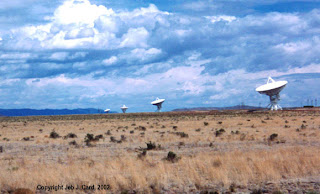
A "mysterious" black, or at least dark, helicopter (Stillings 1989), hovering over the center of the Very Large Array (a not very secret government research facility, located on the Plains of San Agustin in western New Mexico). The helicopter took off, hovered for a few minutes, and landed while I watched. A later visit to the VLA website mentions nothing about a helicopter, crew, or facilities. Secrecy in action?


By the mid and late 1980s, ufologists and others would turn their interest to a secret military facility in central Nevada, referred to as Groom Lake by many insiders, but most famous as Area 51 (Patton 1998). It became a geographical focal point where Cold War paranoia and secrecy, environmental activism, concerns about government overstep, belief in UFO's, and the nascent cyberculture mixed in the 1990s. Glenn Campbell's (aka Psychospy) Desert Rat journal of his activities as an activist at Groom Lake, and the general doings around the site, provide a great historical source for understanding this weird chapter in the history of American distrust of government. A wide variety of stories have grown up in and out of the subculture of Area 51 observers, and several reference the Roswell crash as the seed for alien technology or craft tested and developed at the base. Area 51 doesn’t appear as quickly in Roswell narratives in large part because of the focus on the events in 1947, which predate the establishment of Area 51. The UFO Museum and Research Center has a substantial exhibit on Area 51, but the base does not figure in a major way in most non-cinema versions of the Roswell or other crashed saucer stories. Interestingly, an argument could be made that while these fictional prototypes for Area 51 predate stories about the site, this differs from crashed saucer stories, which typically predate fictional analogs. Area 51 has followed in the footsteps of Roswell in becoming the inspiration for a musical play.

Once a research center is established, the material and crew undergo analysis, which can yield great benefits for society, though in most cases these are hoarded by the secret group in question. A small but persistent thread of ufology links Nazi Germany and flying saucers, and in a couple of crash stories, Nazi scientists are able to study saucers, possibly the origin of many of the German “wonder weapons.” (model below on display at the IUFOMRC).


The concept of reverse engineering to create advanced technology (particularly aircraft) is more commonly applied to the U.S. and Roswell. The most developed version of this thread is Corso’s (1997) The Day After Roswell, within which Corso claims to have been personally responsible for seeding technology from the Roswell crash to defense contractors, and thereby playing a part in the “creation” of nearly every major technological advance in the later 20th century.


Works Cited

Balch, Robert W.
1995 Waiting for the Ships: Disillusionment and the Revitalization of Faith in Bo and Peep's UFO Cult. In The Gods Have Landed: New Religions from Other Worlds, edited by James R. Lewis, pp. 137 - 166. State University of New York Presss, Albany.

Bartholomew, Robert E.
1998 Before Roswell: The Meaning Behind the Crashed-UFO Myth. Skeptical Inquirer, May/June:29-30, 59.

Berliner, Don, and Stanton T. Friedman
1992 Crash At Corona: The U.S. Military Retrieval and Cover-up of a UFO. Marlowe Company, New York.
2004 Crash at Corona: The U.S. Military Retrieval and Cover-up of a UFO. Paraview Special Editions, New York.

Berlitz, Charles, and William L. Moore
1980 The Roswell Incident. Berkeley Books, New York.

Bishop, Greg
2005 Project Beta: The Story of Paul Bennewitz, National Security, and the Creation of a Modern UFO Myth. Paraview Pocket Books, New York.

Bullard, Thomas E.
2000 UFOs: Lost in the Myths. In UFOs and Abductions: Challenging the Borders of Knowledge, edited by David M. Jacobs, pp. 141 - 191. University Press of Kansas, Lawrence.

Cantril, Hadley (With the assistance of Hazel Gaudet & Herta Herzog)
1940 The Invasion from Mars: A Study in the Psychology of Panic (With the complete script of the famous Orson Welles Broadcast). Princeton University Press, Princeton.

Clark, Jerome
1998 The UFO Book: Encyclopedia of the Extraterrestrial. Visible Ink, Detroit.
2000 The Extraterrestrial Hypothesis in the Early UFO Age. In UFOs and Abductions: Challenging the Borders of Knowledge, edited by David M. Jacobs, pp. 122 - 140. University Press of Kansas, Lawrence.

Corso, Philip J., and William J. Birnes
1997 The Day After Roswell. Pocket Books, New York.

Curran, Douglas
2001 In Advance of the Landing: Folk Concepts of Outer Space. Updated and Expanded. Abbeville Press Publishers, New York.

Dean, Jodi
1998 Aliens in America: Conspiracy Cultures from Outerspace to Cyberspace. Cornell University Press, Ithaca.

Denzler, Brenda
2001 The Lure of the Edge: Scientific Passions, Religious Beliefs, and the Pursuit of UFOs. University of California Press, Berkeley.

Dolan, Richard M.
2002 UFOs and the National Security State: Volume 1 - Chronology of a Cover-up 1941-1973. Revised Edition, Hampton Roads, Charlottesville.

Ellwood, Robert S.
1995 UFO Religious Movements. In America's Alternative Religions, edited by Timothy Miller, pp. 393 - 399. SUNY Series in Religious Studies. State University of New York Press, Albany.

Emery, C. Eugene, Jr.
1995 'Alien Autopsy' Show-and-Tell: Long on Tell, Short on Show. Skeptical Inquirer 19(6 November/December):15 - 16, 55.

Festinger, Leon, Henry W. Riecken, and Stanley Schachter
1956 When Prophecy Fails. University of Minnesota Press, Minneapolis.

Friedman, Stanton T.
1992 Crashed Saucers, Majestic-12, and the Debunkers. In UFOs: The Ultimate Mystery of the Millennia (MUFON 1992 International UFO Symposium Proceedings), pp. 68 - 87. Twenty-Third Annual MUFON UFO Sumpoosium. Albuquerque, New Mexico, July 10, 11 & 12.

Fuller, John G.
1966 The Interrupted Journey: Two Lost Hours "Aboard a Flying Saucer." The Dial Press, New York.

Gilmour, Daniel S. (editor)
1969 Final Report of the Scientific Study of Unidentified Flying Objects Conducted by the University of Colorado Under Contract to the United States Air Force. Bantam Books, New York.

Harris, Paola
2000 A Truly "Catholic" Priest, Monsignor Corrado Balducci: Outspoken Supporter of Serious Research on the UFO Phenomenon. UFO Magazine 15(9 October/November):65 - 67.

Jacobs, David M.
2000 The UFO Abduction Controversy in the United States. In UFOs and
Abductions: Challenging the Borders of Knowledge
, edited by David M. Jacobs, pp.
192 - 214. University Press of Kansas, Lawrence.

Kagan, Jeremy
1994 Roswell: The U.F.O. Cover-up. Kyle Maclachlan; Martin Sheen; Dwight Yoakam; Kim Griest. [Film]

Keel, John A.
1991 The Mothman Prophecies. IllumiNet Press, Lilburn, Georgia.

Klass, Philip J.
2000 The New Bogus Majestic-12 Documents. Skeptical Inquirer,
May/June:44-46.

Lewis, James R. (editor)
1995 The Gods Have Landed: New Religions from Other Worlds. State University of New York Press, Albany.

Mack, John E.
2000 How the Alien Abduction Phenomenon Challenges the Boundaries of Our Reality. In UFOs and Abductions: Challenging the Borders of Knowledge, edited by David M. Jacobs, pp. 241 - 261. University Press of Kansas, Lawrence.

McAndrew, James
1997 The Roswell Report: Case Closed. Headquarters United States Air Force, Washington, D.C.

McDermott, Suzanne
1998 The Roswell Incident (song). On McDermott Ephemera (Album). Drexel
Road Music (ASCAP). Available at
http://www.suzannemcdermott.com/recordings.html#roswell

Meehan, Paul
1998 Saucer Movies: A UFOlogical History of the Cinema. The Scarecrow Press, Inc., Lanham, Maryland.

Moseley, James W., and Karl T. Pflock
2002 Shockingly Close to the Truth!: Confessions of a Grave Robbing Ufologist. Prometheus Books, Amherst, New York.

Nickell, Joe
1995 'Alien Autopsy' Hoax. Skeptical Inquirer 19(6 November/December):17-19.

Palmer, Susan Jean
1995 Women in the Raelian Movement: New Religious Experiments in Gender and Authority. In The Gods Have Landed: New Religions from Other Worlds, edited by James R. Lewis, pp. 105 - 135. State University of New York Press, Albany.

Patton, Phil
1998 Dreamland: Travels Inside the Secret World of Roswell and Area 51. Villard, New York.

Peebles, Curtis
1994 Watch the Skies!: A Chronicle of the Flying Saucer Myth. Smithsonian Institution Press. Reprint 1995, Berkley Books, New York, Washington, D. C.

Peterson, Mark Allen
1991 Aliens, Ape Men, and Wacky Savages: The Anthropologist in the Tabloids. Anthropology Today 7(5):4-7.

Randle, Kevin D.
2000 The Roswell Encyclopedia. Quill, New York.

Randle, Kevin D., and Donald R. Schmitt
1991 UFO Crash at Roswell. Avon Books, New York.

Rojcewicz, Peter M.
1987 The "Men in Black" Experience and Tradition: Analogues with the Traditional Devil Hypothesis. Journal of American Folklore 100:148-160.

Saler, Benson, Charles A. Ziegler, and Charles B. Moore
1997 UFO Crash At Roswell: The Genesis of a Modern Myth. Smithsonian Institution Press, Washington.

Saliba, John A.
1995 UFO Contactee Phenomena from a Sociopsychological Perspective: A Review. In The Gods Have Landed: New Religions from Other Worlds, edited by James R. Lewis, pp. 207 - 250. State University of New York Press, Albany.

Scully, Frank
1950 Behind the Flying Saucers. Reprint 1951. Popular Library, New York.

Spielberg, Steven
1977 Close Encounters of the Third Kind. Dell Publishing, New York.

Stillings, Dennis
1989 Helicopters, UFOs, and the Psyche. ReVision 11(4):25-31.

Strieber, Whitley
1989 Majestic. Berkely Books, New York.

Swords, Michael D.
2000 UFOs, the Military, and the Early Cold War Era. In UFOs and Abductions: Challenging the Borders of Knowledge, edited by David M. Jacobs, pp. 82 - 121. University Press of Kansas, Lawrence.

Thomas, David E.
1995 The Roswell Incident and Project Mogul: Scientist Participant Supports Direct Links. Skeptical Inquirer 19(4 July/August):15 - 18.
2001 Retired Air Force Balloon Expert Expands on Origin of 'Majestic 12' UFO Hoax. Skeptical Inquirer, March/April:5 - 6.

Saturday, July 07, 2007

Evolution of the Crashed Saucer Legend, Part 7: The Military Response

If you haven't yet, you should start with the first installment of this article


The Military Response

As part and parcel of crash accounts that involve military radar tracks, a military recovery team leaves soon after the radar-tracked crash, usually at sunup the next day (Berlitz and Moore 1980; Randle and Schmitt 1994). This concept has been present throughout the accounts of the Roswell Incident, especially in relation to a second crash site on the Plains of San Agustin, though it is not limited to those accounts. Typically, the second, more important, crash site with bodies or a saucer is found by the military at the same time or immediately after discovery by engineers, campers, or an archaeological research team. In these accounts, the coverup may already be underway when Brazel informs the Roswell sheriff of his discovery a few days later.

Though not as exciting and action-filled, the narrative thread of the Roswell story concerning Army involvement with the Foster Ranch debris site reported by William “Mac” Brazel is more complex. Most versions agree that soon after Brazel brings debris to Roswell Sheriff Wilcox’s office on July 6, 1947, the military shows up. Specifically, Jesse Marcel accompanies Brazel to his home, stays there overnight, and examines the debris field on the morning of July 7. However, with the exception of the initial July 8, 1947 press release and the 2002 International UFO Museum and Research Center timeline, other accounts of the Roswell story mention that a second military man in plain clothes accompanied Marcel to the debris site. As the Roswell story built steam after 1980, this man was clearly identified as Army counterintelligence agent Sheridan Cavitt. By the early 1990s, this man becomes more anonymous, and is either simply described as a counterintelligence agent (Randle and Schmitt 1991), or as a man in plain clothes (Pflock 1994). The 1994 film Roswell renames him Sherman Carson, but increases his role in the coverup, especially regarding Jesse Marcel. The decreased interest in Cavitt’s specifics may have a lot to do with the fact that Cavitt agreed to describe what he saw in July 1947, and his accounts support the finding of a balloon device, not an extraterrestrial craft, on the Foster Ranch.


The grassroots essence of ufology is reflected in the ample use of personal accounts and affidavits as exhibits in the IUFOMRC.

Relying on Jesse Marcel’s son, Jesse Marcel Jr., as a significant witness, Randle and Schmitt (1991) specifically mention that Marcel brought some of the debris home to show his family in the early morning hours of July 8, 1947. First introduced in 1991, this element plays an important emotional and narrative role in the film Roswell, and has been preserved in the International UFO Museum and Research Center’s presentation in Roswell.

Depending on the discovery of a second site in the particular Roswell narrative, Colonel Blanchard orders a more thorough cleanup of the Foster ranch site and informs his superiors of the debris on either July 7th or July 8th before going on leave. These events are linked to a change in the travel plans of a military inspection group led by Lt. General Nathan F. Twining, who would play a major role in military interest in UFOs in the next few years. The group, including other high-ranking officers, flies to Alamogordo instead of their original planned inspection of a Boeing aircraft on July 7th (Friedman 1992; Randle and Schmitt 1991).

The make up of the gear and personnel of military recovery teams typically include trucks, area lighting for night work, and specialists. The 1973 account of a crashed saucer in Arizona echoes Scully’s informants, specialists flown in to advise on recovery and analysis (Clark 1998:119-141). The 1973 account also foreshadows the stories of specialist transport to Area 51 in the late 1980s, where specialists are flown on private non-descript airplanes, and then loaded onto busses with blacked out windows. In the case of the 1962 Nevada UFO/bolide crash, Project Blue Book flew in its director Lt. Col. Robert Friend and scientific advisor Dr. J. Allen Hynek (Clark 1998:119-141).

In the case of Roswell, the military recovery team becomes more detailed in 1988, as the Majestic documents describe the use of aerial reconnaissance, and by 1991 (Randle and Schmitt 1991) witnesses describe the placement of an MP perimeter to keep out civilians and other unauthorized personnel. The 2002 version of the IUFOMRC website descibes a several day cordon while the site is cleaned up. Few other accounts describe the use of special equipment and biohazard suits as in Corso’s (1997) account.

The debris begins to fly out of New Mexico soon after discovery. Most accounts have some debris flown to Ft. Worth, Texas on July 8 for further analysis, in many cases under armed guard. But Randle and Schmitt (1991) have debris flying out as soon as July 6.


Crash dummy. In 1997, the U.S. Air Force suggested that the recovery of dummies used in testing may have inspired reports of alien bodies (McAndrew 1997). Of course, the IUFOMRC is all to happy to point out that these tests did not begin until several years after 1947.


From the beginning, however, all accounts are unanimous that the U.S. military decides to cover-up the accident, typically to prevent panic ala Orson Welles' 1938 radioplay of War of the Worlds (Cantril 1940), though in some cases looking ahead to the potential for reverse-engineering advanced technology. While fictional accounts of contact between humans and aliens or their material culture utilize more exotic cover-ups such as left-over weapons from WWII (Film Quatermass and the Pit 1967), epidemics (Film 2001: A Space Odyssey 1968), and nerve-gas disasters (Film Close Encounters of the Third Kind 1977), the Roswell story has consistently been laid at the feet of a balloon, first a weather balloon in 1947, and then by the mid-1990s a train of balloons to support audio equipment used in the Mogul spying program. This element first arises in the office of General Ramey in Ft. Worth Texas during a press conference on July 9, 1947. By 1991, it is reasoned that the debris in Ramey’s office was switched with that from a weather balloon, and that Marcel was ordered to lie or stay quiet about this act. In the last few years, there has been some interest in attempts to either find real saucer debris in the pictures from this press conference, or to reconstruct a message on a piece of paper photographed in Ramey’s hand that proves there really was a saucer crash.

Citizens are sworn to secrecy as early as 1973 (Clark 1998:119-141), but beginning with Randle and Schmitt’s 1991 account of the Roswell crash, civilians have been threatened with reprisals from the U.S. military if they don’t keep quiet about what they have seen. Saler, Ziegler, and Moore (1996) go into some detail about the various rank and location changes of an angry red-headed Army officer and his African-American enlisted sidekick. Intimidation in crashed saucer accounts usually comes from military sources, and not the shadowy Men in Black that haunt other parts of UFOland (Keel 1991; Rojcewicz 1987). Concerning the use of violence to enforce the cover up, fictional accounts raced ahead of other versions, such as in the case of the ominous Men in Dark Suits that chase astronauts investigating a crashed UFO in the film Hangar 18 in 1980. William “Mac” Brazel is picked up by the military at some point soon after his July 8th radio interview, and is sequestered by the Army for anywhere from one to three days. During this time, he is allowed to make his July 9th statement that he did not find a flying saucer, and in some versions is bribed with money for a new pickup truck and refrigerator shed on his property (Corso 1997; Randle and Schmitt 1991; Film Roswell 1994).

“Mac” Brazel is not the only civilian cajoled into silence by the military in Roswell. Though many researchers today reject his claims, starting in 1991 (Randle and Schmitt) Roswell mortician Glenn Dennis describes being consulted by Roswell Army Hospital about obtaining four small child-size caskets, and about techniques for preparing a body for storage. When he goes to the Roswell Army Hospital to check on the situation, he is escorted off the premises and physically threatened by military men. Dennis also describes talking to a friend of his the next day, a nurse who witnessed alien bodies in the hospital. Prior to 1991, bodies had been associated with the stories involving archaeological teams on the Plains of San Agustin or near Corona, but Dennis’ story puts them in Roswell itself. The nurse, named Janet, is killed in a military plane crash a short while later. This is another dramatic scene in the film Roswell, though as in the case of the counterintelligence agent, Dennis’ real name is not used and is replaced by a sound alike name (one character attempts to remember the mortician’s name and comes up with several possibilities that sound like Dennis). And despite a lack of confidence about Dennis in the later 1990s by most Roswell researchers, the story is still presented (2002) by the International UFO Museum and Research Center. A very similar tale is retold in Corso (1997), but instead of a mortician, the ejected civilian is plumber Roy Danzer.

Continue to the conclusion, The Aftermath