Showing posts with label magic. Show all posts

Tuesday, June 16, 2015

Great Britain Trip: Part 6 - Investigating Inverness


Great Britain Trip: Part 6 – Investigating Inverness

Two weeks ago I embarked on my first trip to Europe, specifically to Great Britain. This journey had two aspects. First, it is the closest I’ve had to a vacation in at least four years. But honestly, I don’t really do vacation. The primary reason for the trip was to assist several projects I’m working on, including a volume I’m currently writing on why archaeology has the “spooky” image it has in the public imagination.

The following images are not in precise chronological order, though the general narrative does roughly follow the order of places I visited. I spent four days in London at the beginning and another two at the end, and these materials are something of a chronological jumble for thematic purposes. These images are a fraction (specifically, about 7%) of the images I took. Many of these were for research I am not discussing in depth here, or for teaching purposes. The images and text here are instead a rough tour not so much of where I went as why I went, what I learned, and why that might be of interest.

This travelogue is broken into seven sections

Rule Britannia!

Archaeology of Empire

Mysteries of London

Time in Bath

A Green and Magical Land

Investigating Inverness

The Legend of Loch Ness


Investigating Inverness

So far my travels had been based in a single location for several days. Four days in London based out of King’s Cross. Three traveling around from a home base in the Royal Hotel in Bath. But to get in my final goal of visiting Loch Ness and then subsequently preparing for my return flight to the United States, I needed to be a bit more mobile. From here on out, I’d be traveling somewhere different each day. The final day and a half were in London again, one more night in the Bloomsbury area followed by visits to the Natural History Museum and the Victoria and Albert Museum, before going to a hotel near Heathrow for an early morning flight. You’ve seen some of the images from these places, melded with earlier imagery, in my first three posts.

To get to Scotland, I took the bus from Bath to the Bristol airport and flew up to Inverness, which lies between the sea and the Great Glen, the system of lakes and canals of which Loch Ness is the largest.


The heart of the city lies along the River Ness, and already we are into Loch Ness Monster lore. The Irish Saint Columba is said to have invoked the Lord to protect a man being attacked by a fierce beast in the River Ness. After the Loch Ness Monster becomes a sensation in the 1930s, this story becomes relocated into Loch Ness (Nessie promoter Roland Watson has posted images of the text). I’d prefer to think it happened near the spot of today’s Columba Hotel.


The scenery is lovely, and a walking trail encourages visitors to travel along the river and to cross onto the Isle in the River Ness, something I ultimately did not have time to try. It would be a bit farther to the left of this image. 


Some of you have commented on the weather in my images. It has been unusually cold in Great Britain this year. I wore my jacket every day with one exception, the last full day I was there the temperatures reached into the lower 70s. If you look at the mountains in the background of the photo below, you’ll notice their peaks are still snow-capped.


But I had a number of sunny parts of days as my Glastonbury images show. And while the drizzle was a little annoying when visiting the towns of Lacock and Castle Combe, it was perfectly atmospheric when visiting Loch Ness.


I post this image of the Queen's Own Cameron Highlanders monument, located outside the Royal Highland Hotel, less for its quite Scottish imagery, than for the small object next to the soldier, a symbol of service in Egypt.


The Royal Highland Hotel is another one of the grand old railroad hotels. The main lobby was extremely busy when I visited, and was decked out with the classic lodge-style accoutrements of historical documents and artifacts, taxidermy, wood-paneling, and so on. 


The main stairway dominates the space.


I wandered around Inverness a bit, taking in its celebrated Victorian covered market, strolling along the river, and being desperately tempted by a store full of incredibly beautiful and very expensive Harris Tweed (it may be a bit of a professorial cliché, but I could have dropped half the trip’s cost right then and there). But the business pictured above, sadly closed, seemed worth pointing out. The writing does not say kakaw but is the title “Holy Lady of Kaan”, one of the most powerful states of the Classic Maya Lowlands, so I imagine it was chosen more for aesthetic reasons.


I spent part of an afternoon in the Inverness museum, which had a surprisingly strong exhibit section on archaeology. In fact, there was quite a lot of archaeology being promoted in Scotland, with flyers advertising public archaeology of all sorts throughout the summer. Unlike the exhibits in London, these are extremely local, focused entirely on Scottish or even more local finds. They were also presented as part of a linear national history, and the oft-mentioned connection between nationalist movements and archaeology suddenly clicked into my mind in light of recent political developments. 


Notably the signage in the museum was bilingual. I saw books and courses elsewhere in Inverness urging people to learn Scottish.


All sorts of archaeological exhibits were presented, but a set of Pictish inscribed stone slabs was the heart of the archaeological section. Some depict more naturalistic scenes such as the wolf above. Others are more abstract and complex compositions that have led some commentators to compare them to writing, though not all agree with this assessment. Ogham writing was also used at times in pre-medieval Scotland.


Many of the artifacts on display were iconically Scottish and associated in more than a few cases with nationalism and military struggle.


A display on early pipes, including their design, was a must


However, most relevant for my work was an unexpected section on myths and legends


The woodcut at the top depicts a case I talk about in class, the witch-fixation of James I. The Scottish King who would come to sit on the English throne, was obsessed with witches, and personally took part in witch-hunting. In addition to any other religious or scholarly interests (this is the same King James of Bible fame), witches were feared to have conspired against the king, including trying to disrupt the arrival of his wife from Scandinavia (as depicted in the woodcut). A recent National Trust conservation of a house that James I stayed in turned up possible apotropaic marks on timbers in the floorboards, possibly to protect the king from witchcraft and conspiracy in the wake of the Gunpowder Plot. This Scottish king and his concern with witches was much of the inspiration for Macbeth.


The folklore exhibit somewhat sidewise addresses the Loch Ness Monster by briefly mentioning both the supernatural kelpie entity later conflated (poorly) with the monster, and the Columba legend I previously mentioned. 


As in the British Museum, an ancient artifact later believed to be a supernatural “elf hede” arrow was on display.


Other magical objects included a spindle whorl worn against the Evil Eye.


While the only mention of the Loch Ness Monster in the museum proper was the Kelpie and the Columba story, not far away the Inverness tourism information center had a huge paper mache Nessie and many Nessie icons.


Likewise the gift stores in town were full of stuffed Nessies, as well as bits of tartan-inspired objects and Braveheart-esque William Wallace statues. Even in Inverness, the icon of the Loch Ness Monster was very much on offer. I wasn’t certain what to expect the following day in Drumnadrochit, the heart of the Loch Ness Monster phenomenon.

I spent the evening drinking with tourists and locals alike in Hootnanny, considered the best Scottish Music place in town, and certainly the busiest place I saw in downtown Inverness that evening. It was easy to see, that far north in June, the sun didn’t go down until nearly 11, and light began to creep into my hotel room around 4 in the morning. So it was easy enough to get up early, put on my monster hunting trousers, and move on to Loch Ness.

Sunday, June 14, 2015

Great Britain Trip: Part 4 - Time in Bath


Great Britain Trip: Part 4 – Time in Bath

Two weeks ago I embarked on my first trip to Europe, specifically to Great Britain. This journey had two aspects. First, it is the closest I’ve had to a vacation in at least four years. But honestly, I don’t really do vacation. The primary reason for the trip was to assist several projects I’m working on, including a volume I’m currently writing on why archaeology has the “spooky” image it has in the public imagination.

The following images are not in precise chronological order, though the general narrative does roughly follow the order of places I visited. I spent four days in London at the beginning and another two at the end, and these materials are something of a chronological jumble for thematic purposes. These images are a fraction (specifically, about 7%) of the images I took. Many of these were for research I am not discussing in depth here, or for teaching purposes. The images and text here are instead a rough tour not so much of where I went as why I went, what I learned, and why that might be of interest.

This travelogue is broken into seven sections

Rule Britannia!

Archaeology of Empire

Mysteries of London

Time in Bath

A Green and Magical Land

Investigating Inverness

The Legend of Loch Ness


Time in Bath

I had initially intended to write about some of the archival work I conducted in London, but I’ve ultimately realized I’ll leave this to my publications. I will briefly discuss some of this below before moving on to Bath.

Both the British Library and the National Archives were extremely efficient and helpful in both registering me as a reader, and getting me the resources I needed. The British Library has a lovely atmosphere, full of extremely nerdy people all over the grounds. It is a bit over-shadowed as it lies to the west of St. Pancras station and the hotel-structure I presented in the first post.


The National Archives is out in Kew, a bit under an hour on the tube from King’s Cross. The surrounding neighborhood is a mix of Kew Gardens and lovely urban/suburban residences, while the Archives themselves vaguely resemble Starfleet Academy.

Also somewhat in the vein of archival research, I got a glimpse of some of the Italian Renaissance majolica ceramic vessels that came to dominate my doctoral and post-doctoral research. I would love to go back and examine these vessels first hand to expand and refine my comparative work in Latin America.


If you know my research, you’ll understand the following image


After four days in London, it was time to move on to Bath, about an hour and a half by train to the west of London, a bit southeast of Bristol. The city is a World Heritage site for its archaeological and architectural legacy. For my purposes, it was also fairly well situated for the next two days of travels to the megaliths around Salisbury and to Glastonbury and then flying on to Scotland out of the Bristol airport.

I left King’s Cross for the outbound trains of Paddington Station. Even after four days of heavily using the Underground and related London trains, the romantic overtones of a major train station were present for me as I waited and ate a bit of sausage on a roll that made up brunch.

Once out of London, the English countryside was closer to the stereotypes and storybook images than I had imagined. Canal boats, beautifully maintained cottages and houses, country lanes, all were present. The rolling hills and rural flora weren’t too different from my years living and working in the Northeastern US, but the cultural pattern was far closer to traditional idealized imagery than I had expected. The equivalent might be if one visited Massachusetts and every small town looked like Marblehead, or if all of Arizona looked like movie versions of Old West Tombstone.

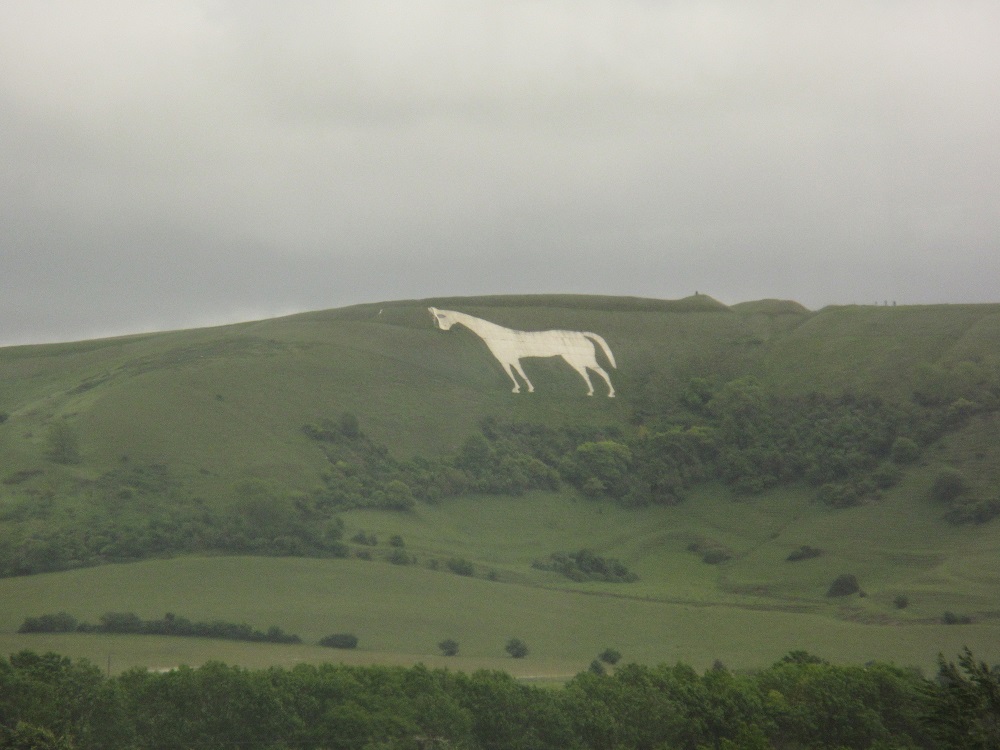
 I roused out of pleasantly watching the landscape slide by when I spotted something on a hillside in the distance. The unexpected appearance struck me like a thunderbolt.


It was one of the White Horses, specifically the Cherhill White Horse. The oldest of the White Horses of England is the Uffington Horse, which may date back to the Bronze Age in design but is regularly cleaned and repaired by digging into the chalk subsoil. The Cherhill White Horse was soon joined by another, the Westbury White Horse. 


These geoglyphs may have some antiquity to them, but in their current forms they are better thought of as follies, purposely romantic and archaic attempts to re-enchant the landscape in the Early Modern and industrial eras. Though these horses are “only” a few centuries old, their reference of the Uffington Horse and the Cerne Abbas Giant meant I had begun to enter the gateway into the purposely ancient landscape of antiquarianism, folklore, and tradition. This theme, which we have already encountered, is important to the larger journey.


Bath is beautiful, and I understand its designation as a World Heritage site. The city has been a mecca for visitors since Roman times when the city was Aquae Sulis. More recently, it benefited from first the canal system and then the railroads. There are a number of residents living in canal boats in Bath, not far from the Pulteney Bridge above, which holds a number of cafes and shops. For reference, the bridge is contemporary with the beginning of the American Revolution, or the destruction by earthquake of Antigua, Guatemala.


I stayed in the lovely Royal Hotel, right across the street from the rail station. This made sense of course, for as I pleasantly discovered, the hotel had been designed by Brunel himself, Britain's great engineering genius (and also one of my favorite characters in the steampunkish comic The Thrilling Adventures of Lovelace and Babbage). 


Bath is still a tourist town, where visitors come to relax and refresh themselves in the ancient spa waters as well as bathe themselves in the ancient and recent history. The connection with Jane Austen’s life and writings is strong and a major focus of the tourism industry. The city is also a cultural center with theaters, galleries, and a university, adding an eclectic student and artist vibe to the ancient center. 


Most striking is the gorgeous Georgian architecture, of which there can be no finer example than the Royal Crescent on the northeastern edge of town


The scope of the place, almost all private housing today, cannot be done justice, by my pictures at least.

The center of the city is still the Roman baths, today a major archaeological tourism attraction. I was struck once again by how commonplace the notion of archaeology is in the United Kingdom, a theme I will return to when I discuss Inverness. 


The heart of the Roman Baths is a mélange of original architecture and Victorian embellishment


The striking Roman statues are a pure Victorian invention, with governors and emperors depicted who were considered to have had important ties to Britain, as well as a depiction of Roma, the spirit of Rome. The baths are in essence lined with a Victorian equivalent of Disneyland’s Hall of Presidents except the recent images have taken on a faux antiquity of their own. The statue depicted below is a Victorian archaized image of governor Publius Ostorius Scapula.


The hot springs were the heart of the Roman settlement, and one can get a drink of the waters at the end of the museum (complete with a detailed statement of the mineral contents and how safe the water is to drink in which quantities)


But the history of archaeology at the site allows for a detailed examination of ancient Romano-British life within the complex facilities of the baths and the nearby temple, as well as in the larger community of Aquae Sulis.


One of the archaeological discoveries in Bath that contributes to the site’s World Heritage status is the collection of curse tablets. These objects are simultaneously exotic and mundane. They could easily be mentioned in my previous post on the esoteric in archaeological museums as they are indeed magical curses. 


On the other hand, the everyday grievances that deserved supernatural punishment are quite recognizable, most being the theft of personal items.


Watching over all of this from the temple would have been the symbol of the Roman Baths today, the Gorgon head.


Discussion of this image is complex, but it may be syncretic, blending a local British water god or spirit with Classical ideology and iconography such as of Oceanus. A Gorgon’s head is likewise worn by an image of Minerva, also found in Bath.


The baths are predominantly presented as a Roman settlement, but the enduring aspect is difficult to ignore. In the main hall, architectural remnants of the 12th century transformation into the King’s Baths are visible, as are seats and statues added in the 17th century in keeping with the legend of the necromancy-favoring King Bladud.


The Pump Room, a center of high social life (made famous by Jane Austen), was added above the baths in the 18th century, delivering us into the Georgian period still dominating the surface. And above it all looms the abbey.


The layers of the past, and the re-creation of an idealized past to serve the present, will continue in the next post on the imagined British countryside of myth and magic.

One last note: the ever-presence of cider made me very happy. 


Not everything I ate was fish and chips and cider, though that was a significant part of my diet. I sadly did not get pictures (though this one is pretty close to my experience) when I ate my final dinner in Bath at Yak Yeti Yak, a Nepalese restaurant decked out with many symbols of Nepal including religious objects, woodwork, a kukri knife and yes, Yeti footprints.

Thursday, September 15, 2011

Why Skepticism is So Important: The anti-Muslim FBI CounterTerrorist Expert and the Satanic Panic


Matteson-jacobs


UPDATE 5-10-12: It's even worse than you thought

A recent revelation of anti-Muslim FBI counterterrorism training suggests disturbing parallels to previous panics, including the Satanic Panic of the 1980s.

Wired Magazine is running an expose on counter-intelligence training within the FBI that trains agents that, I'll quote the Wired piece


"“main stream” [sic] American Muslims are likely to be terrorist sympathizers; that the Prophet Mohammed was a “cult leader”; and that the Islamic practice of giving charity is no more than a “funding mechanism for combat.”
At the Bureau’s training ground in Quantico, Virginia, agents are shown a chart contending that the more “devout” a Muslim, the more likely he is to be “violent.” Those destructive tendencies cannot be reversed, an FBI instructional presentation adds: “Any war against non-believers is justified” under Muslim law; a “moderating process cannot happen if the Koran continues to be regarded as the unalterable word of Allah.”
These are excerpts from dozens of pages of recent FBI training material on Islam that Danger Room has acquired. In them, the Constitutionally protected religious faith of millions of Americans is portrayed as an indicator of terrorist activity."

The author of the training briefings is William Gawthrop, a faculty member at American Military University, a for-profit university focused on military and law enforcement issues, aiming its recruitment especially at veterans. Gawthrop, prior to the Wired piece, was an expert on Islamic law and war for WorldNetDaily, a far-right website known for calls and dreams for secession and "civilian uprising" by actor Chuck Norris and singer Pat Boone, but more recently for being the center of "birther" conspiracy theories that claimed U.S. President Barack Obama was not born in the United States or otherwise is not a natural citizen.

This pattern should be very familiar to anyone who paid attention to the havoc wreaked by the Satanic Panic a generation ago. In the 1960s, foreign and new religions were recognized and gained ground in the United States, including the Church of Satan, driven by charismatic showman and entertainer Anton LaVey. But starting in the late 1960s and throughout the 1970s, a few of these new religions, or cults as their detractors called them, met disastrous ends. The Manson family and its infamous murders was not a religious movement, but was lumped in due to its cultish structure and nature. The nadir of all of this was the Jonestown murders and massacre in which 918 people were either killed or committed suicide in the self-destruction of the People's Temple after the murder of a fact-finding mission led by a U.S. Congressman.

Jonestown became the bedrock of the anti-cult movement. While the movement was already underway, the Jonestown horror gave it much more credibility. As a result, throughout the 1980s especially, the myth of a grand Satanic Conspiracy thrived in American culture. It was a popular theme in movies and television, and it wasn't hard to find media with scenes of ritual human sacrifices by robed cultists. Satanic-themed entertainment had already been popular with movies like The Exorcist, Rosemary's Baby, or The Omen, but the trope became commonplace. Satanists became the first explanation for rumor panics of "cattle mutilations" in the American Plains and West, until UFOs became a more popular explanation. The most public and most ridiculed component of this was the campaign against Dungeons and Dragons (let us all remember to mourn Black Leaf) and against heavy metal music, both products of 1970s pop culture that incorporated elements of fantasy and demonic imagery, just as did the previously mentioned films and television shows. However, because these were media aimed primarily at teenagers, they were seen as particular threats.

But the Satanic Panic also intersected at times with law enforcement. You can explore the extensive wiki page as a start on the topic, but people were investigated, accused, and tried for crimes based on what turned out to be faulty or misleading coaching of witnesses, in some cases alleging vast mass murders and other crimes that were simply physically impossible, and would leave overwhelming physical evidence where none existed. These investigations were at times prompted either directly or as part of a general atmosphere encouraged by "anti-cult experts" that would give instructional briefings to law enforcement, educators, and other authority figures. While not in all cases, in quite a few these experts were heavily invested as activists of a fundamentalist Christianity that was on the rise starting in the 1970s. And some of their "expert advice" reflected this, while other advice was simply silly (infamously telling parents or educators that graph paper [for Dungeons & Dragons maps] and mirrors were signs of Satanic ritual magic on the part of their children or students). I've blogged about this before as a form of "folk archaeology."

The Satanic Panic isn't old news either, at least not entirely. It made headlines again in a different way, with the release of the West Memphis Three. Likewise, such allegations have become involved in the prosecutions in the Meredith Kercher murder case, better known by the name of the woman convicted for the crime, Amanda Knox, who like the West Memphis Three has attracted considerable international support by people who doubt the case against her.

The revelation of the FBI briefing authored by Gawthrop reminds me strongly of some of the "anti-cult expertise" offered to law enforcement during the Satanic Panic. I don't know Gawthrop's religious background, but it is hard to miss the zealotry against Islam, while praising Judaism and Christianity (Gawthrop even provides a graph!).

But a bigger pattern is present. In both cases, horrific criminal acts including mass murder provide credibility to "experts" who instead push religious or political issues. The horror of these mass casualty events, as well as smaller but more gruesome events associated with the larger threat, is a powerful influence on people who might otherwise rationally dismiss some of the more absurdist ideology coming from these "experts." Further, by pointing at the wrong targets, these "experts" get to attack those people and communities they don't like, but actually cloud and damage real efforts to deal realistically with threats. Was training like Gawthrop's responsible for the detention, interrogation, and strip searching of Shoshana Hebshi this last weekend, along with other unnamed people, all of whom were either from southern or southwest Asia, or had genetic heritage as such, and committed no crimes nor ultimately were found to be at all suspicious?

The pattern of rumor panics is a familiar one. It's no accident that Arthur Miller was able to find such easily parallels between McCarthyite anti-communism and the Salem Witch Trials of 1692. In the case of McCarthyism, in addition to the general Cold War fears, that war had recently turned hot in Korea. It has been suggested that the Salem trials may have been nursed by anxiety stemming from recent bloody wars with Native Americans, wars that had not gone well and were considered incompetent or failed by the populace. The witch trials may have been an expression of powerlessness, fear, and anger over failure.

I visited Salem this summer, a weird tourism experience to say the least. But in the more serious moments, the tragedy does come through, and reminds us that just because something horrible is happened, we shouldn't just listen to whoever gives us the most lurid and enticing take on the matter, one that we can deploy against the innocent when we can't lash out against real threats.

So I'll leave this with part of the memorial to the victims of the Salem trials

Monday, October 04, 2010

Fantasies of Control: Government and Supernatural Fears

Image by RadioKirik (Wikicommons)


A recent news item, and two book releases concerning UFOs and the US government, got me thinking about the concept of government reaction to claims of the paranormal.

According to a recent Freedom of Information disclosure from the Dyfed Powys police in Wales, UK. In the past five years, they've dealt with 86 calls concerning witches, as well as
"one call about a werewolf, seven about vampires, 19 about UFOs, 13 about big cats, 73 reports of ghosts, 16 of zombies, 35 of demons, five regarding big foot sightings, 33 of monsters and 18 about wizards"

One of the more cliched ideas in fantastical fiction is that of the government agency that polices the supernatural. While there are more fantastical examples in fiction, the most cliched version boils down to a secret organization, with an odd number or acronym in its name, that investigates and eliminates paranormal threats, often containing them in some fashion. I don't know what the earliest version of the concept is in either folklore or fiction, but by the 1980s it had already become something of a humerous trope (warning: link to addictive tvtropes site, where they call this is some variation on the Extranormal Institute and its subtype Secret Government Warehouse). Current examples include the MiB in the Men in Black Films, Warehouse 13 and Fringe on television, the B.P.R.D in comics, X-Com and Delta Green
in games, and amongst plenty of examples in print, Charles Stross' "The Laundry" (such as his recent The Fuller Memorandum).


More intriguing are the two sorts of groups that appear in both folklore and reporting in the real world. The UFO world in particular has had an obsession with government conspiracies and secret organizations for decades, crystallizing in the form of the Majestic documents, discredited in the eyes of many within and without of ufology. The original documents describe a high-level, shadow-cabinet of sorts, set up after various flying saucer crashes in the 1940s and early 1950s, but subsequent documents include operations manuals and other suggestions of active operations. The operations of Project Moon Dust and other government agencies (US and otherwise) to retrieve objects fallen from space have been brought into the larger UFO mythology. Such efforts, aimed at collecting and exploiting foreign military and aerospace technology, have been enmeshed into Majestic and other ufolore. Paranormal researcher Christopher O'Brien has suggested government or other secret special forces-style occult teams as explaining part of the patterns he finds in cattle mutilations, as he discusses with Greg Bishop on the podcast Radio Misterioso in January 2005. Like something out of the B.P.R.D., he suggests that copycat cattle mutilations may be rituals by such a group to counteract the activities of possibly non-human entities, ultramodern blood sacrifices to deal with ultraterrestrials, if you will.

As exciting as these ideas are, more documented paranormal task forces within government seem to be much less proactive, or active at all. The fall into one of two categories.

The first are those willing to use paranormal beliefs as psychological and propaganda weapons. Legends and supernatural beliefs, most famously Filipino vampire myth, have been used in combat, with mixed success. The CIA thought flying saucers made a great human interest story to flood the Guatemalan papers when their plans for a coup had been exposed, and also were happy for some UFO reports to continue when they were actually sightings of the U-2 and other spy planes (the Soviets made similar efforts regarding space launches). Mark Pilkington's recent book Mirage Men: An Adventure into Paranoia, Espionage, Psychological Warfare, and UFOs suggests that much of the UFO phenomenon can actually be chalked up to such intelligence activities. I have not read this book and cannot evaluate its claims. Arguably Project Bluebook would fall into this category. The very public US Air Force project was in reality a small operation based out of Ohio, and while it did occasionally conduct field investigations of UFO sightings, such as the Socorro, New Mexico landing or the Kelly-Hopkinsville goblin siege, scientific advisor J. Allen Hynek and others have made it clear that the office was primarily an effort to minimize public concerns and interest in UFOs, in keeping with the recommendations of the Robertson Panel.

The second type is intriguingly close to the fictional and more impressive folkloric concepts. Harold Blum's Out There: The Government's Secret Quest for Extraterrestrials suggested back in 1992 that there was an informal UFO study group composed of officers of the intelligence and military communities. Blum's findings would eventually be echoed by the work of Jon Ronson and others culminating in The Men Who Stare at Goats, including some of the same individuals and groups, as well as the release of information on Project Stargate, the CIA psychic/remote viewing project. Despite plenty of myth-making all around, there was clearly at least one set of officers within the military and intelligence establishment that pursued paranormal interests and studies. Similar projects have been declassified by the British Ministry of Defense.

So it is with both interest and skepticism that I mention the most recent high profile claim of an intra-governmental paranormal study and action group. Nick Redfern chronicles (I have listened to and read several discussions of Mr. Redfern's findings, including some on his blog for this book, but not the book itself) in FINAL EVENTS and the Secret Government Group on Demonic UFOs and the Afterlife the tale of a loose group that became convinced that UFOs are actually demonic in nature, and that the transformation of American society to a Christian fundamentalist culture is necessary to defend against these forces. This belief is persistent amongst a subset of UFO followers, and I believe it is growing. Given the public resurgence of the Christian right in recent years, and especially in the training and top-level conduct of the military and government, the concept is controversial but timely. I would like to see some of the evidence that such a group might exist, but its existence is eminently plausible. Just as eastern religious ideas influenced the individuals described in The Men Who Stare at Goats, we would expect more radical Christian ideas to be reflected by some in the power establishment, no matter what you think of those ideas.

All of these groups and efforts, real or imagined, are about control. A classic skeptical critique of conspiracy theory is that people unable to accept that an unruly world is chaotic, imagine secret controlling factions, placing events in someone's hands (even if they are sinister hands), belieinv that someone is in control. While I am a skeptic, I've never liked that idea much, it doesn't make a lot of sense either logically or from experience. Sure, we might feel more comforted if we believe that in the case of catastrophe, say an asteroid impact, that there is some super-secret organization which will spring into action and save us. But I don't see how belief in all-powerful conspiracies controlling the world to the detriment of the believer and society is terribly comforting. Instead, in many cases it seems, in my experience, that belief in a powerful evil conspiracy allows for belief in a powerful counterforce. The New World Order/Satan will rouse good patriots or Christians to battle in a final war and be victorious. Moral decay and oppression acts as a backdrop for enlightened consciousness and transformation into a New Age. This perhaps is comforting, not in imagining control in the hands of a conspiracy, but instead providing the believer with an enemy to fight, something to focus angst upon rather than ill-defined unease.

In the cases of psychological warfare and propaganda, control is the obvious goal. Here, the right words or symbols, including powerfully charged supernatural symbols, are hoped to magically bend a population's or an enemy's will, without the application of brute force physical violence. A push button society, controllable through manipulation, is a technocratic dream of the modern era, by the intelligence officer and the ad man alike.

And lastly, in the case of government paranormal action groups, control is indeed sought over an unruly world. The UFO phenomenon is believed to be maddeningly chaotic to many who study it, to the point that the "trickster" concept from anthropology and mythology has become a popular buzzword in the community. Likewise, parapsychology has a long history of fitful starts and stops, vague and problematic findings and methods, and lack of scientific progress. Individuals feeling as such, but with organizational power at their fingertips, have a tool to possibly control some of that chaos. On the other hand, such beliefs can be a key to understanding and controlling the logic of a chaotic world. Projects like Stargate, the remote viewing effort of the CIA, are shortcuts to hopefully better results than those obtained through traditional intelligence work.