Showing posts with label media. Show all posts

Saturday, June 24, 2017

UFOs are Dead, Flying Saucers Will Live Long
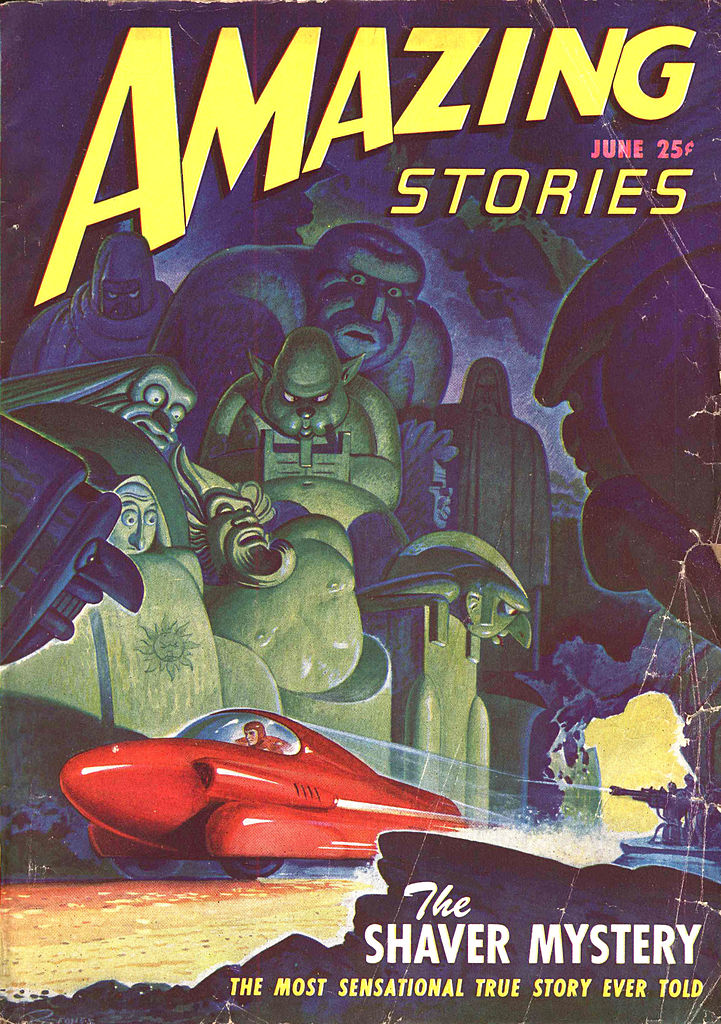


Amazing Stories, June 1947


Saturday will be the 70th anniversary of the Kenneth Arnold "Flying Saucers Sighting". The famous 24 June 1947 sighting is the traditional "beginning" of the Flying Saucer, kicking off a two-week craze that concluded with the Roswell Incident in July 1947.


But this wasn't the beginning of the UFO. EDIT 4 July 2017: Almost forty years ago Peter Rogerson made the same point I'm making here about UFOs vs. Flying Saucers, though as you'll read, I think the time in-between has been less than kind to the UFO. Nonetheless, I want to point this out, especially in the off-chance I read Rogerson's essay some time ago and forgot I had. I was reminded of this in an interesting review by Rogerson of a recent "estimate of the situation".

The UFO, the Unidentified Flying Object, emerged out of genuine official interest by US military institutions in the reports of things seen moving through the sky. Within a few years, institutional interest seems to have largely receded to keeping a UFO desk or project that had as much to do with public relations and institutional thoroughness as anything else. 

Watching the Skies near the end of the Second World War

The UFO, and cryptozoology, and other forms of "alternative" science, or as detractors would put it, pseudoscience, also emerged out of high social status for science and scientists in the wake of massive technological and social change from the industrial revolution, and especially the dramatic technological and scientific leaps made around the period of the Second World War.


 The social value of science, and the previously un-imagined discoveries made by scientists especially starting in the 19th century, made it sensible that analysis of evidence, using science (or activities that resembled science) could reveal amazing things.

Plotting Flying Objects over Britain during the Second World War. Is this the model for the UFO sightings database?

Over time, the UFO came to be largely, though not exclusively associated with the Space Age, extraterrestrials, and searching for evidence of these strange craft and their occupants. The stereotype of the serious ufologist involves collecting reports for databases, creating sightings maps to detect geographical or temporal patterns, looking for commonalities, piecing together puzzles.

Amazing Stories, December 1945

The flying saucer is another matter entirely. Kenneth Arnold and others in the crucial period of the flying saucer of the mid-to-late 1940s were in no small part in the orbit of Ray Palmer (you can read FBI reports into Palmer's involvement in early flying saucers and his publishing here), champion of the Shaver Mysteries. Shaver's stories, edited by Palmer, have roots in pulp fiction and earlier alternative religious influences including Theosophy and Oahspe. The foundations of the flying saucer community were laid among occult and science fiction enthusiasts of the 1940s, and it is unsurprising that the flying saucer first took root in the 1950s in science fiction films and among the Contactees and their transparent relationship to previous new and alternative religious movements.


The UFO, an acronym suitable for the Big Science of powerful government and military institutions of the 1950s, inherently begs for trace evidence, analysis of the situation, collation of reports. While one can still find this style in ufology, it is dying on the vine. This is expressed well in two essays by Vicente-Juan Ballester Olmos and Thomas Bullard, both musing on the 70th anniversary. While Ballester Olmos, keeper of a photographic database to collate evidence, is very pessimistic, Bullard the folklorist is only mostly pessimistic, hoping that among the dross and dashed hopes there may still be a non-mundane phenomenon at the core of the UFO mystery.
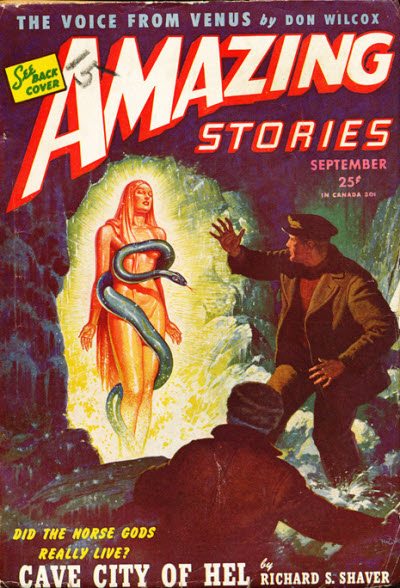


However, most of what is associated with the UFO, or rather the flying saucer, is now conspiracy theory. One can argue that much of conspiracy theory can trace its massive cultural popularity to the UFO. Conspiracy and paranoia are the very bones of the flying saucer. One important ancestor of the flying saucer, and other elements of 20th century pulp fiction and occultism is Edward Bulwer-Lytton's 1871 novel The Coming Race. The children and grandchildren of this tale of an ancient underground master race with psychical powers and menace towards the surface are many, including the Shaver Mysteries. Shaver's writings are of nearly all-powerful Deros causing no end of misery through their invisible stalking and influence on surface dwellers. Their resemblance to much of conspiracy theory and mysticism surrounding the paranormal and UFOs today is profound. Pulp fiction also interjected the Reptilians into the Shaver and Flying Saucer community by the late 1940s. And while the Contactees often preached positive messages in the style of earlier decades theosophical ascended masters, there were also dark warnings of evil forces that would silence such wisdom.
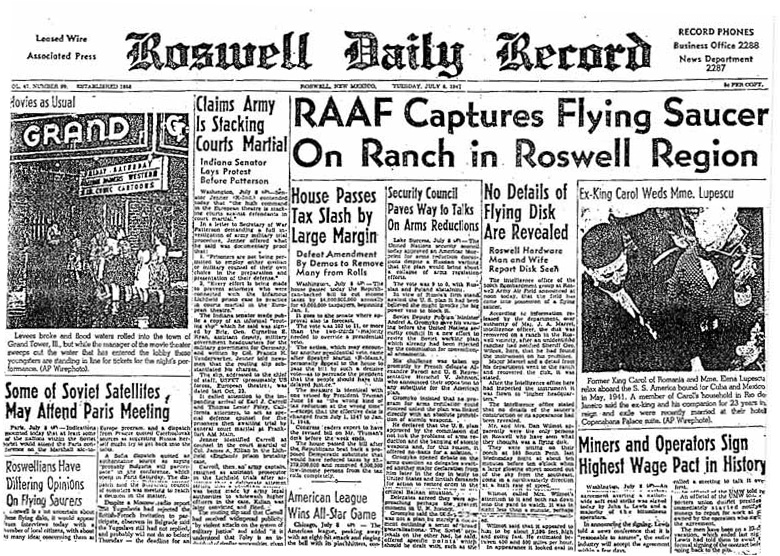


Conspiracy and coverup were constituent to ufology, including with influential early leader Donald Keyhoe. Self-proclaimed serious or scientific ufology until the 1980s was largely about moving towards analysis and away from mysticism on the one hand, and conspiracy fears on the other, though this proved impossible. In previous posts on this blog, and in podcasts, I've discussed the importance of the Roswell myth in strengthening a bond between conspiracy theory and mainstream ufology.


Today, if one looks about the UFO community and its media, one finds two basic styles have supplanted the sightings trackers and account analysts. One is disclosure and expolitics, a focus on government and institutional conspiracy, promises that all will soon be revealed or leaked, and of breakaway civilizations and hidden shadow governments. A rotating cast of characters and tropes promotes or sells the idea that long-suspected truths are being hidden by illegitimate authorities and institutions, and that the imminent revelation of these truths will end the inequities of the modern day and bring about a better future.


The other is focused on ancient evidence for alien or extradimensional origins of humanity, often with a focus on origin myth or  religion in one form or another. Though most prominent through various cable television programs, this element as has eclipsed every other aspect of interest in "UFOs", which seem almost an afterthought. One can easily go from dubious remains of a Roswell crash victim (actually indigenous remains in a museum) to dubious remains of an ancient alien hybrid without changing the roster. A rotating cast of characters and tropes promotes or sells the idea that long-suspected truths are being hidden by illegitimate authorities and institutions, and that the imminent revelation of these truths will end the inequities of the modern day and bring about a better future.


These are not mutually exclusive. Alleged modern conspiracies become new manifestations of ancient magical secret societies, shadow governments hide ancient inhuman bloodlines.They unite into an all pervasive Lovecraftian paranoia of deep secrets and debased cults. Last year, conspiracy theories about evil cults were fashioned out of leaked political emails, and a man was just sentenced to prison for responding violently. Yet one reason these resonated so well in the conspiracy theory world is that the stolen emails came from a long-time UFO disclosure advocate, paralleling a huge amount of chatter and speculation that UFO disclosure would hinge on the US presidential election.

The most viable alternatives in small pockets of the UFO community are hopes that the UFO can show the way to better understandings of the inner self and consciousness, that UFOs are something like poltergeists or Victorian elementals, soon to be erroneously conglomerated with descriptions of tulpas.

In other words, the flying saucers are once again just one manifestation of the underground Deros. Of the Great Old Ones. Of the Coming Race. Ancient wisdom, lost history, hidden cults, subterranean horrors, psychical manifestations.

The investigation of the UFO mirrored the rise of science's social status. It's fall, and the return of ascended masters, psychical entities, and lost races makes perfect sense in an era of partisan attacks on science and neo-Victorian political and social conditions.

The UFO is dead, the flying saucers have returned.

Saturday, June 30, 2012

Chasing UFOs - The Review


UPDATE: Dr. Ben McGee has shown up in the comments below, directing you to a series of blog posts he has begun, explaining more about each episode and musing on some of the topics touched on the episode. They are worth reading, and I'd advise you to check them out. At the same time, my criticisms of the final product still stand.

Dr. McGee's followup 1
Dr. McGee's followup 2

The new National Geographic show (oh, how the mighty have fallen) Chasing UFOs can be boiled down to one word: Childish.

It isn't even unintentionally amusing (a justification I've heard for watching Finding Bigfoot), it is embarrassing and awkward. The core of the show is three adults play-acting out spooky adventures in a manner similar to how children might play cops and robbers, or at best like teenagers legend-tripping (with the payoff being getting paid to work on television and building a promotional base, rather than stumbling around in the dark with your freshman high school crush).

You see the trailer at the top of this post? Where our heroes chase a UFO on foot? It makes more sense than the actual show does. Our team goes searching for soil samples and bits of residue or debris or radiation - at night.

Again, I want you think about it. Searching for small geological or metal fragments. In the dark. When you don't have to. That's the plan. Here, let me illustrate.


There really isn't much more to say about it (in the first two episodes, the team stumbled around Texas searching for the Stephenville UFO that was there four years ago, and then go to California to look for triangular UFOs and underground bases).Our heroes alternate between boring conversations with witnesses and UFO enthusiasts they don't really listen to or critically assess, and boring "scared" dialogue as they sneak around various properties in the dark. And they use lots of gear (so much so that National Geographic has a list for you, I'm amazed the link didn't take me to an online store).

The two male investigators are supposed to be the opposite ends of the belief spectrum, the documentary-making ufologist James Fox, and radiation expert and xenoarchaeologist Ben McGee (while this concept can exist in a hypothetical sense, its presence here seems to have more to do with the continuing issue of how easy it is for anyone to claim to be an archaeologist EDIT: I'll leave this link up as it is related, but this particular blog post does not really cover that topic, I'm confusing it with a recent presentation I co-wrote). But from what I can vaguely remember (honestly, if you gave this show your undivided attention, especially both episodes, please for the sake of humanity find ways to motivate yourself to become a better person), in practice they were virtually indistinguishable in behavior. McGee is the skeptic, and in an interview talks about this as a form of education outreach. I can't really see how running around in the dark poorly imitating the idea of geological or archaeological research is public educational outreach. This leaves Erin Ryder, the tech expert, who from what I can gather is the star of the show not just by being female for what I'm guessing is an expected majority male audience, but also as a veteran of another "run around in the dark and make a mockery of the idea of investigation" show, Destination Truth.

That said, if you are a fancier of tactical vests (apparently an integral part of scientific investigation), this show may be relevant to your interests.

Tuesday, January 03, 2012

"Finding Bigfoot" ... in 2 1/2 minutes

So, I can now say I've seen "Finding Bigfoot," thankfully edited down by VoodooSix (or however they spell their name) The section from 1:16-1:32 is completely awesome

Thursday, December 01, 2011

Places Where Bigfoot Might be Hiding: The Internet

Because apparently it is a poorly explored place.

Bigfoot blog finds amazing article on translation of ancient texts discussing 10th century communication between Chinese Imperial scholars and Yeti.

Blog post actually links to the original source

But apparently, this, and the name of the author (Tim Pulju) was not sufficient to show that the source is in fact, a satirical publication, a The Onion for linguistics.

I mean, that would require looking to the fourth-down return if you google "Tim Pulju"

To be fair, many of the comments on that blog post guess that it is likely satire but others suggested it could be a real journal article,or some sort of misunderstanding. While I approve that some were able to recognize the satire, that no one even bothered to take 15 seconds and actually find out, is the real problem. You don't even need to type if that is too much effort, just copy and paste and click.

I have heard professors say they don't like their students to use internet sources for their work. I think this is an excellent example of why they should be using the internet, under the guidance and training of a professional researcher (as any professor is).

In my classes, especially my introductory classes, I have decided to do two things in addition to the standard curriculum of whatever the class is.

1.) If at all applicable, address pseudoscience and mysticism that routinely gets associated with anthropology and archaeology (the subjects I teach). They are so intertwined in the popular imagination, it seems like we have a professional obligation to hit this stuff head-on, not ignore it and hope it goes away. That didn't work for evolutionary biology, it won't work for us.

2.) Have my students use the internet to look things up, especially early on in the class, and to critique how they found information, identify warning signs a site is not reliable, and suggest productive alternative strategies and practices.

Sunday, November 27, 2011

Werewolves, "Weird Women," and the Web: How the "Satanic Panic" has never really gone away


The term Satanic Panic is typically used to refer to a period from perhaps the late 1970s into the early 1990s, when fears (largely derived from a surging literalist evangelical wing of American Christianity) of Satanism exploded into lurid accusations of secret underground Satanic cults, ritual abuse and murder of children (tied into a media obsession with missing children, this is where the "face on a milk carton" trope comes from), and claims of secret Satanic codes in heavy metal music and role playing games (specifically the most popular of them, Dungeons & Dragons).

But you know, it never really ended. It continues to raise its ugly head, often in very similar circumstances. It showed up in the Amanda Knox trial in Italy. The West Memphis Three have only recently been released from prison what have been seen by some as the last major prosecution in the Satanic Panic, but this release of course has its detractors. I mention both of these cases in this post in relation to the counter-terrorism problems at the FBI, also caused by religious or cultural ideologues. There are plenty of others, especially now on an international scale.

And it shows up in full effect here, in the case of the "satanic sex crime gone wrong." At the link (Salon.com) Ritch Duncan discusses how his comedy book The Werewolf's Guide to Life, was found at the scene of, well, maybe a crime (simple summary: guy met up with two girls for sex, some sort of ritual element and knifeplay ensued that apparently got to be too much for the guy, police got involved, guy went home and didn't press charges). Duncan discusses his horror, and then disgust, at how the media exploded and mislead the public about both the case, and arguably about his book (which is an obvious comedy book, I've browsed it in a bookstore, when I was thinking about a similar project involving Lovecraft's creations).

He goes further, and makes an important observation: these media reports didn't do it because they were incompetent or lazy, or least not just for that reason. They did it because they knew it sold to a specific audience. Duncan describes what Glenn Beck did with the story, tying it into vast conspiracy theories of Baal worship and Occupy Wall Street and the Nazis.

Well, yeah. That's the thing with the Satanic Panic, folks. It was always part of a larger ideology, a bigger worldview that was inherently conspiratorial. I've written how a conspiracy theory disguised as scholarship helped inspire both Wicca and H. P. Lovecraft's cosmic horror stories known as the Cthulhu Mythos. Well, it didn't just end there. Margaret Murray argued, incorrectly, that the Satanic witch hunts of the Reformation era were actually a secret pre-Christian religion branded as Satanism. But with the growth and bold assertion of a literalist apocalyptic American Christianity from the 1970s on, this was turned around, and all of it instead seen as Satanism masquerading under politically correct masks. And was tied into other conspiracy theories that are particularly prosperous in the populist right wing, exemplified by Beck's ranting about communist/nazi conspiracies, secret meetings and religions, and global plots against Western civilization (much of which feels lifted from Alex Jones anyway, who has himself flipped around and marched right into the arms of something like Lovecraft's mythos).

It never went away. It just didn't sell broadcast tabloid TV anymore after some of the flashier cases ate up all the oxygen in the room (especially when they fell apart, ala the McMartin case), it was easier to sell stories of aliens in the 1990s (and how that's not that different is a whole other story), and conspiracy theories moved back into the political with the Clinton administration (I'm not saying every witch hunter then went in search of stains on blue dresses or drug planes at Mena airport, as correlation isn't causation, but yeah ;) ). But an audience was always out there, and in internet age of personalized news and entire subcultural media spheres, it can be catered to.

So, when the right "spooky" symbols or associations pop up (creepy books [always available at major book retailers of course. Not, you know, worm-eaten copies of De Vermis Mysteriis], sex rituals, dark outcast teenagers, million-sided dice [or in this case, fantasy monsters]), watch out, here comes the Satanism!

Monday, October 11, 2010

All the Myths are True (a little fun)


One of my favorite songs over the last few years, and one eminently suited for the topics this site covers is Abney Park's "All the Myths are True." It's all about legends, monsters, lost cities, zombies and the like. They had me at "Scientists unearth enormous skeletons" You'll hear what I mean.

Now, you can listen to it with Abney Park's Electro-Mechanical Music Listening Machine. Just twist the dial until the song you want is lined up with the selector cog within the machine's face. Or the winding stem. It's a little cantankerous.


If you haven't guessed already, Abney Park is one of the music groups flying the steampunk flag. The band flies the H. M. S. Ophelia, on the lookout for zeppelin freighters to plunder, and dodging air krakens of the sort we covered over the last two years.

You can check more of their music (I loved their last album Aether Shanties, and they've got a new one coming out this week) and other sundry goods at their site or myspace.

Monday, February 22, 2010

The Paracast - Arguably the Most Interesting of the Paranormal Podcasts

Years ago, I did a post noting the importance of radio/podcasts to the paranormal community. When I did it, I give mention, but not much more, of The Paracast. That was because I had just discovered it. Over time, I think the show, hosted by Gene Steinberg and David Biedny, got better and better, as it got more and more examining and critical of some of the less-reliable or believable guests they interviewed. More intriguingly, there started to be a move towards falsifying and discarding certain elements that float around these various communities. The episode examining and then putting away MJ-12, for example, is a highlight. A recent interview with David M. Rountree made me at least intrigued by ghost hunting, a topic that usually does little to interest me. Last year's "wake" round tables after the deaths of Richard Hall, John Keel, and Mac Tonnies were depressing as you might imagine, but very informative (especially the Keel one on Keel's earlier years pre-Mothman) and demonstrative of the ability of The Paracast to get good guests and spark them to make good discussion, rather than just the usual sell-spiel.

For several weeks now, I've been meaning to make a "Check out The Paracast Archives" post, and haven't gotten around to it (partly because I got hung up on trying to recommend a top ten list of episodes; I've ultimately decided that mileage varies, so people should instead check out some of the episode discussions on The Paracast forums to see what they may or may not like).

But today news has reached me that one of the two creators/co-hosts, David Biedny, has left the show. Fans of the show know that dealing with the idiocy that these topics often attract had been increasingly exasperating Mr. Biedny. Any other reasons are his own. This is not an appeal for his return, simply a thank you for the time and effort he spent actually listening to and responding intelligently to the people interviewed on the show, whether this ultimately was something the interviewees preferred or not.

Sunday, January 31, 2010

Monster Walks: The Mainstreaming of Cryptozoology Continues

Of course, calling it mainstreaming is a bit disingenuous. Monsters, politely called "cryptids" by some, have had lots of popular interest for decades now. If Bigfoot isn't defending his beef jerky, he's fighting the Six Million Dollar Man (youtube link)(and by the way, six million dollars in 1974 would be $25,000,000 today. Steve Austin's cutting-edge cybernetics weren't much more expensive than an AH-64 Attack Helicopter, and I never saw an Apache fight an alien-controlled Sasquatch or go solve mysteries on the moon).

But when I read this article/friendly plug about a monster walk business set to open in London, it grabbed my attention. If ever any urban city in the world was going to be home to an entertainment experience focusing on monsters, London's going to be your best bet. From the Highgate Vampire, Springheeled Jack, and possibly even (though the article doesn't mention this) stretching the definition out to Jack the Ripper (more on that in a sec), London's got more than its fair share of historical monster tales for an urban environment. Then you get all the stories about monsters either set in London (the various werewolves of London, Gorgo, the dinosaur loose at the end of The Lost World, I imagine that's how they'll work in the Hound of the Baskervilles, etc. etc.).

And in a larger sense, London was the heart of the colonial empire that produced cryptozoology's most basic narrative: an intrepid explorer goes to "exotic" places to search for an animal never seen by civilized eyes (in colonial days this would have been explicitly White eyes), guided by native folklore that has mythologized the beast. While earlier studies of sea serpents can be considered the origins of cryptozoological ideas, the first great star truly owned by cryptozoology was the Abominable Snowman (or its various local names, mangled or otherwise), which was the stuff of British exploration and derring-do, propagated by the sensationalist media that still thrives in London.

And arguably, the very concept of the non-magical monster, a flesh-and-blood giant from the past, was born in London with the classification of dinosaurs, and their exhibition to the public at the Crystal Palace in 1854. At that moment, giants and dragons were declared real by science, and the only question was whether some of them still might be wandering about, in the exotic colonial lands (or Scotland) in the gaps where civilized history couldn't see them. Billions of dreams and fantasies by the young and young at heart were soon to follow.

Ghost walking tours have been around for years. In New Orleans, where I used to live, these spawned not just numerous ghost tours, but vampire tours inspired by the works of Anne Rice but soon including other monsters of the city's past, and in one case during the first year I lived there, a tour group witnessed a real-live murder. Folklorist Heather Joseph-Whitham has done some research on the New Orleans vamp tours. And in London, similar Jack the Ripper tours have been a staple for decades (while I've never been on one, my ex went on one as a teenager, and her description makes it sound very similar to many a ghost tour, and reminding me that a little drama and performance study in school never hurt anyone). UFOs had a higher-rent version of this, when one group would host paying would-be-contactees as they signaled UFOs with high-power lights as well as sound and thought. Bigfoot research has its pay-to-go expeditions too in the BFRO, though this year they are apparently limiting the expeditions to those who have previously joined in the hunt. So I guess with numerous television shows and other media dedicated to cryptozoology, a tourist walk would eventually emerge. We'll see if it has the same reproductive success other evening quests into the dark and mysterious.

Friday, November 20, 2009

Fat-sucking vampire gang in Peru

You may have seen the AP story about a gang in Peru supposedly murdering people to sell their fat on the black market for cosmetics use.

I might be less skeptical if this wasn't directly in line with centuries of folklore in the region, of the fat-sucking pishtaco. Which of course the AP report does not mention.

Google turns up this volume which I have not read, on the subject

Cholas and pishtacos: Stories of race and sex in the Andes

Edit: This Peruvian story notes the mythological connection up-front, and also quotes a doctor who is highly skeptical, as fat is extracted all the time by plastic surgeons but it has no significant value, and the methods reported probably wouldn't work anyway.

Edit2: Unsurprisingly, this turned out to be untrue. The surprising bit is that it may be covering up something bigger. This is reminiscent of various governments using UFO reports to cover up more clandestine activities.

Edit3: Slate has a researched, long, somewhat meandering and in a mainstream media way, mystery mongering take on all of this, placing it in the larger context of the legends of organ-legging and in the reality of transplant tourism.

Friday, October 16, 2009

Balloon Boy: The 21st Century War of the Worlds

See Update for additional UFO link

I won't go into the details about the Balloon Boy fiasco, but there are a couple of point worth noting, some of interesting comparison with the infamous H. G. Wells/Orson Welles War of the Worlds radio play 71 years ago this month.


- Like the radio play, this incident (I can't call it a purposeful hoax at this time, but mistake doesn't quite cover the mess) took advantage of recent developments in media and communication. The 1938 radio play was done in the manner of live international news broadcasts, which had just come into being shortly before the play aired, and had taken up a lot of the 1938 radiosphere due to concerns about a second European war breaking out (an element alluded to in the play). We know that this was on the minds of many, because many of those who believed the radio play was real did not believe it was an attack from Mars, but instead misidentification of a German air raid. A psychological/sociological study was immediately put into action, resulting in the 1940 book The Invasion from Mars: A Study in the Psychology of Panic

With Balloon Boy, a number of commentators have noted that this story spread via twitter and other new media, with bursts of micro-information keeping people glued to their cable news networks. This story, however, was entirely a creature of those networks, and reflects how they do business. People are making the inevitable "baby down a well" comparisons, and they do apply. But the breathless chase, the child in danger, the constant "breaking news" marks this as being very similar to the "child/white girl in peril" stories that have come to dominate the news landscape, the cable nets in particular. An outlandish story in 1938 could be believed if it conformed to the format of breaking war news. In 2009, such a story is believable if it conforms to a drawn-out and information poor individual peril story.

The great difference between the 1938 War of the Worlds and the 2009 Balloon Boy is that while the former was scripted by a media outlet and fooled the people, the latter was (as currently described) an accident happening to someone quite familiar with new media (entertainer on a reality show and Youtube vlogger who apparently had his kids on the roof when the balloon apparently escaped), then spun into a narrative by the media, which then fooled itself. This brings up the second point.

- The news media is absurdly bad at basic reasoning. Last year, CNN and other news outlets made a frenzy about the unveiling of a supposed Bigfoot corpse. Even the most basic investigation made it clear that the Bigfoot hoax was, well, a hoax. The "finders" acted like braying jackasses for months on Youtube. The man responsible for bringing the "body" to the media had been involved in a Bigfoot hoax before (he says he was fooled, but even if that is the case, that doesn't make the media reaction any better). And just looking at the images made it pretty clear, in the shady context of it all, that this was bunk.

At the time, I thought CNN and co. were just going along because it would get them some ratings as an amusing piece. Maybe they did, but after yesterday, I'm not so sure. The media did a horrible job with this story yesterday in either not thinking things through for even a second, or not thinking to ask basic questions. As soon as one knew the size of the balloon, either by numbers or by seeing it in video, it becomes apparent that it is quite small. But they kept peddling it. There was the question of a basket, leading one to ask if this balloon was intended for human use. There was no way an adult could ever be lifted by such a thing, so was there ever a plan for a child to go in this, in case you somehow thought it might even lift a child?

Either members of the tv news media really are as stupid as I have always feared but assured myself they couldn't be, or they keep spinning this story in full panic mode when they knew better. Given the freakout by CNN on 9/11/09 earlier this year, transforming a radio-only exercise into a terror scare on the Potomac, and the performance of its anchors on Celebrity Jeopardy this fall (Wolf Blitzer's infamously bad loss, and last night's third place showing, though at least not requiring a rule-bending bailout from negative territory ala Blitzer, by Soledad O'Brien), I'm leaning towards the stupid.

- This whole thing was quite interesting to watch from a paranormal/Fortean reports perspective. Never mind that the balloon was a flying saucer, or the oft-noted belief of Richard Heene regarding evidence of intelligent life on Mars. Throughout the coverage, we had eyewitnesses talking about having seen a basket or similar object fall from the balloon, and of course the claim referenced though not confirmed that the other Heene children saw Falcon enter a basket attached to the balloon. I don't know what the eyewitnesses saw, but it was quickly inserted into a false narrative. But my favorite has to be the photograph supposedly showing the fall of this basket. A neighbor snapped a photo, and only upon examining it, sees what they believe to be an object, perhaps a basket, falling from the balloon. Of course, once one sees the photo, it resembles nothing more than a standard "blurry photograph" of UFO/Bigfoot/Loch Ness fame, with no idea if the "object" "under" the balloon has anything to do with it, is a bird, or something else.

Ugh. You know, at least an invasion from Mars is awesome. This is just pathetic.

Update 1 PM 10/16/09: In his 9/11 call, Richard Heene says his balloon is actually more complex, and there is a directional or propulsion system that has 1,000,000 volts coursing over the skin of the balloon. As others have noted and I suspected, this is tied into the fringe-appeal science/engineering/community of electrogravitics. the most high-profile expression of this has been the lifter community (wiki here). Elements of this community are tied into fringe science, ufology, zero point energy, conspiracy theories (Nick Cook's The Hunt for Zero Point: Inside the Classified World of Antigravity Technology is a major expression of this), and the like. Given Heene's interests, this makes a lot of sense. No idea if he actually was electrifying the balloon or not, but that seems to be what he is talking about.

Here's the sort of thing I'm talking about. Tying Adamski into all of this is just icing on the cake.

http://linux-host.org/energy/bahnsonufo.htm

Sunday, October 12, 2008

Dan Ackroyd and the Kingdom of the Booze Bottles

This is one of the funniest things I've seen in a long time. Never mind the "In Search of ..." opening and the prompt segue to hawking vodka in skull shaped bottles, which is good enough.

Wait until you hear about the manufacturing process for the vodka. I don't want to spoil the surprise.

Courtesy Martini Boys, Cabinet of Wonders, and Professor Hex

http://www.youtube.com/watch?v=WZs29am4msg


Update: Yup, it's quite real, with reviews of the liquor being mixed. No, that's not a joke.

Thursday, June 12, 2008

Indiana Jones and the Extraterrestrial UFO Hypothesis

I just saw Indiana Jones and the Kingdom of the Crystal Skull. While it makes a total mockery of Mesoamerican archaeology (my professional forte), it was an entertaining movie. I'd rate it higher than the second or third films, but not close to the original.

It is also an interesting movie from the perspective of UFOs. The following will spoil the movie in a large way, so I suggest you don't read if you don't want to be spoiled.


SPOILER WARNING

A fair amount of interest in alt/psuedo-archaeology and ufology was involved in the making of this movie. I'll note some of the highlights

1.) The title character (aka Henry Jones Jr., PhD) was involved with the Roswell UFO recovery. However, the film takes its cues not from the Roswell narratives, but from a mix of Area 51/Groom Lake stories about security, and some elements of UFO crash retrieval stories that started appearing in the 1950s. Jones says he was called out in the middle of the night by government agents, forced to board a bus with blacked-out windows along with other scientists with whom he was not allowed to talk. They were each shown some of the Roswell wreckage and remains, but not given any real idea of what they were looking at, and were then sworn to secrecy on pain of treason. The idea of specialists being brought in dates back to the early 1950s in crash stories, but the blacked-out bus is similar to a specific crash retrieval tale dating to 1973, and stories of some of the security at Groom Lake.

It should also be noted that an archaeologist or archaeological team has been part of some versions of the Roswell story for decades. In the Roswell narratives, the team stumbles across the wreckage, they are not brought in to consult.

2.) Groom Lake/Area 51 vaguely makes an appearance as "Hangar 51" in Nevada.

3.) The "aliens" (more on that in a minute) are classical Grays. At least the ones recovered from UFO crashes (more on that too). Later in the film, other "aliens" are met that look like Grays, but rather than being stereotypically short, tower over humans.

4.) By 1957, there have been at least two other UFO crashes from which the Soviet Union was able to retrieve bodies. The idea of multiple crashes dates back as far as 1950 and Frank Scully's Behind the Flying Saucers.

5.) Unlike most Roswell stories, the FBI is aware of the case and at least somewhat involved. By contrast, Hoover is on record complaining about lack of access to Roswell materials.

6.) Here's the biggie: The movie favors extradimensional or ultraterrestrial "aliens" to space-faring ETs. It is explicitly and repeatedly mentioned that the aliens are from another dimension, from the "space between spaces." They have a flying saucer, but it disappears through an extradimensional portal, and does not zoom into outer space.

This is a very interesting little fact. Spielberg, one of the most successful promoters of interest in UFOs through his movies, has given the most public support for extradimensional ideas over the ET hypothesis. This is not a surprise. In his movie Close Encounters of the Third Kind. one of the main characters is a French ufologist based on Jacques Vallee. Vallee would go on to suspect human involvement in many UFO cases, but in the 1970s, was part of a small group that suggested extradimensional explanations for UFOs over space-faring ETs. Another proponent at that time was Dr. J. A. Hynek, the designer of the close encounter classification system. As a result of legal action, Hynek got a cameo in Close Encounters. Hynek was the scientific advisor to Project Blue Book and had a high profile regarding UFOs, but by the 1970s had left the mainstream views on the subject and became what some called a "demonologist."

I'm not saying this movie will sound the deathknell for the public's widely held equation of UFO = space-faring ET. But it will likely make the ultraterrestrial/extradimensional memes much more popular.

7.) Ancient astronaut ideas are the core of the film. Some reference von Daniken's main memes about the Nazca lines being involved with aliens, or ancient artwork showing spacesuits. The visitors teach the locals agriculture, irrigation, and other technologies. But other ideas are reminiscent of Zecharia Sitchin. In particular, the legend in the film is that the gods (aliens) ordered the people of South America to build a city of gold. This turns out to be a misunderstanding of pseudo-Maya translations of "treasure" but nonetheless the gold and ancient astronaut mix sounds familiar.

I'll be curious to see what effect this has on popular ideas about UFOs.

Thursday, February 14, 2008

Indiana Jones Trailer: Roswell and Mayas

The trailer for the new Indiana Jones movie is out (you can watch it here).

As I expected, it has Area 51, Roswell, and Maya ruins (though I didn't expect actual Maya warriors).

I'll be curious to see if they hire any "experts" to flack for this.

Saturday, February 09, 2008

Reporter that Kicked Off Stephenville UFO Flap - Unemployed

I haven't seen confirmation from someone outside of UFO enthusiasts, but apparently Angelia Joiner, whose reporting was at the core of the Stephensville UFO flap, is now unemployed. According to what is apparently her accounting of events, her newspaper decided they didn't want any more UFO stories. She suggests this was influenced by community leaders that found the intense interest embarassing.

So, she quit, but was told to leave the paper faster than two weeks.

http://ireporter.wordpress.com/2008/02/09/texas-newspaper-writer-unemployed-after-publishing-military-harassment-story-of-ufo-witness/

http://www.ufodigest.com/news/0208/joiner.html

UPDATE February 13, 2008: It appeas that Angelia Joiner has decided to keep reporting on UFOs being seen in Texas, employed or not. If this website is actually hers.

Thursday, January 24, 2008

The Curse of the Joker

A few days ago, I blogged about Wired's story on The Strange Case of the Dead AI Researchers. It's not so strange a case, but it can be spun that way.

This is how media-legends begin. Here's another: The Curse of the Joker.

The NY Daily News, a paragon of journalistic integrity, says about the recent death of actor Heath Ledger:

Heath Ledger thought landing the demanding role of the Joker was a dream come true - but now some think it was a nightmare that led to his tragic death.

Jack Nicholson, who played the Joker in 1989 - and who was furious he wasn't consulted about the creepy role - offered a cryptic comment when told Ledger was dead.

"Well," Nicholson told reporters in London early Wednesday, "I warned him."

Though the remark was ambiguous, there's no question the role in the movie earmarked as this summer's blockbuster took a frightening toll.

Ledger recently told reporters he "slept an average of two hours a night" while playing "a psychopathic, mass-murdering, schizophrenic clown with zero empathy ...

"I couldn't stop thinking. My body was exhausted, and my mind was still going."


The article then goes on to talk about how creepy the character is, especially Ledger's expected portrayal of him.

What the article doesn't do is note a later development, that Nicholson was referring to was the use of a prescription sleep drug. Not about playing the Joker.

If you were wondering how things like Tutankhamun's "Curse" began, here's a good example.

No More "Area 51": The World's Least Secret Secret Base has Its Name Revealed

Homey Airfield.

That's right. That's the English-language designation Groom Lake, AKA Area 51 gets. It appears to be a descendant of an earlier nickname for the place, Home Plate, during the OXCART days.

If you prefer, you can also call it XTA.

It amazes me that, because of one reporter in Las Vegas, a guy saying he worked on a flying saucer, and a few activists, "Area 51" has become a legend and a household word across the globe. After its appearance in movies, video games, books, and countless tv shows, you know you've looked at satellite imagery of it on Google Earth.

Meanwhile, the US regularly operates out of secret military bases around the world, moving vast quantities of people, military and contractor, and material. And if you mention this to 99% of people, they stare at you like you're speaking Tzotzil.

William Arkin talked about these bases, for example those in Jordan and Israel, in his impressive book Code Names. Here in his blog at the Washington Post, Arkin goes into some detail about the secret facilities that aren't household words, that aren't even close to bubbling up into mainstream public view. And that of course is the point. As Arkin puts it


"There are some logistic security arrangements that we have with Jordan that I don't want to go into," Pentagon spokesman Lawrence Di Rita told the AP. I know that Di Rita is just a water boy, but this type of lying about the real U.S. military presence and intelligence relations with foreign governments ultimately undermines the war on terrorism and the American's public's ability to add its wisdom and values to the conduct of that war.

I'm all for legitimate secrecy to protect America's intelligence operations, but official secrecy imposed to obscure what is otherwise observable by the local population and the bad guys only serves to deny the American public the ability to understand what is being done in its name and to have proper context for understanding the not so insane targeting of our terrorist enemy.

Wednesday, January 23, 2008

The Dueling UFO Hunter TV Shows and Why Ufology May Not Be Ready for Prime-Time

Positioned almost perfectly to take advantage of the increased popular and media interest in UFOs, two different television series entitled UFO Hunters will be airing this year.

Clearly the model for each of these is the popular American Ghost Hunters franchise and similar shows from the United Kingdom such as Most Haunted.

The first will be on the History Channel. Each episode will follow four investigators (one a previously known figure in ufology, but not the others) from case to case. The official website has the reality-style video in the opening promo, but the videos on the site are in droning narrator style, and I suspect may not be part of the show (and if they are, they are pulling a serious bait-and-switch). Much more information about the investigators and cases can be found at Slice of SciFi.

The second is on the SciFi channel, a stylistic spin-off of Ghost Hunters. As with the other show, two lead investigators are the main "characters" with a rotating ensemble cast of investigators. The official site has video previews, and bios of the two lead investigators. It is noteworthy that both have ties to Bud Hopkins. And in a promo for the History Channel show, an implant case is featured prominently. This suggests abduction will be a significant part of the mix on both shows.

Personally, I think the SciFi show has a better chance at success. The format has been tested and works. Two main characters, with an emphasis on them being "everyday" people, rather than degreed experts. The Mission Impossible-style rotating cast of investigators that are called in for each case (and importantly, not all male). The use of acronyms (ala the now famous TAPS). By contrast, the History Channel show focuses on four men (no women) who are older, and in the promos at least one of them, the most well known ufologist in the group, is already talking about how they know many of the answers, etc. in a style more suited to the stock-footage/talking head style UFO tv shows that History Channel runs every week. Furthermore, the History Channel show is focusing on historical cases, from decades ago, starting with Maury Island, hitting Socorro, and others.

This is part of the problem both shows will face. First off, while UFOs are hot now, popular interest in ghosts and ghostly matters is much higher, and was before Ghost Hunters ever hit the air. Second, part of the reason people watch ghost hunting shows of any sort is because there is the supposed chance that the camera crew and investigators, skulking around in creepy dark abandoned buildings, could run directly into the ongoing phenomenon. That can be thrilling and engaging. By contrast, ufology is for the most part a forensic study (if proper research is even being done at all), looking for evidence (physical trace, photographs, testimony) to understand a past event, a sighting. Attempts to build up dramatic tension will be much harder.

Tuesday, January 22, 2008

Stephenville UFO Update Status

I am still placing new media stories in the earlier Stephenville posts, where appropriate, rather than making new update posts daily. These are marked with (Update) and typically the date of the edit, so you can find them easily. If new developments or a new approach to the story comes to my attention, I'll make a new post.

I will note two stories of interest.

The first is claims by Walter Andrus (former head of MUFON) of UFO sightings over San Antonio the same night as the Stephenville sightings.

The other is a few days old, but I missed it. It is an editorial by the editor of the Stephenville Empire-Tribune, the newspaper that started the whole flap. I believe that without the paper's reporting, no one outside of the area would have ever heard of this, and it would not be a flap, which is not so much a cluster of UFO sightings as a cluster of publicized reported UFO sightings.

Sunday, January 20, 2008

The Strange Case of the Dead AI Researchers - The Dead Scientists meme

Wired published a story on Friday entitled

Two AI Pioneers. Two Bizarre Suicides. What Really Happened?

that spins the tale of two similar suicides, only four weeks apart, by researchers in the world of artificial intelligence.

Perked your interest yet? I bet it has, it did mine at that point. But there is something else to be learned here.

It brings to mind several manifestations of a powerful meme in the Spooky Paradigm: the missing and dead scientists. I don't know how far back the meme goes, I know it is over fifty years old in the world of fiction. Maybe it goes back to the Manhattan Project. But in brief, it is a collection of disappearances and deaths amongst top-flight scientists, or scientists within a particular field, leaving a pattern that suggests a sinister motive.

The most infamous fictional example would be Alternative 3, a television program that has left a substantial mark on the conspiracy and UFO parts of the Spooky Paradigm. This British programme was supposed to air on April Fool's Day, but because of scheduling issues, it aired in June, leading to many angry viewers who believed the news-style show was real (like the infamous radio iterations of the War of the Worlds). In summary, the show starts by examining a real-world concern of the day, the "Brain Drain" of highly educated workers leaving Britain's flagging economy. But the "drain" turns out to be actual disappearances, leading to a conspiracy of global elites, imminent danger due to global warming and overpopulation, and scientists kidnapped and forced to work on the Moon.

Alternative 3 may have spanned the boundary between fiction and conspiracy theory (some people continued to believe the idea was at least partially true), but there are two major examples within "conspiracy theory" where real-world events are interpreted through the dead scientists meme.

In the late 1980s, people began to notice a series of unusual deaths of scientists and others in the UK who worked on technology projects associated with military contracting (all had worked at GEC-Marconi at some point), including space weaponry. These deaths were considered suicides, though in a number of cases the conditions of death were quite bizarre. This attracted both the mainstream press as well as other outlets, but resulted in nothing more than. While speculation included Cold War spy games, terrorism, and corruption, the narrative that has had the most enduring play was that the scientists knew too much about some project they had worked on, presumably involving SDI or some other aspect of space weaponry.

In the immediate aftermath of the 9/11/01 attacks and the anthrax murders that targeted the American press and the Democratic leadership in the U.S. Senate, a similar list of dead microbiologists began making the rounds. The original version of this narrative in late 2001 noted the death of five scientists, but eventually the list would not only grow but also become merged with the Marconi scientists to make a master list. This time, the story is more obvious: by simply combining the deaths with mention of the anthrax attacks, an article suggests the scientists were involved with or could potentially identify the still-unidentified perpetrators of the attacks. Not surprisingly these narratives are typically constructed by those who also suggest more than al-Qaeda involvement in the 9/11/01 air attacks. Dr. David Kelly takes his place on the list after his strange and high profile death, also ruled a suicide.

Death lists are not restricted to the scientific world. During the 1990s, GOP and others passed along and added to the Clinton Body Count, a list of the deaths of people involved or believed to be involved with the Clintons and their scandals (the Vince Foster incident serves as the main wellspring for this meme). Somehow conspiracy theory martyr Daniel Casolaro ended up on the list, don't ask me how. Even more esoteric, Loren Coleman has created the Mothman Death List, compiling the deaths of people associated with the Mothman incidents, including the film version of The Mothman Prophecies.

All of these lists argue through compilation, bargaining that (to borrow from H. P. Lovecraft) "the piecing together of dissociated knowledge will open up such terrifying vistas of reality." Or to steal again from fiction, this time from Ian Fleming, "Once is happenstance. Twice is coincidence. The third time it's enemy action." The counterpoint would be that the deaths are coincidence in a world with a lot of scientists where bad things happen to people.

And more importantly, that the facts got mangled by accident or on purpose by those compiling the lists. The NYTimes Magazine piece, in between soft paragraphs on coincidence, notes.

The article went on to call Benito Que, the cancer lab technician, ''a cell biologist working on infectious diseases like H.I.V.,'' and said that he had been attacked by four men with a baseball bat but did not mention that he suffered from high blood pressure. It then described the disappearance of Wiley without mentioning his seizure disorder and the death of Pasechnik without saying that he had suffered a stroke. It gave the grisly details of Schwartz's murder, but said nothing of the arrests of his daughter's friends. Nguyen, in turn, was described as ''a skilled microbiologist,'' and it was noted that he shared a last name with Kathy Nguyen, the 61-year-old hospital worker who just happened to be the one New Yorker to die of anthrax.


This is where we return to our two dead AI scientists in the recent Wired piece. The title of the piece promises mystery, possibly something sinister. The two men are identified as pioneers in AI, and their suicides linked and called bizarre. The story can write itself from there, leaping past the mundane to exciting plots of a rogue AI, an uploaded machine ghost hellbent on revenge, you get the picture. William Gibson already got the picture when he wrote an X-Files episode with a similar storyline.

Of course as soon as we start reading the piece itself, it becomes clear that other forces are at work, and one of them is the bipolar disorder one of the two pioneers has suffered from for over fifteen years, while the other was in chonic pain from a back injury and depressed as a result. But the title of the piece isn't

Mental illness claims two AI pioneers

is it?

This is the key to understanding so much writing and reporting about Spooky Paradigm topics. The best cases and reports hold up with scrutiny, but in many others, either sloppiness or willing desire to sensationalize or even remotely connect certain facts requires discretely emphasizing certain aspects and ignoring others. Wired is obviously not doing this, but the bait switch between the title (a title that got this piece a place on high-profile paranormal news portals) and the content is a good illustration of the principle. Snappy wording brings the piece far more attention and revenue or sales.

On the other hand, the same approach can be followed by debunkers. The NYTimes Magazine article above on coincidence doesn't just investigate the case of the microbiologists, it also loops in more bizarre pattern recognition such as numerology. This is guilt by association. And I would be clear that I am not trying to do the same thing here by mixing fact and fiction. A pattern of bizarre deaths, if properly investigated, that show common links is something anyone would rightly find suspicious. But it can't be ignored that the meme has a long pedigree in fiction, as attested by the text of numerous discussions of these topics that reference fictional examples.

So why mention all of this? Because I suspect Wired's piece may well end up spawning a new list: The Strange Case of the Dead AI Researchers.

Did I just change my title to The Strange Case of the Dead AI Researchers? Hmm.

Thursday, January 17, 2008

Stephenville UFO Flap, pt. 6 - The first videos and photos

As I previously mentioned, a video surfaced from near Shreveport that was initially linked to the Stephenville sightings, but didn't seem that impressive. In the last day, three sets of photos have appeared that are being tied to the case of the Stephensville UFO, this time from Texas (at least one case, the other doesn't have much contex).

1.) An incredibly difficult to see cellphone video of what looks to be a light in the sky. CNN has been playing it today, and it can be seen on their website. It, and the "videographer," are unimpressive and the clip is presented poorly.

2.) More images come from a suburb of Austin, 130 miles south of Stephensville. The reporting outlet specifically states that this is not the Stephensville UFO, but nonetheless it is being linked to it by many people. The UFO was only noticed by photographer Virgil Fowler after he took the pictures. In contrast, the Stephensville sightings are supposedly of something very big, very fast, and looking unmistakably odd.

3.) A photo and sighting description only 45 miles from Stephenville, on the night in question. Unfortunately, the photo doesn't look like much, and has been suggested to be a sundog.

Given the huge media attention, I suspect more photos will appear that may have nothing to do with the Stephensville case, or be glommed onto it by excited news or bloggers. This phenomenon, of noticing unexpected things once they are pointed out elsewhere, is discussed by mori in the essay Attack of the Invisible Gorillas.

Update: More photos, but this time from sightings Monday night (January 14, 2008) south of Fort Worth (Stephensville is to the northwest of Fort Worth). And another video, released on January 23.