Showing posts with label ultraterrestrial. Show all posts

Saturday, June 25, 2011

Demons, the Great Old Ones, and the Unified Field Theory of the Paranormal


Is there a unified theory of paranormal thinking replacing the alternative belief structures of the 20th century? A recent address by conspiracy theory master Alex Jones veered into territory he normally doesn't cover, non-human entities and their role in what he believes to be a global elite bent on depopulating the earth.

The statements in the video above may not make a great deal of sense to you, but they are in fact quite in keeping with some of the more esoteric theories held by some of the more esoteric thinkers or intellectuals of the UFO community and other alternative belief sets. John Keel, author of The Mothman Prophecies (my review can be read here), was one of the first to suggest that rather than spaceships, UFOs and their occupants were signs of interdimensional entities that had been here for far longer than the modern era of flying saucers. Keel echoed Charles Fort's infamous phrase from The Book of the Damned, "I think we're property," while contemporary Jacques Vallee wrote of a control system that might be guiding (and not necessarily for the good) the religious and cultural development of humanity.

With the rise of abduction changing the face of ufology, Terrence McKenna's machine elves, which he said he saw while under the influence of DMT, became roped in with aliens, opening the suggestion that they weren't aliens at all, or not even necessarily physical in the sense we may suggest. Graham Hancock, famous for his books and tv shows arguing for lost Paleolithic Civilizations leaving traces like the Sphinx (or inspiring its makers), possibly from the continent of Antarctica, has picked up this idea, suggesting in his book Supernatural (review) that human modernity and civilization derives from contact and influence with such entities or constructs through the use of hallucinogens.

This is half the idea that Jones lays out in his "rant" above, that "clockwork elves" speak to DMT users, that they are not in our dimension but might be able to reach it via a machine like the Large Hadron Collider, and that they are the fairies and aliens of our legends and occult lore.

The other half of the equation according to Jones is that they are either worshiped or otherwise served by a secret global elite society. Jones himself says in the video that this sounds like David Icke's talk of a cult led by shapeshifting Reptilians (an idea lifted right from Robert E. Howard's fantasy story "The Shadow Kingdom," and alluded to in the film Conan the Barbarian). Indeed, Jones is suggesting with this statement an immense time depth and possible purpose to the Illuminati he fears are planning to install a global police state to control those who aren't killed in vast depopulation plans. But an equally appropriate link would be to a section of Christian evangelicals that have embraced the idea that UFOs are demons in disguise. One group has set up shop in the flying saucer Mecca, Roswell, New Mexico (I attended a Raelian meeting in their lobby, something I still don't entirely understand). Nick Redfern has recently published a book, Final Events, specifically suggesting something akin to Jones' concerns, of a group within the US government and US politics trying to contact and control such entities, or alternatively planning to turn America into a theocratic police state in order to fight such creatures, or rather, demons.

In short, Jones is arguing that there is a world-wide conspiracy that either is (or believes it is) contacting ancient extradimensional entities, ones with plans dangerous for humanity, in order that they can join with these entities. The group lives without morality, practicing bizarre rituals behind closed doors and acting without concern for Christian or conventional values, instead planning a bizarre future and the mass killing of millions. They intend to bring about the end of the recognizable world and let demonic aliens through interdimensional gates, ushering in the fall of man as dominant species on this planet.

If you read my other blog, Miskatonic Museum, based on the history and science associated with the cosmic horror tales of H. P. Lovecraft, this should sound very, very familiar to you. It's the Cthulhu Cult with a bit of the Whateleys thrown in for good measure (compare with the excerpt from the Necronomicon in "The Dunwich Horror".


Nor is it to be thought (ran the text as Armitage mentally translated it) that man is either the oldest or the last of earth's masters, or that the common bulk of life and substance walks alone. The Old Ones were, the Old Ones are, and the Old Ones shall be. Not in the spaces we know, but between them, they walk serene and primal, undimensioned and to us unseen. Yog-Sothoth knows the gate. Yog-Sothoth is the gate. Yog-Sothoth is the key and guardian of the gate. Past, present, future, all are one in Yog-Sothoth. He knows where the Old Ones broke through of old, and where They shall break through again. He knows where They had trod earth's fields, and where They still tread them, and why no one can behold Them as They tread. By Their smell can men sometimes know Them near, but of Their semblance can no man know, saving only in the features of those They have begotten on mankind; and of those are there many sorts, differing in likeness from man's truest eidolon to that shape without sight or substance which is Them. They walk unseen and foul in lonely places where the Words have been spoken and the Rites howled through at their Seasons. The wind gibbers with Their voices, and the earth mutters with Their consciousness. They bend the forest and crush the city, yet may not forest or city behold the hand that smites. Kadath in the cold waste hath known Them, and what man knows Kadath? The ice desert of the South and the sunken isles of Ocean hold stones whereon Their seal is engraved, but who hath seen the deep frozen city or the sealed tower long garlanded with seaweed and barnacles? Great Cthulhu is Their cousin, yet can he spy Them only dimly. IƤ! Shub-Niggurath! As a foulness shall ye know Them. Their hand is at your throats, yet ye see Them not; and Their habitation is even one with your guarded threshold. Yog-Sothoth is the key to the gate, whereby the spheres meet. Man rules now where They ruled once; They shall soon rule where man rules now. After summer is winter, after winter summer. They wait patient and potent, for here shall They reign again."


These stories speak of ancient conspiracies and cults of bizarre and amoral cultists who seek to allow horrific alien monstrosities known as the Great Old Ones into our world, to do horrible things to it and us, so that they can rule as humanity's masters, free from morality. Just as Lovecraft's writings were heavily influential (though not exclusively so) in creating the idea of ancient astronauts, are we now to see Lovecraft and co. birthing the 21st century's mix of demology, conspiracy theory, and paranormality?

Jones would not be the first to take this route, as David Icke has pointed to the faux-Necronomicon by "Simon" and to Doreal's Howard and Lovecraft inspired writings as evidence of his claims. Kenneth Grant's Typhonian writings also tread this territory, as ably dissected by Justin Woodman in his four-part lecture series on Lovecraft and "occulture," where he also discusses the alien astronaut tie, and briefly discusses Icke. It's a recurring theme in Nick Redfern's books, not just his Final Events (in which he reports on, but does not believe in, this worldview, an attitude echoed by Jones in the above video), but in others where he describes occultists and Fortean investigators dealing with extradimensional spirits or entities, and elite secret groups well aware of them. Cattle mutilation researcher and Trickster theorist Christopher O'Brien has also speculated that government or other shadowy operatives may be involved in animal mutilations as a method of controlling or preventing the arrival and actions of interdimensional entities through techniques similar to what ancient religions called blood magic and sacrifice.

And so on, there are others. But Jones, a commentator that has appeared on Fox News and other mainstream mass media, that has been pointed to as the underground inspiration for Glenn Beck, suggesting that the core of the secret societies he has dedicated his life to fighting, and in doing so becoming the highest profile conspiracy theory advocate in modern America, is a landmark moment. It could mean that Jones alienates (so to speak) many of his listeners. Alternatively, this may be a tipping point for mainstreaming what I believe is the coming focus of alternative or paranormal belief systems: demonology. I've outlined above how it has always been with ufology before there were flying saucers, and how it has grown. It is also a topic not too far from many discussions of ghosts and ghost hunting. The Warrens on a number of occasions emphasized the possibility of a demonic role in the hauntings they were involved in. More recently, demons and ghosts have mixed on ghost hunting television shows like Paranormal State. A recent book suggests a very similar model behind beliefs in Djinn in Muslim societies, complete with an American secret effort to capture a djinn, and a secret history of djinn as masters of the planet aiming to re-enter our world and take it over. Even cryptozoology shades into the demonological and extradimensional in the writings of some of the authors mentioned above, and in narratives such as Hunt for the Skinwalker, documenting a secret but high profile investigation in Utah in the 1990s, painted with heavy overtones of the interdimensional, an including Bigfoot in the mix.

What might this change suggest? One obvious, perhaps too obvious solution, would be to point to the growth of politicized and radicalized religion in the United States, and an increasingly loud war with science. The idea of ghost hunting and parapsychology emerged out of Spiritualism in the Victorian era (when scientific progress was the definition of civilization over barbarism, and evolution the philosophical backbone of modernity), coming into its own in the interwar period, and gaining some modicum of scientific cover with psychic research in the mid-20th century. Around mid-century, cryptozoology and ufology both took their early cues from science, either in the form of expeditions and writings with a strictly biological bent suggesting the discovery of unknown or supposedly extinct creatures, or saucer organizations modeled on amateur science clubs or scientific organizations, focused on collecting sighting data for statistical analysis.

They did this in the era of big science, when laboratories could cure diseases, win wars, and build a better tomorrow through chemistry and atomic power. But then it all changed. Anti-science sentiments grew on the political left (over concerns of ecological damage, a revulsion at modernity, and the role of science in imperialism and warfare), and on the religious right (in ways too numerous to note, but generally involving both the clash with biblical literalism, and elements of populism and class conflict, what gets labeled "the Culture War" in the media). Within scholarship, the flaws and human frailties of the scientific community were also given a greater profile through postmodern and deconstructionist techniques (most famously Thomas Kuhn's argument that science is a succession of paradigms, tied to the production of knowledge and internal politics within the scientific community, rather than a simple accumulation of knowledge and understanding). For these and other reasons, science's prestige has been tarnished, and it is more often associated with visions of a future dystopia rather than a Gernsbackian or Jetsonian wonderland of Tomorrow.

Should we be surprised that belief communities that had once modeled themselves after prestigious science, have now backed away from this role, and that some have turned to demonology in the face of a resurgent movement of Biblical literalism in religion and politics?


EDIT: Found an even more illustrative passage from "The Dunwich Horror." Read and compare with Jones' video.


'It was—well, it was mostly a kind of force that doesn't belong in our part
of space; a kind of force that acts and grows and shapes itself by other laws
than those of our sort of Nature. We have no business calling in such things
from outside, and only very wicked people and very wicked cults ever try to.
... if you men are wise you'll dynamite that altar-stone up there, and pull
down all the rings of standing stones on the other hills. Things like that
brought down the beings those Whateleys were so fond of—the beings they were
going to let in tangibly to wipe out the human race and drag the earth off to
some nameless place for some nameless purpose.

Monday, October 04, 2010

Fantasies of Control: Government and Supernatural Fears

Image by RadioKirik (Wikicommons)


A recent news item, and two book releases concerning UFOs and the US government, got me thinking about the concept of government reaction to claims of the paranormal.

According to a recent Freedom of Information disclosure from the Dyfed Powys police in Wales, UK. In the past five years, they've dealt with 86 calls concerning witches, as well as
"one call about a werewolf, seven about vampires, 19 about UFOs, 13 about big cats, 73 reports of ghosts, 16 of zombies, 35 of demons, five regarding big foot sightings, 33 of monsters and 18 about wizards"

One of the more cliched ideas in fantastical fiction is that of the government agency that polices the supernatural. While there are more fantastical examples in fiction, the most cliched version boils down to a secret organization, with an odd number or acronym in its name, that investigates and eliminates paranormal threats, often containing them in some fashion. I don't know what the earliest version of the concept is in either folklore or fiction, but by the 1980s it had already become something of a humerous trope (warning: link to addictive tvtropes site, where they call this is some variation on the Extranormal Institute and its subtype Secret Government Warehouse). Current examples include the MiB in the Men in Black Films, Warehouse 13 and Fringe on television, the B.P.R.D in comics, X-Com and Delta Green
in games, and amongst plenty of examples in print, Charles Stross' "The Laundry" (such as his recent The Fuller Memorandum).


More intriguing are the two sorts of groups that appear in both folklore and reporting in the real world. The UFO world in particular has had an obsession with government conspiracies and secret organizations for decades, crystallizing in the form of the Majestic documents, discredited in the eyes of many within and without of ufology. The original documents describe a high-level, shadow-cabinet of sorts, set up after various flying saucer crashes in the 1940s and early 1950s, but subsequent documents include operations manuals and other suggestions of active operations. The operations of Project Moon Dust and other government agencies (US and otherwise) to retrieve objects fallen from space have been brought into the larger UFO mythology. Such efforts, aimed at collecting and exploiting foreign military and aerospace technology, have been enmeshed into Majestic and other ufolore. Paranormal researcher Christopher O'Brien has suggested government or other secret special forces-style occult teams as explaining part of the patterns he finds in cattle mutilations, as he discusses with Greg Bishop on the podcast Radio Misterioso in January 2005. Like something out of the B.P.R.D., he suggests that copycat cattle mutilations may be rituals by such a group to counteract the activities of possibly non-human entities, ultramodern blood sacrifices to deal with ultraterrestrials, if you will.

As exciting as these ideas are, more documented paranormal task forces within government seem to be much less proactive, or active at all. The fall into one of two categories.

The first are those willing to use paranormal beliefs as psychological and propaganda weapons. Legends and supernatural beliefs, most famously Filipino vampire myth, have been used in combat, with mixed success. The CIA thought flying saucers made a great human interest story to flood the Guatemalan papers when their plans for a coup had been exposed, and also were happy for some UFO reports to continue when they were actually sightings of the U-2 and other spy planes (the Soviets made similar efforts regarding space launches). Mark Pilkington's recent book Mirage Men: An Adventure into Paranoia, Espionage, Psychological Warfare, and UFOs suggests that much of the UFO phenomenon can actually be chalked up to such intelligence activities. I have not read this book and cannot evaluate its claims. Arguably Project Bluebook would fall into this category. The very public US Air Force project was in reality a small operation based out of Ohio, and while it did occasionally conduct field investigations of UFO sightings, such as the Socorro, New Mexico landing or the Kelly-Hopkinsville goblin siege, scientific advisor J. Allen Hynek and others have made it clear that the office was primarily an effort to minimize public concerns and interest in UFOs, in keeping with the recommendations of the Robertson Panel.

The second type is intriguingly close to the fictional and more impressive folkloric concepts. Harold Blum's Out There: The Government's Secret Quest for Extraterrestrials suggested back in 1992 that there was an informal UFO study group composed of officers of the intelligence and military communities. Blum's findings would eventually be echoed by the work of Jon Ronson and others culminating in The Men Who Stare at Goats, including some of the same individuals and groups, as well as the release of information on Project Stargate, the CIA psychic/remote viewing project. Despite plenty of myth-making all around, there was clearly at least one set of officers within the military and intelligence establishment that pursued paranormal interests and studies. Similar projects have been declassified by the British Ministry of Defense.

So it is with both interest and skepticism that I mention the most recent high profile claim of an intra-governmental paranormal study and action group. Nick Redfern chronicles (I have listened to and read several discussions of Mr. Redfern's findings, including some on his blog for this book, but not the book itself) in FINAL EVENTS and the Secret Government Group on Demonic UFOs and the Afterlife the tale of a loose group that became convinced that UFOs are actually demonic in nature, and that the transformation of American society to a Christian fundamentalist culture is necessary to defend against these forces. This belief is persistent amongst a subset of UFO followers, and I believe it is growing. Given the public resurgence of the Christian right in recent years, and especially in the training and top-level conduct of the military and government, the concept is controversial but timely. I would like to see some of the evidence that such a group might exist, but its existence is eminently plausible. Just as eastern religious ideas influenced the individuals described in The Men Who Stare at Goats, we would expect more radical Christian ideas to be reflected by some in the power establishment, no matter what you think of those ideas.

All of these groups and efforts, real or imagined, are about control. A classic skeptical critique of conspiracy theory is that people unable to accept that an unruly world is chaotic, imagine secret controlling factions, placing events in someone's hands (even if they are sinister hands), belieinv that someone is in control. While I am a skeptic, I've never liked that idea much, it doesn't make a lot of sense either logically or from experience. Sure, we might feel more comforted if we believe that in the case of catastrophe, say an asteroid impact, that there is some super-secret organization which will spring into action and save us. But I don't see how belief in all-powerful conspiracies controlling the world to the detriment of the believer and society is terribly comforting. Instead, in many cases it seems, in my experience, that belief in a powerful evil conspiracy allows for belief in a powerful counterforce. The New World Order/Satan will rouse good patriots or Christians to battle in a final war and be victorious. Moral decay and oppression acts as a backdrop for enlightened consciousness and transformation into a New Age. This perhaps is comforting, not in imagining control in the hands of a conspiracy, but instead providing the believer with an enemy to fight, something to focus angst upon rather than ill-defined unease.

In the cases of psychological warfare and propaganda, control is the obvious goal. Here, the right words or symbols, including powerfully charged supernatural symbols, are hoped to magically bend a population's or an enemy's will, without the application of brute force physical violence. A push button society, controllable through manipulation, is a technocratic dream of the modern era, by the intelligence officer and the ad man alike.

And lastly, in the case of government paranormal action groups, control is indeed sought over an unruly world. The UFO phenomenon is believed to be maddeningly chaotic to many who study it, to the point that the "trickster" concept from anthropology and mythology has become a popular buzzword in the community. Likewise, parapsychology has a long history of fitful starts and stops, vague and problematic findings and methods, and lack of scientific progress. Individuals feeling as such, but with organizational power at their fingertips, have a tool to possibly control some of that chaos. On the other hand, such beliefs can be a key to understanding and controlling the logic of a chaotic world. Projects like Stargate, the remote viewing effort of the CIA, are shortcuts to hopefully better results than those obtained through traditional intelligence work.

Wednesday, June 18, 2008

Into the Lair of the Mothman - My Visit to Point Pleasant, WV

I've previously written a review of both the book and film The Mothman Prophecies, so I won't rehash the background here.


On a trip to Illinois to set up my new home, I took a side trip to Point Pleasant, WV, made infamous by the Mothman legend. The town has adopted some aspect of paranormal tourism, though not as full-blown as Roswell. The following are some images from that trip.


The Curse of Cornstalk has long been suggested as having something to do with Mothman and the Silver Bridge collapse. The Mothman has also been linked to "Indian burial grounds," that time honored source of American paranormal mayhem. Specifically, the TNT area (see below) is supposed to be such a site, and is one of the reasons why ghost hunters now visit it.


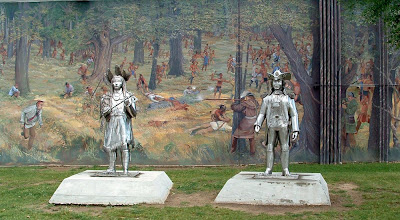
Part of a town historical exhibit of the Indian wars in the area, focusing on Cornstalk (on the left)


The town's shiny Mothman statue was inspired less by the descriptions than by some Frazetta cover art for one edition of Keel's book


I bought a homemade and expensive Mothman statue here. However, in doing so, I got the inside scoop on where to find some open bunkers at the TNT area, and was shown some pictures of "orbs" taken there by the proprietor. Speaking of which, several people asked me if my visit was in response to a recent episode of Paranormal State, which visited Point Pleasant. I've never seen the show.


While photographing the Mothman statue, I noticed the local Odd Fellows lodge, and no. 33 to boot (a number of interest to those interested in Masonic symbolism). Odd Fellows have always interested me, as their lodges regularly turn up a literal skeleton in the closet (apparently used in rituals symbolizing mortality) when demolished or abandoned.


The front of the Mothman Museum. I actually greatly enjoyed the museum, and it beats some other paranormal museums I've visited. In particular, I liked that it had many original artifacts, including clippings, eyewitness manuscripts, and items related to John Keel. It has been open for about five years.

About a third of the museum holds props and costumes from the movie The Mothman Prophecies. I didn't care about that (though I did notice the Chapstick). I was more interested in the rest of the museum. Note the MIB (Man in Black), an integral part of Mothman lore after Keel's book.


Point Pleasant hosts a Mothman Festival in September.

Cryptozoology is big in Japan, a country that loves its monsters. Below are Japanese toys of the Mothman and the Flatwoods Monster, an apparition associated with a UFO flap in West Virginia in 1952.


Here we have the stuff that interested me most. Original documents associated with the Mothman legend, and John Keel. Below is an early draft of what became Keel's book.


This letter by Keel captures much of the feel of the book. The letter is specifically about the Men in Black. They too were running around Point Pleasant and harassing Keel and friends. It appears at least some of the harassment was actually Gray Barker, making strange phone calls, unbeknownst to Keel. Note the inscription at the bottom. Keel was talking to numerous UFO contactees, and began to believe some disaster would take place tied to the sightings and prophecies.

Original early eyewitness report (possibly the first) of Mothman.


Original newspaper clippings give some idea of the scope of the sightings, and their association with UFO sightings. While Mothman is the most remembered part, it was part of a Point Pleasant UFO flap, which was in turn part of a national UFO wave.

The Mothman legend has become inextricably linked with the collapse of the Silver Bridge. After 13 months of Mothman sightings, the Silver Bridge in town collapsed, a major national tragedy. The Mothman has become famous, being interpreted as something akin to a banshee.


New bridge

Many of the Mothman sightings took place in an army ordinance storage area, the "TNT Area." After getting my hand drawn map and directions, I headed out there. After having minimal luck finding a crash site outside of Roswell, I was determined to get into a good part of the TNT area.


A rise in trash was a clue to finding some of the open bunkers. Guess that archaeology PhD comes in handy. This, and a lead I got in town allowed me to find some of the bunkers. A shopkeeper in town, who sells mothman statues, regularly goes in there and photographs "orbs" (a crossover from ghost hunting, which makes sense as local lore holds that the TNT is an "Indian Burial Ground"). I didn't buy a print of the orb photos, but I did buy one of the statues. In return he hand drew me a map to get me to this specific part of the depot site.

Once I got on the path, I ran into three teenagers. They warned me not to venture in alone, as something might "get me." I thanked them for the advice, and pressed on.


The nearby pond looked like the perfect home for some sort of swamp monster. Photo and video


One of the bunkers. I took some video too. Narration could be better and more courageous-sounding


Did my hunt meet with success? Well ...


Thursday, June 12, 2008

Indiana Jones and the Extraterrestrial UFO Hypothesis

I just saw Indiana Jones and the Kingdom of the Crystal Skull. While it makes a total mockery of Mesoamerican archaeology (my professional forte), it was an entertaining movie. I'd rate it higher than the second or third films, but not close to the original.

It is also an interesting movie from the perspective of UFOs. The following will spoil the movie in a large way, so I suggest you don't read if you don't want to be spoiled.


SPOILER WARNING

A fair amount of interest in alt/psuedo-archaeology and ufology was involved in the making of this movie. I'll note some of the highlights

1.) The title character (aka Henry Jones Jr., PhD) was involved with the Roswell UFO recovery. However, the film takes its cues not from the Roswell narratives, but from a mix of Area 51/Groom Lake stories about security, and some elements of UFO crash retrieval stories that started appearing in the 1950s. Jones says he was called out in the middle of the night by government agents, forced to board a bus with blacked-out windows along with other scientists with whom he was not allowed to talk. They were each shown some of the Roswell wreckage and remains, but not given any real idea of what they were looking at, and were then sworn to secrecy on pain of treason. The idea of specialists being brought in dates back to the early 1950s in crash stories, but the blacked-out bus is similar to a specific crash retrieval tale dating to 1973, and stories of some of the security at Groom Lake.

It should also be noted that an archaeologist or archaeological team has been part of some versions of the Roswell story for decades. In the Roswell narratives, the team stumbles across the wreckage, they are not brought in to consult.

2.) Groom Lake/Area 51 vaguely makes an appearance as "Hangar 51" in Nevada.

3.) The "aliens" (more on that in a minute) are classical Grays. At least the ones recovered from UFO crashes (more on that too). Later in the film, other "aliens" are met that look like Grays, but rather than being stereotypically short, tower over humans.

4.) By 1957, there have been at least two other UFO crashes from which the Soviet Union was able to retrieve bodies. The idea of multiple crashes dates back as far as 1950 and Frank Scully's Behind the Flying Saucers.

5.) Unlike most Roswell stories, the FBI is aware of the case and at least somewhat involved. By contrast, Hoover is on record complaining about lack of access to Roswell materials.

6.) Here's the biggie: The movie favors extradimensional or ultraterrestrial "aliens" to space-faring ETs. It is explicitly and repeatedly mentioned that the aliens are from another dimension, from the "space between spaces." They have a flying saucer, but it disappears through an extradimensional portal, and does not zoom into outer space.

This is a very interesting little fact. Spielberg, one of the most successful promoters of interest in UFOs through his movies, has given the most public support for extradimensional ideas over the ET hypothesis. This is not a surprise. In his movie Close Encounters of the Third Kind. one of the main characters is a French ufologist based on Jacques Vallee. Vallee would go on to suspect human involvement in many UFO cases, but in the 1970s, was part of a small group that suggested extradimensional explanations for UFOs over space-faring ETs. Another proponent at that time was Dr. J. A. Hynek, the designer of the close encounter classification system. As a result of legal action, Hynek got a cameo in Close Encounters. Hynek was the scientific advisor to Project Blue Book and had a high profile regarding UFOs, but by the 1970s had left the mainstream views on the subject and became what some called a "demonologist."

I'm not saying this movie will sound the deathknell for the public's widely held equation of UFO = space-faring ET. But it will likely make the ultraterrestrial/extradimensional memes much more popular.

7.) Ancient astronaut ideas are the core of the film. Some reference von Daniken's main memes about the Nazca lines being involved with aliens, or ancient artwork showing spacesuits. The visitors teach the locals agriculture, irrigation, and other technologies. But other ideas are reminiscent of Zecharia Sitchin. In particular, the legend in the film is that the gods (aliens) ordered the people of South America to build a city of gold. This turns out to be a misunderstanding of pseudo-Maya translations of "treasure" but nonetheless the gold and ancient astronaut mix sounds familiar.

I'll be curious to see what effect this has on popular ideas about UFOs.

Sunday, November 11, 2007

Conference on the Semiotics of Cryptids and the Flatwoods Monster

Loren Coleman recently attended a conference on text, code, cryptids, and the Flatwoods Monster case in ufology.

The cryptozoology papers sound interesting, though primarily of a sort that I'm not a fan of, trend-dipping. In such cases, as academics were doing a bit of in the late 1990s and early 200s, a topic is noticed to be of increasing interest in the pop culture. Semioticians, deconstructionists, and other folks interested in symbolism and meaning, then take the basic face-values of these terms, maybe do a small to moderate amount of research in the general topic, and then use the term to examine some larger societal trends of interest to to the author. This usually results in fair to good scholarship, but misleading as to the topic. For example, Jodi Dean's Aliens in America: Conspiracy Cultures from Outerspace to Cyberspace, made several interesting and useful points about the American culture of space and the astronaut and arguing that conspiracism is a rational stance in the face of decentralization and proliferation of information production post-internet. But the author sheds little light on UFO culture, other than abduction to some degree (academics love abduction just as they love contactees). The papers in the SLSA conference sound interesting, so I don't want to judge them simply from Coleman's description.

The Flatwoods papers are primarily about Gray Barker, mythmaker. The paper outlined sounds interesting, though as Coleman points out, there is some sloppy scholarship involved. But while Coleman (and especially his readers, see comments) want to downplay the PoMo nature of the analysis, Gray Barker is an important figure in understanding the history of ufology. He is in many ways highly responsible for the intertangling, particularly through the proxy of John Keel, of high strangeness with what Keyhoe and others had fashioned as a nuts and bolts problem of aliens in metal spaceships. The Mothman would not be the figure it is today without Barker, nor would MiBs.

Tuesday, July 03, 2007

The End of the Wilderness: Implications for Cryptozoology and other parts of the Paradigm

In a memorable scene of the film The Truman Show, a young Truman (an unwitting captive in an artificial world designed as a secret television studio) declares in his grad school classroom that he wants to be an explorer when he grows up. His teacher, or rather an actor employed as his teacher, immediately tells Truman that everywhere has been explored, there is nothing left to discover. This is one of many ploys employed to limit Truman's interest in the outside world. It is also, of course, to help establish Truman's character as someone willing to explore the unknown and escape the confines of his reality.

But, it is also largely true. It's not true of course. There are plenty of mysteries, plenty of new discoveries made daily. I've been in archaeology for about fifteen years now, and while some basic elements haven't changed much, so much has been refined by new discoveries, and some things have just come out of the blue. Other field sciences continue to find new fossil species, new evidence for past climate, or perhaps a crater from the still-mysterious Tunguska blast. New scientific discoveries in turn lead to new paradigm shifts, such as increasing evidence that while geneticists continue to get greater control over their subject material, greater questions emerge that may undermine the entire notion of gene theory (see also this press release on other genetic re-thinking).

But in the traditional sense, the wilderness is nearly gone. By next year, half the world's population will live in cities. The reciprocal point is that with so many people, and urbanism sprawling ever farther along rail and road lines, wilderness has vanished. A recent review in Science magazine emphasizes we have to stop thinking about pristine wilderness, and understand that in one form or another, humans have domesticated and constructed the planet. Twelve years ago, only 17% of the globe could be considered pristine wilderness, without settlement, farms, access roads, and the like. That percentage has to be smaller today. This isn't even considering the element of being pristine, not being unexplored, let alone surveilled by satellites and airplanes to the point that anyone can get a free, detailed, updating 3d map of the world from one of several sources (I use Google Earth, but I've heard good things about some of the other similar programs).

I've never visited true wilderness from that definition. Sure, I've trampled through forest and brush in Mexico and Guatemala that looked impressive, that at points required a machete to continue. But I've done the same thing half-a-mile from a Walmart in Louisiana, or in National Park land in Mississippi. In all of those cases, I was either in parkland, or in areas farmers knew well enough because they either farmed them at points (and then let them grow back) or travelled through these areas to their farmland.

I have colleagues who do work in something closer to wilderness. An ex-girlfriend of mine used to hike a day's journey or more into the Maya Mountains, up steep rockfaces with the danger of killer bees and deadly fer-de-lance. They'd stay for three weeks, getting some logistical support from helicopters in the British military, before walking back out again. Even here, though, this wilderness had once been farmland (though farther in the past, during the Classic period of the Maya whose settlemets and tombs the archaeologists were studying), and the work was being done within a jaguar preserve that had been surveyed by the project in order to find the ruins. Another of my colleagues, who did survey in some of the wildest parts of Central America, worked in the "wilderness" too. Of course, this wilderness was one where he was accompanied by the locals, and there was concern of being ambushed by bandits and kidnappers out in the bush, and not without cause as this is exactly what happened on one trip. That colleague was convinced that we should do no further archaeology in parkland at known sites, but instead should focus on the frontiers, because that is where unknown sites will be found, if not by archaeologists, then by looters.

But therein again lies the point. Looters are a human issue, and they go hand-in-hand with local settlements where the looters live (the buyers and middlemen may be international or from the city, but despite what the movies might have you think, tomb raiders are typically poor locals looking for a way to make money). That these are issues of human interaction and conflict, and the relationship between humans and their environment, including cultural resources in the case of archaeology.

But so much of the Spooky Paradigm is based on the notion of exploration. The word and the concept appear time and again in discussion and advertising of the subject. In some cases, this is referring to mental or spiritual or metaphysical exploration. But in other cases, it doesn't mean that at all, and is very much in the realm of physical exploration.

Cryptozoology is the most obvious example, as the entire concept is based around undiscovered animals living where they are mostly undetected by science. The Center for Fortean Zoology expedition to Gambia in 2006 is a great example of this (you can see a film on the expedition, or look through the expedition's blog and background), an expedition to the Dark Continent to look for dinosaur-like creatures based on native accounts. It could be right out of an adventure story a century ago. An entertainment-oriented simalcrum of cryptozoology has been airing on the SciFi Channel, called Destination Truth. I think it is telling that all of the episodes, even though dealing with creatures (such as a Bigfoot-like hominid, chupacabra, a haunting, a lake monster, a werewolf, and something akin to a gremlin) in most cases reported and more famous elsewhere, are centered around "remote" areas in former colonial lands, in the Southern Hemisphere, and also very much presented in relationship to "exotic" local beliefs and cultures.

Even in the Northern Hemisphere, the wilderness argument is evoked to explain how Sasquatch, for example, could continue to elude capture (alive or dead). This has led to some acronomious debate in the Bigfoot community, for example, between those who open to Bigfoot reports in any part of the continent, regardless of the terrain or proximity to urban areas, and those who think Sasquatch exists in the rugged forests of the Northwest, but scoff at reports from the outskirts of suburbia east of the Mississippi. One obvious point, and one not thought up by myself, is that by definition sightings and evidence of cryptids are reported by people, and not always people in the absolute middle of nowhere.

Now, don't get me wrong. I'm not saying big animals are not found in relatively remote places, or that there is no wilderness left at all (there still is some, even if it is only 10-15% of the planet, that's still a lot of ground). In November of last year, I blogged about a paper presented on this topic concerning the "Lost World" of Vietnam. For years, there have been reports of spectacular new animal discoveries in the post-Cold War forests of Vietnam. Some are questionable, but many are clearly legitimate and extraordinary. But Dr. McElwee's point was that these aren't lost worlds, they are quite inhabited, and "discovery" is a relative matter creating a false notion of pristine wilderness where people (just not European settlers) have lived for quite some time. She focused on the hominid searchers in this "Lost World" as being a symptom of a larger lingering colonial mentality, with dangers for it being replicated at the local state level and looking at such "Lost World's" as places to be exploited since they are "empty."

What I am getting at is not that there isn't wilderness, but that rather these stories of strange and unexplained phenomena are not those of the mysteries of the frontier and wilderness, but rather they are evidence of mystery being in our domesticated world. Bigfoot may be a wild man of the wilderness, but so many sightings are made along roads, on farms and private land, and other places that may not be in a metropolitan area, but that are also not in the deepest and darkest mountain caves and thickest forest. Aquatic monster sightings don't come from submarines in the darkest depths of the seas, or in the center of oceans far from land. They come from lakes, often large well-visited lakes in heavily populated areas. UFOs are supposed to be, in the majority opinion, from outer space. And indeed, there is a branch of ufology that is interested in video from the space shuttle or other views of orbit or the Moon. But the true natural habitat of the UFO is slowly moving over suburban housing developments, along the ridges and valleys of ranches, or even over major cities. Pilot sightings might be considered an exception to this. And while spooky old hospitals and insane asylums or old cemeteries are common haunts for ghost hunting teams, so many spectral stories come from inhabited (and not even necessarily that old) private homes or businesses.

Just as the Science review suggests a new paradigm for conservation, one focused on managing a domesticated world, the Spooky Paradigm is not one of monsters on the edges of the known world, but of strange things happening in mundane places, of mystery intruding on everyday life. Not in far away places with exotic names for creatures never seen by civilized man, because at this point, everywhere is civilized in the basic sense of the word. This isn't just a matter of form or style, but directly effects the frames used for understanding these mysteries. Lisa Shiel , as she discusses in a recent interview on Binnall of America, has been writing about her claims of communication and interaction with Bigfoot creatures that braid horse hair, leave stick signs, and have other ways of interacting with humans. I find these concepts to be, to say the least, bizarre and difficult to believe. But I have to admit, I could see how one could argue that an intelligent Bigfoot, one able to interact with humans, would presumably have a better shot at living in closer proximity to human settlements and evading detection than say a non-human-intelligencelevel giant ape like Gigantopithecus. This is a similar dilemma to the question of time in ufology. If UFOs have been seen on Earth for thousands of years, some of the assumptions about visiting space aliens, especially the notion that they were attracted by the a-bomb and other recent technological development, start to give way to ideas about a permanent presence by UFOs on the Earth, either as indigenous cryptoterrestrials or as ultraterrestrials or some other kind of thing from another dimension.

The world hasn't been all explored, like Truman's teacher said. We explored it, an found that it held even more mysteries than initially thought possible.

Wednesday, December 06, 2006

The Mothman Prophecies: Paranormal Hybrid Vigor

I've posted dual book/movie review and discussion this on my Tulane page for some time (since 2003, I believe), but I figured it was time to move it, since I'll be leaving there in the coming year. I believe I'll be revisiting some of the issues raised in this review in the very near future.

The Mothman Prophecies: Paranormal Hybrid Vigor

You know what flying saucers are, right? Spaceships from outer space! They can be big, or small. They can look like clouds, or silent helicopters, or ice cream cones, or cigars. More commonly, they look like discs, or spheres, or VW NeuBeetles, something rounded to contrast them with all those long and pointy missiles and rockets the white(jumpsuited) guys in the Air Force and NASA send up. If fifty-one years of flying saucer movies are anything to go by, UFOnauts don't seem to be made of the "right stuff", either. Usually Zeta Reticuli sends us Attila the Hun, who trashes the place but is always sent packing by super-science, germs, or more recently, yuppie hackers. Other times, they send us Jesus (WWETD?), ready to give us the answer to atomic disarmament, the ozone layer, or whatever else the cover of Time magazine is trying to scare people with this week. Since the 1960s, we've been treated to a double-header of Dracula and Jack the Ripper, as the little gray men walk amongst us undetected, get their jollies making off with the blood and genitals of genetically hormone enhanced cattle, and mesmerize abductees for cold clinical sex. They've even brought their pet chupacabras along for the ride. Anyway, flying saucers are weird aluminum spaceships full of illegal aliens waiting to disintegrate, illuminate, or exsanguinate us.

The various Hollywood scenarios above are all variants of the Extraterrestrial Hypothesis (ETH) for UFOs, or the "nuts and bolts" paradigm. Simply put, UFO occupants are biological or mechanical, and the flying saucers are part of their advanced material culture. The Crashed Saucer legend, most famously the Roswell Incident, is the epitome of this philosophy. Believer or skeptic, most people around the world think of the ETH as synonymous with UFOs.
But there are other explanations. Skeptics cite the "Kook Hypothesis". More charitably, sociologists and anthropologists propose the psychosocial hypothesis, that these beliefs are a part of human culture, like religion or folklore (anthropology is the least religious of all academic fields in the United States). Evangelical Christians quote Genesis to show that UFO enthusiasts are actually worshipping demons. Militia members think the UFOs are all a ruse, which the New World Order will use to throw John Birchers into makeshift concentration camps in Nevada. New Age-y contactees remember their former lives as aliens on the planet Zeist.

And then there is John Keel. A freelance reporter and writer based in New York, Keel conducted some field research on UFOs in the 1960s before combining all of the above into a unique occult stew. He is most famous for The Mothman Prophecies, a jumpy collection of Keel's ruminations hung upon a framework of strange happenings in rural West Virginia throughout 1967. The Mothman of the title is the most unique element of the story, though not the most important. Alternatively described as a large man with wings, or a huge headless furry creature with giant glowing red eyes, "Mothman" lived to terrorize young couples in secluded lover's lanes.

But Keel was more interested in UFOs and those who were contacted by them than in nocturnal winged peeping toms. To hear Keel tell it, West Virginia, and indeed the world, was crawling with sightings of strange lights, extraterrestrial visitors with misspelled Biblical or Classical names, and Men in Black. Particularly Men in Black. Though he didn't invent the concept, Keel's books and writings solidified the Men in Black as strange beings in their own right. Flying saucer enthusiasts had reported intimidating visits from men in dark suits since the 1950's. These strange visitors were interpreted as government agents sent to intimidate the daring ufologists; more skeptical observers suggested that these tales made the teller "important" enough to be silenced by Them. But Keel's MIB's are far stranger. They can have unusual facial features (often classified as "Oriental", a term which seems to have no meaning the way Keel uses it), wear all sorts of clothes (not just the Reservoir Dog funeral suits), often with strange thick-soled shoes. They may talk too fast or too slow, often in the same conversation. Simple objects will puzzle them, yet they seem to have mastered the use of dark-colored sedans and flash cameras.

Instead of suspecting government spooks, Keel lumps MIBs with space travelers, mothmen, fairies, hairy monsters, ghosts, devils, angels, gods, spirits, doppelgangers, and other strange folk. From his perspective, they act in similar ways, through time and space. There is only a cosmetic difference between a beam of light striking Saul on the road to Damascus, hastening the spread of Christianity, and a flying saucer taking George Adamski or Rael on an interplanetary trip so that they can spread the word of the Space Brothers. Skeptics and rationalists would agree with Keel, and label all of these things part of the human tendency to create a rich supernatural world and populate it with wonderous and terrible beings. But Keel accepts some kind of reality for these beings, though he has no idea what they are. Because the same kinds of reports are recorded throughout human history, Keel proposes that these things have been here as least as long as we have, that they are a permanent part of life on earth. He calls them ultra-terrestrials, but I believe my favorite term for them comes from the title of a chapter in The Mothman Prophecies, "Games Non-People Play". As an all-encompassing unified field theory, the concept is overwhelming yet simple at the same time. If accepted, the explanatory power is intoxicating. Aztec blood sacrifice, UFO sightings, Bigfoot, Fatima, phone malfunctions, men with thick rubber-soled shoes, deja-vu, and Adam Weishaupt: IT'S ALL CONNECTED!

And because it touches so much, and encompasses so much, yet is still unexplained, it can't be disproved. One can question the behavior of aliens as bizarre, non-scientific, and irrational (what's with all the abductions?), traits that might not be expected of beings flying in spaceships. One can also ask why flying ships have changed through time, going in and out of style. Or why alien messages are always simplistic or pointless, as after all, an advanced intellect should be able to provide more of a direct clue to global problems than "Make peace and open your minds." But as Keel describes the strange behavior reported by eyewitnesses and experienced by Keel himself, the fragmentary non-logical patterns rule out ET astronauts. Instead, the vague prophecies and unusual folk are all part of the "Games Non-People Play", for an end we cannot fathom. God works in mysterious ways, after all.

And so we return to the Mothman. As stated above, the early focus of The Mothman Prophecies is Mothman. But non-people come in all shapes and sizes in Point Pleasant, and soon Keel is dealing with Space Brothers, MIB's, Mothmen, and UFOs of every shape and size (on a clockwork basis no less). Keel places all of this into the larger 1966 UFO flap (which also spawned the infamous Project Blue Book explanation of "swamp gas"), and begins to suspect that big things are on the horizon. He is prompted by the titular prophecies of local Woody Derenberger, who gets his information from a long-haired silver-suited spaceman by the name of Indrid Cold. While other Cold contactees both in and outside West Virginia begin to come to Keel's attention, Woody is the best source of information. As Keel begins to get an inkling of what terrible event Cold's messages might be foretelling, They start to apply pressure. MIB's tail and photograph Keel, his associates, and acquaintances not even connected with UFOs or West Virginia. Keel's phone begins to act up, with constant strange sounds and interruptions. People report calls from Keel that he never makes, and when he calls his own home, an unknown man answers on his behalf.

Finally, the strange events come to a head, and a horrible disaster comes to pass, but one only tangential at best to the contactees' prophecies. Keel counts the dead, and step quietly back into the land of the living, not much wiser than he had been a year before. There is no resolution, no hero's journey fulfilled. Unlike many UFO and Forteana books, The Mothman Prophecies has a setting, a cast of characters, a goody spooky author, and something of a narrative. But there is no mind-blowing final discovery, no smoking gun, nothing to show but speculation that perhaps the world is far wilder than we suspect (or that the author is mad, or just a good storyteller, or all of the above). Other approaches generally provide some answers: religion illuminates; science explains. If UFOs are flown by Space Brothers, the author imparts their wisdom. If a cover-up is found, at least things are under control, and the bad guys named. Even abduction accounts provide some closure, with memories recovered, and maybe patterns exposed to reveal an agenda. But no loose ends are tied up in The Mothman Prophecies, things just end, with no indication they won't start up again elsewhere or when.

Mothman Does Hollywood

The book The Mothman Prophecies is nihilistic, and if one accepts its assertions, disconcerting. Not exactly blockbuster material. And yet, in early 2002, a big-budget film version of The Mothman Prophecies was released. The movie wildly veers from much of Keel's book, fictionalizes much of the story (yet claims to be based on true events), adds some upbeat sentiments, and stars �ber-Buddhist Richard Gere. And yet, oddly enough, the film is able to capture some of the basic feel and ideas of Keel's book, ideas that have not really been explored in pop media before.

Instead of recreating John Keel's yearlong field investigation in Point Pleasant, the movie focuses on John Klein (Richard Gere), a famous reporter for the Washington Post. The events are also dragged into the present day (curious, since the one major public event in the book, a real disaster, is kept as the centerpiece of the movie). Klein is no Fortean investigator, but a happily married political reporter and commentator. The film opens with Klein skipping out on the office Xmas party to help his wife Mary (Debra Messing) view a potential new house.

WORD TO THE WISE: fast forward through the first 15-20 minutes. You and I will be the better for your discretion. Let me sum up: The Kleins see the house, have closet sex, leave, Mary sees some crazy CGI red thing in the street that runs them off the road, she cracks her head, cat-scans find a tumor (in the shape of a Y, just like the CGI Mothman thing) Mary starts sketching ominous Blair Witch knock-offs, she dies, John is sad.

Ok, now, you can start watching the movie again. Anyway, for reasons that are not entirely clear to him or anyone else, John gets sucked into strange occurrences around Point Pleasant, West Virginia. This is where the action really begins. The filmmakers pick and choose some of the creepiest and most evocative moments in Keel's book, and use them as the basis for the rest of the film. Gordon Smallwood (Will Patton) is clearly based on Woody Derenberger, and relays messages from Indrid Cold (now a menacing and ethereal presence instead of a Space Brother). Gordon hooks up with John at gunpoint, as he is certain Klein has been stalking him for days before he ever arrives in West Virginia. Time and space inconsistencies abound, as do phone hijinks. None of these events make much sense, and instead are played for a high creep factor. Which works perfectly well with the feel of the Mothman book.

Once in town, Klein pairs up with the pretty local sheriff Connie Parker (Laura Linney), and the two begin to investigate weird claims and occurrences. Inevitably, John and Connie develop romantic feelings for each other. If only I could find romance while spending cold nights staking out old haunted chemical plants, or questioning country folk who have seen a flying version of Bigfoot, but I digress. But as Hollywood loves a romantic triangle, John's dead wife Mary becomes entangled in the Mothman phenomena. Let me just say that while Debra Messing doesn't play live characters terribly well, she is great in this film as a corpse. John's desperate desire to contact, or at least understand the death of, his wife takes the weirdness to a personal level. The film jettisons the UFO's and MiB's in favor of a strange multi-dimensional ghost story.
As in Keel's book, Indrid Cold's messages begin to prophesize disasters. John decides (perhaps because of his inability to save his own wife) to take this opportunity to help people. He tracks down an author and expert on this phenomenon, Dr. Alexander Leek (Alan Bates), to help him decipher the situation. Yes, that's L-E-E-K, try holding it up in front of a mirror.

Now, may I say, I can only hope to be as cool as Alexander Leek when I grow up. After lecturing Klein on the prehistory and history of ultra-terrestrials (the word is never used, but the meaning is plain), he goes on to explain that he too tried to follow Mothman's prophecies to save people. He then stridently informs us that it landed him in an insane asylum for five years, and asks Klein "Do you know what that does to a man"? Damn. Mr. Bates plays Ke-, um, Leek, as just a touch mad yet with an insane insight into to the nature of the universe. He sums up Indrid Cold's incrutable messages by asking Klein if he, clearly superior to a cockroach, has ever tried explaining himself to one? The Mothman Prophecies may have it's problems, but any film that has an extended discourse by a madman on ultra-terrestrials, citing cave paintings and set in a library, gets my dollar.

Armed with this "wisdom", Klein must decide whether to embrace the madness of the Mothman Prophecies, potentially averting some tragic catastrophe, or wash his hands of the whole convoluted affair. I won't give away the answer here, but the filmmakers wisely adopt some of Keel's nihilism for the film's climax, only to throw a little of it away for the sake of Hollywood sentimentality.

On the whole, I was surprised at the performances and skill in this film, barring the first twenty minutes. The aforementioned first twenty minutes, all set in Washington D.C., contain most of the worst acting in the film. Most of the annoying bits in the film are here as well, most particularly film-school cuts and jumps that seem to have been added just to look showy, and to have "scary" bits for the movie trailer (indeed, much of the trailer is derived from these scenes). Once the film moves to Point Pleasant, we enter into another, much more interesting movie. Instead of the slick blacks and reds of Washington (and many Hollywood thrillers and horror movies), everything in West Virginia is gray. As a long-time resident of the Northeast and Mid-Atlantic, I recognize the desolate gray November scenery. Personally, I have even more reason, as the film was shot in and around Pittsburgh, where I lived for three years. Those familiar with the city should be able to identify a number of locations around Oakland (the University of Pittsburgh and the Carnegie Museum in particular), a few downtown, and one on the southern riverbank of the city. Regardless, the gray country landscapes, strange small town, and hypnotic ambient soundtrack combine to give a sort of "Twin Peaks East" feel to much of the proceedings.

Richard Gere is actually quite good here. Clearly he is a natural to play the successful reporter with everything going right in the world. But with the exception of a heroic act near the end, he also does a good job trying to regain some control over anything after the death of his wife. Gere's usual quiet, "Zen", slightly superior demeanor keeps him quiet and slightly taken aback as the rest of the cast tells him things. In essence, with the exception of his scenes with Laura Linney's Sheriff Connie, Gere's Klein acts as a near-silent proxy or avatar for the viewer, moving from clue to clue.

Klein's relationship with Connie is an interesting change from the book, but an unexpected one. Along with the specter of his dead wife, Connie gives Klein a stake in the phenomenon beyond curiosity. Linney isn't given much to do here, other than to comfort and occasionally skeptically ground Klein in his quest for the truth (shades of The X-Files here). In his book, Keel does have a female partner (a local newspaper reporter), but she is significantly older and less attractive than Laura Linney, and married to boot. Instead, Keel describes nearly all of the other women of Point Pleasant as young, lithe, and attractive, presumably doing much to further the cause of gonzo ufology.

The other two significant roles in the film are heavily inspired by Keel's book. Will Patton is excellent as Gordon Smallwood, an average man contacted by forces from beyond and forced into the role of a prophet. Alan Bates is a bit more over the top as Alexander Leek, a very different sort of man who tried and failed to deal with these forces. But both represent well some of the "High Strangeness" in Keel's book.

Lastly, there is the Mothman himself. Like Keel, the filmmakers use this apparition as a symbol and focusing point for their own explorations of the strange. Like the Flying Saucer, the Mothman stands for the strange, and potentially dangerous. Surprisingly, the Mothman is used for little else in the film. In Keel's book, there are several Mothman-related encounters and chase scenes (most interestingly, when it follows a bloodmobile) that are more exciting than those in the film.

In both versions, The Mothman Prophecies offers an alternative to more mainstream approaches to the paranormal in twentieth century American culture. The 2002 film version stylistically treads some of the same ground as The X-Files or Twin Peaks, but the focus on exploring the emotional and philosophical elements of an unusual take on paranormal phenomenon sets it apart from flying saucers and little gray men. Keel's book is much more out there, and while including UFOs and MIBs, spins these elements to much wilder ends. The film is a nice, stylistic, slice of weirdness with several unsatisfying elements (mostly involving Klein's relationship with his wife). Keel's book is a comprehensive smorgasbord of High Strangeness, one that is a bit of a mind-blower of insane inspiration, whether the reader believes Keel or not.