Sunday, September 30, 2007

Gigantopithecus in Upstate New York

I visited Hartwick College today, in Oneonta, New York. Or more specifically, the sculpture of Gigantopithecus, the largest primate ever. The sculpture was created by Kevin Andersen, as detailed on his website.


As you can see, the sculpture is huge (for comparison, I'm 6'2"). In fact, I think it is a little too big. Most estimates I've heard suggest that the ape was up to nine feet tall if it reared up on its hind legs. As you can see, the sculpture is that tall while resting on the knuckles of the arms. But it probably isn't far off.

Gigantopithecus is more famous than many fossil primates due to Dr. Grover Krantz and others who argued that modern stories of hairy men of the woods were actually living Gigantopithecines. Some, such as Sasquatch or Bigfoot or the other American hairy hominids are a bit far afield, but the Yehren and to some degree the Yeti have the advantage of being talked about and reported in roughly the area where Gigantopithecus teeth and jaw fragments (the only evidence for the genus) are found.

Other reconstructions, in part influenced by Krantz, depict Gigantopithecus as a bipedal creature looking a lot like stories of wild men and hairy monsters. On the other hand, the range and diet of these creatures suggests something more like an orangutan or even gorilla, and especially the panda, decidely less-Bigfoot-esque creatures in terms of behavior or locomotion. David Daegling discusses the issue of Krantz's reconstruction of Gigantopithecus and his identification of the genus as Bigfoot in Bigfoot Exposed: An Anthropologist Examines America's Enduring Legend, available through Amazon by clicking on the thumbnail link on the right side of this page.

I should note that despite the expectation of Bigfoot stories and accounts being at home in the Pacific Northwest, they do occur in Upstate New York, as discussed by the authors of Monsters of the Northwoods.

Tuesday, September 25, 2007

Shag Harbor UFO Crash Festival

I finished reading the book Dark Object on the Shag Harbor crash of October 1967. I have no idea why this well-documented UFO crash story doesn't get more attention. Anyway, they're starting a festival in two weeks.

http://www.novanewsnow.com/article-141294-Celebrations-planned-for-40th-anniversary-of-UFO-sighting.html

Friday, September 14, 2007

Glenn Danzig's Book Collection

This is pretty damn funny. Even moreso if you've seen him buy a pool of elf blood on Aqua Teen Hunger Force. Anyway, the library of self-appointed "evil" rocker Glenn Danzig:


http://www.youtube.com/watch?v=weNO9k1TXS0

Thursday, September 13, 2007

Indiana Jones and the Next Year of Fielding Questions

As discussed by Mayanist Marc Zender for MTV, crystal skulls and their lore will be the center of the next Indiana Jones movie, currently being filmed. Zender notes their ties to "New Age" (come on, you can say occult, you know) beliefs, UFOs, etc. Though he doesn't note that with the exception of the Mitchell-Hedges skull, many have been traditionally associated with the Aztecs and not the Maya.

Anyway, I expect people will be bugging me for the next year about this, since:

I'm an archaeologist
I'm a Mayanist (the Mitchell-Hedges skull was supposedly "found" at Lubantuun in Belize)
For most people I know, I'm the resident occult expert

At least it will be break from answering the 2012 question all the time, though that will probably just go along with it.

Update 4/16/08: Interesting article in Archaeology Magazine takes advantage of the upcoming movie to present the history of the crystal skulls, and how they swirl around one antiquities dealer in the second half of the 19th century.

Tuesday, September 11, 2007

I guess I left New Orleans too soon

The Haunted Mortuary

Mothman Festival this Weekend

Point Pleasant, West Virginia, is having it's 6th Annual Mothman Festival this coming weekend. Cryptomundo has the info.

Also, it apparently has a psychic fair.

Sunday, August 12, 2007

Ufology Unfalsifiable: A Review of The Roswell Dig Diaries

I'm a professional archaeologist, so it is a natural I'd read the SCI-FI Channel published report, The Roswell Dig Diaries, of the the 2002 archaeological project to investigate the "Roswell" debris field outside of Corona , New Mexico. The work was funded by the SCI-FI channel so that it could feature in a television broadcast in November 2002, The Roswell Crash: Startling New Evidence. Ufologists Donald Schmitt and Thomas Carey served as the Roswell UFO crash advisors to the channel, while the actual investigation was led by Dr. William Doleman, an archaeologist in the Office of Contract Archaeology at the University of New Mexico.

The book isn't a book as much as a semi-random series of emails, notes, and journals packaged with the final archaeological report, which stands out in contrast with the rest of the material.

The initial section of the book, the emails and discussions about how the project came to be, is interesting. If nothing else, the Bureau of Land Management proposal is an awesome read. The proposal was fairly ordinary, except for the lines like "All Native American and extraterrestrial artifacts will be cataloged ..." etc. On the one hand, it sounds ridiculous. Yet on the other, it is kind of exciting, and at least it is an attempt to actually apply established scientific and investigatory methods to a UFO problem.

So that section isn't bad.

The middle section, on the other hand, is an epic pox on ufology, in printed form. It consists of the diaries of various participants in the project. These were also placed on SCI-FI's website, so presumably they were designed by someone in the production team with the "confessional" bit from many reality shows in mind, where the game show contestants/avocational actors dish about their feelings and the other contestants/actors.

And man do they make this all look dumb. The two main figures with diaries are Bill Doleman, the archaeologist hired to head up the field excavation and coordinate with technical specialists, and Tom Carey. Doleman has gone on to star in a short-lived SCI-FI reality show that I have yet to see, but here he comes off fairly grounded and with a good showing. He does minimize some clear personnel difficulties (more on that in a bit) but otherwise comes across as professional and largely patient.

Tom Carey's diaries, on the other hand, sound amateur. They are filled with constant whining and griping about many, many things. Especially about Don Schmitt. Much complaining about Schmitt. And Schmitt's friend. Schmitt's driving. His comandeering of the car. And some of the volunteers. And the eyewitnesses that can't adapt to his schedule. And constantly being ditched. And bad hotel accomodations. And many other things. When not complaining, his diaries are often about which budget restaurant Carey ate at that night.

Schmitt's aren't much better. They are shorter than Carey's, as he is extremely busy and running around (something Carey complains about), but can at points also strike a patronizing tone.

Other diaries are kept. One is by the SCI-FI exec in charge of the whole shebang, who comes across as excited to be a part of it all, though I wonder whether either he or one of his employees was simply a good communications major in college. The volunteers (much of the excavation work was done by volunteers who got room and board for their efforts) also keep diaries, and like Carey they complain all the time, and several sound ridiculous the rest of the time. One in particular, one of several labelled "Independent UFO Investigator" constantly second-guesses Doleman, and is allowed to take over a portion of the excavation out of what seems to be frustration.

In the diaries as a whole, it is clear that while initially some interesting work was done, particularly the subsurface remote sensing, once the TV cameras showed up, everything turns to garbage. The television cameras dominate everything, including a huge and pointless distraction of using a helicopter that ends up having mechanical trouble (one wonders if it helped provide drama to the otherwise not very dramatic excavations).

Even Doleman gets into it. When the cameras are there, much of his caution gets dashed when he is clearly stressed out, and starts to get excited by what turns out to be a likely ephemeral feature in alignment with the remote sensing return for "the gouge" supposedly left by the Roswell craft. BTW, I'd just like to note that the gouge has grown slightly, and in this accounting is now five hundred feet long, a bit bigger than the 390 - 480' gouge described by Randle and Schmitt in 1991, though still in the same ballpark. The discovery of a supposed gouge in the profile and in the remote sensing is a major hook in the television show that aired in 2002, but in the book and in the included report, it becomes clear that feature was likely a side-effect of the backhoe that was brought in, or otherwise ephemeral. Likewise, Doleman gets very excited about another gouge, and the discovery of an unrelated weather balloon, all when the cameras are around. His caution returns when the cameras are gone, and he has time to think about all of this.

Overall, I'd make the following points

1.) The media aspect, in particular television, is highly disruptive and damaging, and I think this can apply to not just this case but ufology in a larger sense. Kudos to SCI-FI for paying for the work, and for publishing the report. And there doesn't seem to be any real effort on their part to "sex up" the work, in the sense of pushing or modifying the results.

But the estimated cost of the archaeological project, in the end, is about $30-35,000 (if you replaced the volunteers with hired labor, it would go up, but not even to the level of doubling). Not exactly pocket change, but not a lot of money in terms of a project, either. I know archaeology grad students who secured that much money to do their dissertation work, and even moderately sized projects work with much more. I could turn this around to echo the whine that there is no institutional support for ufology (though it should be noted that archaeologist Greg Fewer proposed a very similar research design [pdf] to the National Discovery Institute, unaware of the SCI-FI effort). But given the amount of money that pours into and out of Roswell on UFOs, the amount of money that is spent on books and DVDs, and the amount of interest there is in the topic, $35K to dig up and actually physically investigate probably the most famous UFO case of all time isn't exactly that much money. Sure, SCI-FI spent a lot more money on that, not on the work, but on the making of a TV show, selling the show, etc. Dolan's work clearly suffered from the tv crews taking over the project, from the emphasis of the "advisors" on taking yet more eyewitness testimony, from the need to base out of Roswell instead of much closer Corona, etc. Much of that wouldn't be present if the money was not part of the big swirl of media and market.

2.) Anyone can be a ufologist. According to his bio in the book, Thomas Carey has gone through CUFOS and MUFON, and has an MA in anthropology. But Schmitt's controversies over his background are well known in ufology. Between that and the "independent investigators," nothing looks very professional and so much is either caught up in dreaming emotion, or in managing the media circus (Schmitt's absence is in part because of family commitments, but the rest due to his role in managing the UFO giftshop-museum). There is some clear disconnect as the various "investigators" get fed up with Doleman's methods, and want results NOW.

3.) Hypotheses? What Hypotheses? The strength of the whole project is that Roswell is testable. Schmitt and Carey, using eyewitness testimony (which is all they seem interested in for the most part) are positive they have the Brazel debris field site. It is stated several times, and emphasized by Carey, that all the research basically boils down everything to either a balloon array, or something like a hard ship that left a gouge, described by eyewitnesses. The best evidence will of course be something unusual as an artifact that broke off the "ship." Doleman includes a brief discussion of the recovered artifacts, but they are generally easily identified as likely man-made and modern. But the other major piece of evidence would be finding that gouge, since a balloon won't leave a gouge. That, ladies and gentlemen, is a hypothesis. "If we find a gouge, it can't be a balloon." But the opposite does hold true "If we are in the right spot, and don't find a gouge, a non-balloon does seem less likely"

They don't find a gouge. The remote sensing detects an anomaly that might be a gouge. But it is then ground-truthed through excavation, and Doleman doesn't find evidence of a gouge. For the purposes of the TV show, there is a potential feature that might be a gouge, but by the time the analysis is done, it is clear that it isn't any gouge.

I've only briefly browsed Schmitt and Carey's new book, with the Haut "affidavit." But from what I saw, there is little to no discussion of their archaeological project that didn't find a gouge.

When you actually have something testable, say like an archaeological site, and your hypotheses go against the answer you want, you need to deal with that. Not just forget it, and write another book based on eyewitness testimony. Otherwise, why did you do the science in the first place? Oh, right. You did it for tv.

Thursday, July 19, 2007

One Last Mystery From New Orleans

I'm leaving New Orleans soon, to do some archaeology in New York. I'll blog again soon, though perhaps not until after the move. Though if I run into any Fortean or otherwise interesting things on the road, I'll post them here.

But here's one last conspiracy story with some bizarre bits, from New Orleans. With corruption comes conspiracy theories, and Louisiana is known for its corruption (and this week, for its family-values senator getting outed for visiting at least one prostitute). The story combines the intrigues surrounding Jim Garrison's infamous New Orleans investigation of the JFK assassination, an unsolved grisly murder thirty years ago in New Orleans, and an an attempt to kill Castro. But it then stretches into territory much further afield with a conspiracy to cover-up a massive medical disaster that, in my opinion, feels almost bolted onto the rest.

The article is from local paper Gambit Weekly. The link is to their current cover story, so after this week you may need to find the story in the archives, which shouldn't be hard.

An excerpt

Official reports about the murder pointed to stab marks on her body that indicated a link to an alternative lifestyle -- and an apartment fire. The problem, Haslam says, is that one of her arms and rib cage had been incinerated, which could not have occurred in an apartment fire that did little damage to the room. He also learned that the degree of damage could only have been caused by extremely intense heat -- even higher than the 3,000 degrees used in cremation. He believes it was caused by a device called a linear particle accelerator. Such a device was being used to radiate monkey viruses to help develop a vaccine for soft-tissue cancers that could result from the contaminated polio vaccine administered to millions of school children in the 1950s and '60s and/or to develop a super cancer-causing virus that could be used to assassinate Fidel Castro. Haslam found evidence that such an accelerator existed at the U.S. Public Health Services (USPHS) hospital in New Orleans in the 1950s. He even found a witness who claims to have worked there.

Here the story takes a wild turn.

Haslam says Sherman actually worked on a monkey virus project at the secret, government-funded USPHS laboratory under the direction of famed New Orleans doctor Alton Ochsner. She worked alongside David Ferrie, one of the main characters in former New Orleans District Attorney Jim Garrison's ill-fated investigation into the JFK assassination, and Lee Harvey Oswald, named by the Warren Commission as the lone gunman who killed Kennedy. The author believes Sherman's arm and ribcage were incinerated during an accident at the lab and that she later was stabbed in the heart, a wound that actually killed her, then stabbed in other places post-mortem to establish a cover story.

More at

http://www.bestofneworleans.com/dispatch/current/cover_story.php

Update: I went to the book signing today and picked up a copy, if nothing else as a guide to one of the more famous spooky chapters in New Orleans history.

Sunday, July 08, 2007

Evolution of the Crashed Saucer Legend, Part 8: Aftermath and Bibliography


Please start at the beginning if you haven't yet

The Aftermath of a Saucer Crash

Government Secrecy

Even as far back as 1897, there is a relationship between stories of unidentified flying objects and government secrect (Clark 1998:141-159). But it is after 1947 that secrecy becomes one of the enduring hallmarks of the saucer era and later ufology. From the beginning, a vocal part of ufology has blamed a lack of good UFO information and public interest on “silence groups” in the American government. Probably the most influential of these researchers was NICAP czar Donald Keyhoe, who wrote about “Project Saucer” (actually called Projects Sign and Grudge [Swords 2000]), and continued to rail against government secrecy (Peebles 1994:44-48). In particular, throughout his ufological career, Keyhoe’s number one priority was pressing for open Congressional hearings. According to long-time ufological prankster and social historian James Moseley in his memoirs Shockingly Close to the Truth! (2002:46-47), Keyhoe’s persistence actually increased secrecy on the part of the U.S. military.


Jim Moseley signs copies of his memoirs after a lecture at the IUFOMRC. According to his semi-monthly 'zine Saucer Smear, Jim is apparently not welcome for a return performance.


Congressional action and the University of Colorado “Condon Report” (Gilmour 1969) from 1966-1968 silenced this cause to a large degree, but with the 1990s came an increase in popular interest in the concept of UFOs and government conspiracies. This has led toa focus on government documents obtained by the Freedom of Information Act, most notably The Black Vault, as well as the branch of ufology called "exopolitics," a topic I will not get into at this time.

At the heart of the Roswell legend is the issue of a government cover-up. Though the UFO issue has had an edge of paranoia about the American government since the 1950's, conspiracy theories and the belief that government officials are hiding information about UFO's have grown over the last two decades along with the Roswell legend. The most successful of these concepts has been that of the “Majestic” (also known as Majestic-12, MAJIC, and MAJIC-12) group formed to deal with saucer secrecy in the wake of the Roswell crash. Majestic came to public knowledge in 1987 with the release of the Majestic documents by William Moore, Stanton Friedman, and filmmaker Jaime Shandera. Shandera says he received the documents on anonymously-sent film. The debate about the validity of the Majestic documents is too lengthy to go into at this time, but as of 2003, many ufologists and critics believe the documents to be fake (Klass 2000), though several in this group support the existence of one or another group similar to Majestic with some cosmetic differences. A smaller number, led by Friedman (1992), hold to the validity of the original documents. A larger number of additional documents have appeared, which have even less support than the originals. On my reading list for the summer is Greg Bishop's book Project Beta: The Story of Paul Bennewitz, National Security, and the Creation of a Modern UFO Myth. This book touches on, but is not directly about the MJ-12 documents, but instead documents Air Force disinformation against ufo resarchers, and some of the players in the Bennewitz affair are involved in the release of the Majestic documents.

Despite the direct links to Roswell, Majestic is able to cross between different narrative threads. Roswell researcher Kevin Randle has generally shied away from, or flat out attacked, the Majestic documents. And yet, a dramatic sequence of scenes based directly on the Majestic documents provides the major climax of the 1994 film Roswell, largely based on the work of Randle and co-author Schmitt. Furthermore, while the film relies heavily on Majestic, it ignores the crash site championed by the highest-profile Majestic proponent, Stanton Friedman. The International UFO Museum and Research Center in Roswell follows the film’s lead, and marries a narrative similar to that proposed by Randle and Schmidt to exhibits about Majestic. This melding of sources is reminiscent of some of the elements of Walter Haut's affidavit, released in 2007.


Aftermath

In addition to looking at the specifics surrounding narratives of airship, saucer, and UFO crashes, we must consider the aftermath posited after these wondrous machines fall from the heavens. Only in a few fictional accounts is a flying saucer revealed to the public after a crash. Typically, the remains of the saucer and its crew are crated up and shipped off to one or more secret locations. As early as 1897, human-piloted airships were tied to (as originating from, not going to) secret military bases in Illinois and Colorado (Bartholomew 1998). By the saucer age, alien bodies and crashed saucers started to be hidden at places like Wright Field (later Wright-Patterson AFB) in Ohio. The history of the relationship between Wright Field and crashed saucers is still murky (though it seems to go back until at least the 1960s), but the base was home to Project Blue Book starting in the 1950s, and before that Project Sign and E.T.-friendly Air Force investigator General Nathan Twining. It should come as no surprise, then, that after the release of the Majestic documents, nearly all later Roswell and many crashed saucer stories would designate Wright-Patterson and its infamous Hangar 18 as a resting place (if not a final one) for bodies and debris.

Fictional film versions of UFO silence groups and UFO crashes began to presage as early as 1971 the next major geographical center in crashed saucer stories. Though not dealing with a UFO, the novel and film (1971) Andromeda Strain depict the analysis of an alien life form within a secret underground government facility under Nevada. Six years later, a multinational silence group (backed up by the U.S. military) seal off a section of Wyoming so they can meet with UFOs and their occupants near Devil’s Tower in Close Encounters of the Third Kind (Spielberg 1977). In 1980, a crashed UFO is transported from Arizona to a lunar landing facility at Wolf AFB in Texas in the film Hangar 18 (not located at Wright-Patterson in the film). Each of these films depicts a secret government base used for making contact with E.T.s or their material culture, located in the arid American West.

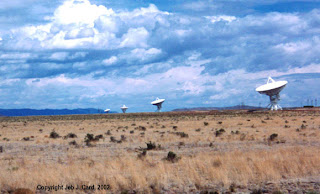
A "mysterious" black, or at least dark, helicopter (Stillings 1989), hovering over the center of the Very Large Array (a not very secret government research facility, located on the Plains of San Agustin in western New Mexico). The helicopter took off, hovered for a few minutes, and landed while I watched. A later visit to the VLA website mentions nothing about a helicopter, crew, or facilities. Secrecy in action?


By the mid and late 1980s, ufologists and others would turn their interest to a secret military facility in central Nevada, referred to as Groom Lake by many insiders, but most famous as Area 51 (Patton 1998). It became a geographical focal point where Cold War paranoia and secrecy, environmental activism, concerns about government overstep, belief in UFO's, and the nascent cyberculture mixed in the 1990s. Glenn Campbell's (aka Psychospy) Desert Rat journal of his activities as an activist at Groom Lake, and the general doings around the site, provide a great historical source for understanding this weird chapter in the history of American distrust of government. A wide variety of stories have grown up in and out of the subculture of Area 51 observers, and several reference the Roswell crash as the seed for alien technology or craft tested and developed at the base. Area 51 doesn’t appear as quickly in Roswell narratives in large part because of the focus on the events in 1947, which predate the establishment of Area 51. The UFO Museum and Research Center has a substantial exhibit on Area 51, but the base does not figure in a major way in most non-cinema versions of the Roswell or other crashed saucer stories. Interestingly, an argument could be made that while these fictional prototypes for Area 51 predate stories about the site, this differs from crashed saucer stories, which typically predate fictional analogs. Area 51 has followed in the footsteps of Roswell in becoming the inspiration for a musical play.

Once a research center is established, the material and crew undergo analysis, which can yield great benefits for society, though in most cases these are hoarded by the secret group in question. A small but persistent thread of ufology links Nazi Germany and flying saucers, and in a couple of crash stories, Nazi scientists are able to study saucers, possibly the origin of many of the German “wonder weapons.” (model below on display at the IUFOMRC).


The concept of reverse engineering to create advanced technology (particularly aircraft) is more commonly applied to the U.S. and Roswell. The most developed version of this thread is Corso’s (1997) The Day After Roswell, within which Corso claims to have been personally responsible for seeding technology from the Roswell crash to defense contractors, and thereby playing a part in the “creation” of nearly every major technological advance in the later 20th century.


Works Cited

Balch, Robert W.
1995 Waiting for the Ships: Disillusionment and the Revitalization of Faith in Bo and Peep's UFO Cult. In The Gods Have Landed: New Religions from Other Worlds, edited by James R. Lewis, pp. 137 - 166. State University of New York Presss, Albany.

Bartholomew, Robert E.
1998 Before Roswell: The Meaning Behind the Crashed-UFO Myth. Skeptical Inquirer, May/June:29-30, 59.

Berliner, Don, and Stanton T. Friedman
1992 Crash At Corona: The U.S. Military Retrieval and Cover-up of a UFO. Marlowe Company, New York.
2004 Crash at Corona: The U.S. Military Retrieval and Cover-up of a UFO. Paraview Special Editions, New York.

Berlitz, Charles, and William L. Moore
1980 The Roswell Incident. Berkeley Books, New York.

Bishop, Greg
2005 Project Beta: The Story of Paul Bennewitz, National Security, and the Creation of a Modern UFO Myth. Paraview Pocket Books, New York.

Bullard, Thomas E.
2000 UFOs: Lost in the Myths. In UFOs and Abductions: Challenging the Borders of Knowledge, edited by David M. Jacobs, pp. 141 - 191. University Press of Kansas, Lawrence.

Cantril, Hadley (With the assistance of Hazel Gaudet & Herta Herzog)
1940 The Invasion from Mars: A Study in the Psychology of Panic (With the complete script of the famous Orson Welles Broadcast). Princeton University Press, Princeton.

Clark, Jerome
1998 The UFO Book: Encyclopedia of the Extraterrestrial. Visible Ink, Detroit.
2000 The Extraterrestrial Hypothesis in the Early UFO Age. In UFOs and Abductions: Challenging the Borders of Knowledge, edited by David M. Jacobs, pp. 122 - 140. University Press of Kansas, Lawrence.

Corso, Philip J., and William J. Birnes
1997 The Day After Roswell. Pocket Books, New York.

Curran, Douglas
2001 In Advance of the Landing: Folk Concepts of Outer Space. Updated and Expanded. Abbeville Press Publishers, New York.

Dean, Jodi
1998 Aliens in America: Conspiracy Cultures from Outerspace to Cyberspace. Cornell University Press, Ithaca.

Denzler, Brenda
2001 The Lure of the Edge: Scientific Passions, Religious Beliefs, and the Pursuit of UFOs. University of California Press, Berkeley.

Dolan, Richard M.
2002 UFOs and the National Security State: Volume 1 - Chronology of a Cover-up 1941-1973. Revised Edition, Hampton Roads, Charlottesville.

Ellwood, Robert S.
1995 UFO Religious Movements. In America's Alternative Religions, edited by Timothy Miller, pp. 393 - 399. SUNY Series in Religious Studies. State University of New York Press, Albany.

Emery, C. Eugene, Jr.
1995 'Alien Autopsy' Show-and-Tell: Long on Tell, Short on Show. Skeptical Inquirer 19(6 November/December):15 - 16, 55.

Festinger, Leon, Henry W. Riecken, and Stanley Schachter
1956 When Prophecy Fails. University of Minnesota Press, Minneapolis.

Friedman, Stanton T.
1992 Crashed Saucers, Majestic-12, and the Debunkers. In UFOs: The Ultimate Mystery of the Millennia (MUFON 1992 International UFO Symposium Proceedings), pp. 68 - 87. Twenty-Third Annual MUFON UFO Sumpoosium. Albuquerque, New Mexico, July 10, 11 & 12.

Fuller, John G.
1966 The Interrupted Journey: Two Lost Hours "Aboard a Flying Saucer." The Dial Press, New York.

Gilmour, Daniel S. (editor)
1969 Final Report of the Scientific Study of Unidentified Flying Objects Conducted by the University of Colorado Under Contract to the United States Air Force. Bantam Books, New York.

Harris, Paola
2000 A Truly "Catholic" Priest, Monsignor Corrado Balducci: Outspoken Supporter of Serious Research on the UFO Phenomenon. UFO Magazine 15(9 October/November):65 - 67.

Jacobs, David M.
2000 The UFO Abduction Controversy in the United States. In UFOs and
Abductions: Challenging the Borders of Knowledge
, edited by David M. Jacobs, pp.
192 - 214. University Press of Kansas, Lawrence.

Kagan, Jeremy
1994 Roswell: The U.F.O. Cover-up. Kyle Maclachlan; Martin Sheen; Dwight Yoakam; Kim Griest. [Film]

Keel, John A.
1991 The Mothman Prophecies. IllumiNet Press, Lilburn, Georgia.

Klass, Philip J.
2000 The New Bogus Majestic-12 Documents. Skeptical Inquirer,
May/June:44-46.

Lewis, James R. (editor)
1995 The Gods Have Landed: New Religions from Other Worlds. State University of New York Press, Albany.

Mack, John E.
2000 How the Alien Abduction Phenomenon Challenges the Boundaries of Our Reality. In UFOs and Abductions: Challenging the Borders of Knowledge, edited by David M. Jacobs, pp. 241 - 261. University Press of Kansas, Lawrence.

McAndrew, James
1997 The Roswell Report: Case Closed. Headquarters United States Air Force, Washington, D.C.

McDermott, Suzanne
1998 The Roswell Incident (song). On McDermott Ephemera (Album). Drexel
Road Music (ASCAP). Available at
http://www.suzannemcdermott.com/recordings.html#roswell

Meehan, Paul
1998 Saucer Movies: A UFOlogical History of the Cinema. The Scarecrow Press, Inc., Lanham, Maryland.

Moseley, James W., and Karl T. Pflock
2002 Shockingly Close to the Truth!: Confessions of a Grave Robbing Ufologist. Prometheus Books, Amherst, New York.

Nickell, Joe
1995 'Alien Autopsy' Hoax. Skeptical Inquirer 19(6 November/December):17-19.

Palmer, Susan Jean
1995 Women in the Raelian Movement: New Religious Experiments in Gender and Authority. In The Gods Have Landed: New Religions from Other Worlds, edited by James R. Lewis, pp. 105 - 135. State University of New York Press, Albany.

Patton, Phil
1998 Dreamland: Travels Inside the Secret World of Roswell and Area 51. Villard, New York.

Peebles, Curtis
1994 Watch the Skies!: A Chronicle of the Flying Saucer Myth. Smithsonian Institution Press. Reprint 1995, Berkley Books, New York, Washington, D. C.

Peterson, Mark Allen
1991 Aliens, Ape Men, and Wacky Savages: The Anthropologist in the Tabloids. Anthropology Today 7(5):4-7.

Randle, Kevin D.
2000 The Roswell Encyclopedia. Quill, New York.

Randle, Kevin D., and Donald R. Schmitt
1991 UFO Crash at Roswell. Avon Books, New York.

Rojcewicz, Peter M.
1987 The "Men in Black" Experience and Tradition: Analogues with the Traditional Devil Hypothesis. Journal of American Folklore 100:148-160.

Saler, Benson, Charles A. Ziegler, and Charles B. Moore
1997 UFO Crash At Roswell: The Genesis of a Modern Myth. Smithsonian Institution Press, Washington.

Saliba, John A.
1995 UFO Contactee Phenomena from a Sociopsychological Perspective: A Review. In The Gods Have Landed: New Religions from Other Worlds, edited by James R. Lewis, pp. 207 - 250. State University of New York Press, Albany.

Scully, Frank
1950 Behind the Flying Saucers. Reprint 1951. Popular Library, New York.

Spielberg, Steven
1977 Close Encounters of the Third Kind. Dell Publishing, New York.

Stillings, Dennis
1989 Helicopters, UFOs, and the Psyche. ReVision 11(4):25-31.

Strieber, Whitley
1989 Majestic. Berkely Books, New York.

Swords, Michael D.
2000 UFOs, the Military, and the Early Cold War Era. In UFOs and Abductions: Challenging the Borders of Knowledge, edited by David M. Jacobs, pp. 82 - 121. University Press of Kansas, Lawrence.

Thomas, David E.
1995 The Roswell Incident and Project Mogul: Scientist Participant Supports Direct Links. Skeptical Inquirer 19(4 July/August):15 - 18.
2001 Retired Air Force Balloon Expert Expands on Origin of 'Majestic 12' UFO Hoax. Skeptical Inquirer, March/April:5 - 6.

Saturday, July 07, 2007

Evolution of the Crashed Saucer Legend, Part 7: The Military Response

If you haven't yet, you should start with the first installment of this article


The Military Response

As part and parcel of crash accounts that involve military radar tracks, a military recovery team leaves soon after the radar-tracked crash, usually at sunup the next day (Berlitz and Moore 1980; Randle and Schmitt 1994). This concept has been present throughout the accounts of the Roswell Incident, especially in relation to a second crash site on the Plains of San Agustin, though it is not limited to those accounts. Typically, the second, more important, crash site with bodies or a saucer is found by the military at the same time or immediately after discovery by engineers, campers, or an archaeological research team. In these accounts, the coverup may already be underway when Brazel informs the Roswell sheriff of his discovery a few days later.

Though not as exciting and action-filled, the narrative thread of the Roswell story concerning Army involvement with the Foster Ranch debris site reported by William “Mac” Brazel is more complex. Most versions agree that soon after Brazel brings debris to Roswell Sheriff Wilcox’s office on July 6, 1947, the military shows up. Specifically, Jesse Marcel accompanies Brazel to his home, stays there overnight, and examines the debris field on the morning of July 7. However, with the exception of the initial July 8, 1947 press release and the 2002 International UFO Museum and Research Center timeline, other accounts of the Roswell story mention that a second military man in plain clothes accompanied Marcel to the debris site. As the Roswell story built steam after 1980, this man was clearly identified as Army counterintelligence agent Sheridan Cavitt. By the early 1990s, this man becomes more anonymous, and is either simply described as a counterintelligence agent (Randle and Schmitt 1991), or as a man in plain clothes (Pflock 1994). The 1994 film Roswell renames him Sherman Carson, but increases his role in the coverup, especially regarding Jesse Marcel. The decreased interest in Cavitt’s specifics may have a lot to do with the fact that Cavitt agreed to describe what he saw in July 1947, and his accounts support the finding of a balloon device, not an extraterrestrial craft, on the Foster Ranch.


The grassroots essence of ufology is reflected in the ample use of personal accounts and affidavits as exhibits in the IUFOMRC.

Relying on Jesse Marcel’s son, Jesse Marcel Jr., as a significant witness, Randle and Schmitt (1991) specifically mention that Marcel brought some of the debris home to show his family in the early morning hours of July 8, 1947. First introduced in 1991, this element plays an important emotional and narrative role in the film Roswell, and has been preserved in the International UFO Museum and Research Center’s presentation in Roswell.

Depending on the discovery of a second site in the particular Roswell narrative, Colonel Blanchard orders a more thorough cleanup of the Foster ranch site and informs his superiors of the debris on either July 7th or July 8th before going on leave. These events are linked to a change in the travel plans of a military inspection group led by Lt. General Nathan F. Twining, who would play a major role in military interest in UFOs in the next few years. The group, including other high-ranking officers, flies to Alamogordo instead of their original planned inspection of a Boeing aircraft on July 7th (Friedman 1992; Randle and Schmitt 1991).

The make up of the gear and personnel of military recovery teams typically include trucks, area lighting for night work, and specialists. The 1973 account of a crashed saucer in Arizona echoes Scully’s informants, specialists flown in to advise on recovery and analysis (Clark 1998:119-141). The 1973 account also foreshadows the stories of specialist transport to Area 51 in the late 1980s, where specialists are flown on private non-descript airplanes, and then loaded onto busses with blacked out windows. In the case of the 1962 Nevada UFO/bolide crash, Project Blue Book flew in its director Lt. Col. Robert Friend and scientific advisor Dr. J. Allen Hynek (Clark 1998:119-141).

In the case of Roswell, the military recovery team becomes more detailed in 1988, as the Majestic documents describe the use of aerial reconnaissance, and by 1991 (Randle and Schmitt 1991) witnesses describe the placement of an MP perimeter to keep out civilians and other unauthorized personnel. The 2002 version of the IUFOMRC website descibes a several day cordon while the site is cleaned up. Few other accounts describe the use of special equipment and biohazard suits as in Corso’s (1997) account.

The debris begins to fly out of New Mexico soon after discovery. Most accounts have some debris flown to Ft. Worth, Texas on July 8 for further analysis, in many cases under armed guard. But Randle and Schmitt (1991) have debris flying out as soon as July 6.


Crash dummy. In 1997, the U.S. Air Force suggested that the recovery of dummies used in testing may have inspired reports of alien bodies (McAndrew 1997). Of course, the IUFOMRC is all to happy to point out that these tests did not begin until several years after 1947.


From the beginning, however, all accounts are unanimous that the U.S. military decides to cover-up the accident, typically to prevent panic ala Orson Welles' 1938 radioplay of War of the Worlds (Cantril 1940), though in some cases looking ahead to the potential for reverse-engineering advanced technology. While fictional accounts of contact between humans and aliens or their material culture utilize more exotic cover-ups such as left-over weapons from WWII (Film Quatermass and the Pit 1967), epidemics (Film 2001: A Space Odyssey 1968), and nerve-gas disasters (Film Close Encounters of the Third Kind 1977), the Roswell story has consistently been laid at the feet of a balloon, first a weather balloon in 1947, and then by the mid-1990s a train of balloons to support audio equipment used in the Mogul spying program. This element first arises in the office of General Ramey in Ft. Worth Texas during a press conference on July 9, 1947. By 1991, it is reasoned that the debris in Ramey’s office was switched with that from a weather balloon, and that Marcel was ordered to lie or stay quiet about this act. In the last few years, there has been some interest in attempts to either find real saucer debris in the pictures from this press conference, or to reconstruct a message on a piece of paper photographed in Ramey’s hand that proves there really was a saucer crash.

Citizens are sworn to secrecy as early as 1973 (Clark 1998:119-141), but beginning with Randle and Schmitt’s 1991 account of the Roswell crash, civilians have been threatened with reprisals from the U.S. military if they don’t keep quiet about what they have seen. Saler, Ziegler, and Moore (1996) go into some detail about the various rank and location changes of an angry red-headed Army officer and his African-American enlisted sidekick. Intimidation in crashed saucer accounts usually comes from military sources, and not the shadowy Men in Black that haunt other parts of UFOland (Keel 1991; Rojcewicz 1987). Concerning the use of violence to enforce the cover up, fictional accounts raced ahead of other versions, such as in the case of the ominous Men in Dark Suits that chase astronauts investigating a crashed UFO in the film Hangar 18 in 1980. William “Mac” Brazel is picked up by the military at some point soon after his July 8th radio interview, and is sequestered by the Army for anywhere from one to three days. During this time, he is allowed to make his July 9th statement that he did not find a flying saucer, and in some versions is bribed with money for a new pickup truck and refrigerator shed on his property (Corso 1997; Randle and Schmitt 1991; Film Roswell 1994).

“Mac” Brazel is not the only civilian cajoled into silence by the military in Roswell. Though many researchers today reject his claims, starting in 1991 (Randle and Schmitt) Roswell mortician Glenn Dennis describes being consulted by Roswell Army Hospital about obtaining four small child-size caskets, and about techniques for preparing a body for storage. When he goes to the Roswell Army Hospital to check on the situation, he is escorted off the premises and physically threatened by military men. Dennis also describes talking to a friend of his the next day, a nurse who witnessed alien bodies in the hospital. Prior to 1991, bodies had been associated with the stories involving archaeological teams on the Plains of San Agustin or near Corona, but Dennis’ story puts them in Roswell itself. The nurse, named Janet, is killed in a military plane crash a short while later. This is another dramatic scene in the film Roswell, though as in the case of the counterintelligence agent, Dennis’ real name is not used and is replaced by a sound alike name (one character attempts to remember the mortician’s name and comes up with several possibilities that sound like Dennis). And despite a lack of confidence about Dennis in the later 1990s by most Roswell researchers, the story is still presented (2002) by the International UFO Museum and Research Center. A very similar tale is retold in Corso (1997), but instead of a mortician, the ejected civilian is plumber Roy Danzer.

Continue to the conclusion, The Aftermath